
Minneapolis Airport Disruptions: American Airlines, Endeavor Air and United Cancel 4 Flights
Minneapolis/St Paul International Airport records 4 cancellations and 17 delays across American Airlines, Endeavor Air, and United on April 29, 2026, with ripple effects reaching Dallas, Atlanta, Chicago, Denver, Detroit, and international routes to Dublin, Paris, and Toronto.

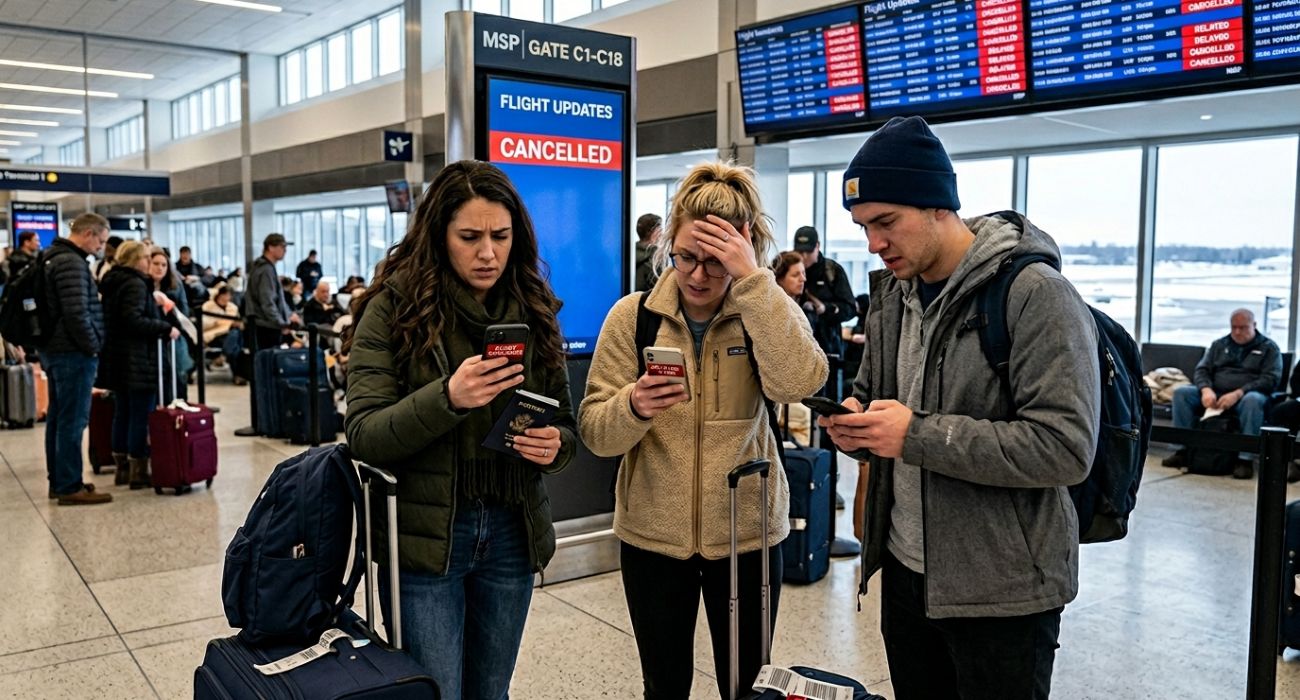
Image generated by AI
Travel Turmoil at Minneapolis/St Paul International Airport as American Airlines, Endeavor Air, and United Cancel 4 Flights and Log 17 Delays, Sending Disruption Rippling to Dallas, Atlanta, Chicago, Denver, Detroit, Dublin, Toronto, Paris, and Beyond on April 29, 2026
What begins in Minneapolis does not stay in Minneapolis — the MSP cancellation cluster is propagating through the interconnected US aviation grid to cities across two continents, from Sioux Falls to Incheon.
Minneapolis/St Paul International Airport (MSP) has emerged as a significant focal point of aviation disruption on April 29, 2026, as American Airlines, Endeavor Air (Delta Connection), and United Airlines collectively recorded 4 flight cancellations and 17 delays at the Minnesota hub — sending shockwaves outward through a nationwide and international network of connected cities including Dallas–Fort Worth, Atlanta, Chicago, Denver, Detroit, Houston, Philadelphia, and international destinations as far reaching as Dublin, Paris, Toronto, Amsterdam, Cancun, Mexico City, and Incheon.
The disruption at MSP is not an isolated event. Cancellations at the Minneapolis hub are simultaneously feeding into a broader US-wide disruption day — with Dallas/Fort Worth International Airport (DFW) logging 1 additional cancellation (12% cancellation rate), Cincinnati/Northern Kentucky International Airport (CVG) recording 1 cancellation at a sharp 20% rate, and Chicago O'Hare (ORD) adding 1 further cancellation (4%) — collectively painting a picture of network-wide pressure well beyond MSP's own terminal walls.
EXPANDED OVERVIEW: MSP as the Day's Regional Disruption Anchor
Minneapolis/St Paul International Airport serves as one of the upper Midwest's most critical aviation nodes, connecting a wide catchment area spanning Minnesota, Wisconsin, the Dakotas, and upper Michigan with the full scope of the US domestic network and numerous international gateways. When MSP experiences concentrated cancellation pressure — as it is today — the downstream effects propagate across the entire upper Midwest feeder network and into the major hubs that MSP traffic feeds: Atlanta, Dallas, Chicago, and Denver in particular.
Today's MSP disruption is operationally notable for its distribution across three distinct carrier groups — a legacy mainline carrier (American Airlines), a regional feeder operator (Endeavor Air, operating as Delta Connection), and a second legacy carrier (United Airlines). This three-carrier concentration at a single airport suggests the disruption root cause is more likely systemic — weather, ATC constraints, or hub-level congestion upstream — rather than carrier-specific.
FULL FLIGHT DISRUPTION TABLE AT MSP
| Airport | Airline | Cancellations | Cancellation Rate | Delays |
|---|---|---|---|---|
| Minneapolis/St Paul Intl (MSP) | American Airlines | 2 | 9% | 3 |
| Minneapolis/St Paul Intl (MSP) | Endeavor Air (Delta Connection) | 1 | 1% | 11 |
| Minneapolis/St Paul Intl (MSP) | United Airlines | 1 | 3% | 3 |
| MSP Combined Total | 4 | 17 |
ADDITIONAL CANCELLATIONS IN THE BROADER NETWORK
| Airport | City | IATA | Cancellations | Cancellation Rate |
|---|---|---|---|---|
| Dallas/Fort Worth International | Dallas | DFW | 1 | 12% |
| Cincinnati/Northern Kentucky Intl | Cincinnati | CVG | 1 | 20% |
| Chicago O'Hare International | Chicago | ORD | 1 | 4% |
AIRLINE-BY-AIRLINE BREAKDOWN AT MSP
American Airlines — 2 Cancellations (9%), 3 Delays
American Airlines has recorded the highest absolute cancellation count at Minneapolis/St Paul today, grounding 2 services at a 9% cancellation rate. While 9% remains below crisis-level thresholds, it represents meaningful operational contraction for American at MSP — particularly given that the carrier's DFW hub is simultaneously recording its own cancellation event today. Passengers holding American Airlines bookings through MSP with onward connections to DFW face the most complex rebooking environment, as both ends of their intended journey are experiencing disruption simultaneously.
Endeavor Air (Delta Connection) — 1 Cancellation (1%), 11 Delays
Endeavor Air's disruption profile at MSP today presents a striking contrast between its cancellation rate and its delay volume. A 1% cancellation rate suggests the carrier has largely maintained schedule integrity in absolute terms — but its 11 delays represent the highest delay count of any single carrier at MSP today, and a figure that vastly exceeds what a 1% cancellation rate would suggest in terms of operational health. This delay-heavy, cancellation-light pattern typically indicates a carrier operating under intense schedule pressure while deliberately choosing to delay rather than cancel services — absorbing operational strain to preserve flight numbers and crew rotation frameworks.
For passengers connecting through MSP onto Delta's broader network at Atlanta — Endeavor's primary downstream hub — an 11-delay count at the regional feeder level can generate a cascading wave of missed Atlanta connections that reaches far beyond the Minneapolis terminal.
United Airlines — 1 Cancellation (3%), 3 Delays
United Airlines has recorded 1 cancellation (3%) and 3 delays at MSP today. United's Chicago O'Hare hub is simultaneously experiencing its own cancellation event (1 cancellation, 4% rate), meaning United's network is absorbing dual-hub pressure on the same operating day — from both its upper Midwest spoke at MSP and its primary domestic hub at ORD. Passengers on United itineraries routed Minneapolis → Chicago → onward destinations face a compounding disruption scenario.
THE BROADER CANCELLATION PICTURE: DFW, CVG, and ORD
Beyond MSP, the most operationally significant cancellation rate in today's dataset belongs to Cincinnati/Northern Kentucky International Airport (CVG), which is recording a 20% cancellation rate on its single confirmed cancellation. While the absolute volume is limited, a 20% rate means one in every five CVG-operated services has been grounded — the sharpest proportional impact of any airport in today's snapshot.
Dallas/Fort Worth's 12% cancellation rate (1 cancellation) is similarly elevated relative to DFW's enormous operating volume, signaling ongoing ATC and weather-driven constraints at the Texas hub that compound its separate, larger-scale disruption events from earlier in the day.
AFFECTED CITIES: A US AND INTERNATIONAL NETWORK IN MOTION
The geographic reach of today's MSP-centered disruption is extraordinary for an event of this scale. Across the domestic US network, cities impacted span the full breadth of the country:
Major hubs: Dallas–Fort Worth, Atlanta, Chicago, Denver, Detroit, Houston, Los Angeles, Philadelphia, Phoenix, San Francisco, Tampa, San Diego
Upper Midwest and regional: Appleton, Sioux Falls, Kalispell, Hibbing, Syracuse, Madison, Milwaukee
Secondary hubs: Nashville, Baltimore, Charlotte, Portland, Kansas City, Memphis, Raleigh, San Antonio
The international reach of MSP's disruption is equally striking. Connecting services through affected hubs are generating downstream disruptions at:
Europe: Dublin, Aberdeen, Amsterdam, Paris
North America (international): Toronto, Cancun, Mexico City
Asia-Pacific: Incheon (Seoul)
The appearance of Incheon in the affected city list is particularly noteworthy — it reflects how even a regionally contained US disruption event can, through connection-chain propagation, generate consequences that reach South Korea within the same operating day.
PASSENGER IMPACT: The Midwest-to-World Connectivity Problem
For passengers at Minneapolis/St Paul, the specific nature of their disruption depends heavily on their booking type. Passengers on purely domestic itineraries — Minneapolis to Dallas, Minneapolis to Chicago, Minneapolis to Denver — are facing rebooking waits and same-day rescheduling challenges. For these travelers, alternative routing options through other carriers or alternate city pairings may be available, though seat availability on popular corridors is filling rapidly as affected passengers compete for the same limited remaining inventory.
For international passengers — particularly those routing Minneapolis → Atlanta → Dublin or Amsterdam, or Minneapolis → Chicago → Incheon — the disruption is categorically more severe. International rebooking timelines extend across multiple days in some cases, and the downstream connection airports (Dublin, Paris, Incheon) may not have daily frequency services that allow same-day recovery.
INDUSTRY ANALYSIS: The Upper Midwest's Vulnerability
The concentration of cancellations across American Airlines, Endeavor Air, and United at MSP on the same operating day highlights a structural characteristic of upper Midwest aviation: the region depends heavily on hub-spoke connectivity through Chicago, Atlanta, and Dallas for its access to the broader domestic and international network. When those downstream hubs experience operational pressure — as Chicago O'Hare and Dallas/Fort Worth both are today — the capacity constraints at the hub level propagate back upstream to spoke airports like MSP, reducing available aircraft and crew for outbound departures.
Today's data also highlights the outsized operational importance of regional carriers like Endeavor Air, whose 11 delays at MSP — despite a low 1% cancellation rate — underscore how regional feeder networks absorb hub pressure in delay form rather than cancellation form, effectively hiding the true scale of network disruption behind a misleadingly stable headline cancellation count.
CONCLUSION: A Day of Concentrated but Far-Reaching Disruption
Minneapolis/St Paul International Airport's 4 cancellations and 17 delays on April 29, 2026, are a concentrated but operationally significant disruption event whose consequences extend far beyond Minnesota. With American Airlines, Endeavor Air, and United all absorbing simultaneous operational pressure at MSP — and with the wider network showing additional cancellation events at DFW (12%), CVG (20%), and ORD (4%) — the system is maintaining stability but operating within narrow margins. Passengers across two dozen US cities and four international destinations are being reminded today that in modern aviation, no disruption is truly local.
KEY TAKEAWAYS
- 4 total cancellations and 17 delays recorded at Minneapolis/St Paul International Airport (MSP) on April 29, 2026.
- American Airlines recorded 2 cancellations (9%) and 3 delays at MSP.
- Endeavor Air (Delta Connection) recorded 1 cancellation (1%) and 11 delays — the highest delay count of any carrier at MSP today.
- United Airlines recorded 1 cancellation (3%) and 3 delays at MSP.
- Cincinnati/Northern Kentucky (CVG) shows the sharpest proportional rate: 1 cancellation at 20% — the highest cancellation rate in today's network snapshot.
- Dallas/Fort Worth (DFW) and Chicago O'Hare (ORD) each record 1 additional cancellation at rates of 12% and 4% respectively.
- Disruptions extend across 30+ US cities and 8 international destinations including Dublin, Paris, Amsterdam, Toronto, Cancun, Mexico City, and Incheon.
- Passengers on international connections via affected hubs face the most severe rebooking challenges with limited same-day recovery options.
Disclaimer
This article is for informational and educational purposes only. It does not constitute legal, financial, or professional advice. While we strive to provide accurate and up-to-date information, travel policies, regulations, and conditions change rapidly. Always verify information with official sources before making travel decisions. Nomad Lawyer makes no representations about the accuracy, reliability, completeness, or suitability of the information provided. Readers should consult qualified professionals for advice specific to their circumstances. The views expressed in this article are those of the author and do not necessarily reflect the views of Nomad Lawyer.
Kunal K Choudhary
Co-Founder & Contributor
A passionate traveller and tech enthusiast. Kunal contributes to the vision and growth of Nomad Lawyer, bringing fresh perspectives and driving the community forward.
Learn more about our team →