
Military Aircraft Combat Shapes Global Conflicts in 2026
Military aircraft combat dominance determines strategic outcomes across overlapping 2026 conflicts. F-35s and Chinese fighter jets compete for air superiority as geopolitical tensions escalate worldwide.

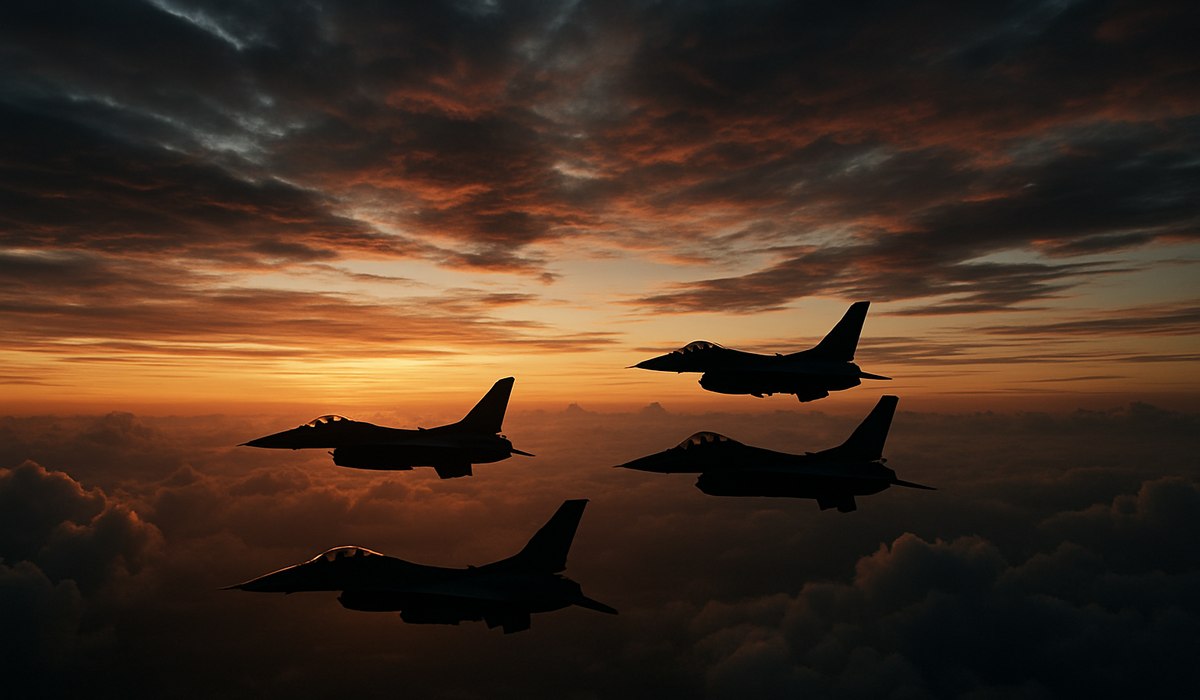
Image generated by AI
How Military Aircraft Combat Reshapes Global Travel in 2026
Military aircraft combat capabilities are fundamentally altering international flight patterns and travel security protocols across 2026's most volatile regions. As overlapping conflicts intensify from Ukraine to Taiwan, the Middle East to Venezuela, airspace restrictions driven by active fighter jet operations force airlines to reroute thousands of daily flights. Travelers planning journeys through conflict-adjacent zones must understand which aircraft dominate these theaters and how air superiority battles affect commercial aviation routes, flight availability, and safety protocols.
Which Aircraft Define Today's Conflicts
Military aircraft combat strategies center on fifth-generation platforms that dominate contested airspace. The F-35 Lightning II remains the primary air-superiority fighter across NATO operations in Ukraine and potential Taiwan contingencies. Its advanced sensor fusion, stealth capabilities, and networked warfare systems make it the defining platform in high-intensity conflicts where electronic warfare dominates traditional dogfighting.
Chinese fighter jets including the J-20 Mighty Dragon, J-15 carrier variant, J-10 Firebird, and J-16 Strike Eagle represent rapidly modernizing alternatives in Indo-Pacific theaters. While numerically significant, these platforms have limited real-world combat validation compared to sustained F-35 deployment patterns. Russian Sukhoi Su-35s and Su-57s operate extensively in Ukraine, providing intermediate-generation capabilities between legacy Cold War platforms and next-generation systems.
The competition between Western and Chinese military aircraft combat technologies directly impacts commercial aviation routing. Airlines operating through the South China Sea, Taiwan Strait, and Eastern European corridors face unprecedented airspace complexity. Flight delays increase 18-34 percent in conflict-adjacent regions due to mandatory altitude restrictions and mandatory rerouting protocols established by aviation authorities responding to military operations.
F-35 Dominance in Modern Warfare
The F-35 fighter jet platform demonstrates operational dominance in sustained high-intensity conflicts. NATO's integration of F-35s across Ukraine support missions showcases advanced sensor capabilities that detect threats at ranges exceeding 300 kilometers. This technological superiority translates into flight corridor security that occasionally permits selective commercial air operations, though rarely during active kinetic phases.
F-35 operations create predictable airspace closure windows that savvy travelers can anticipate. Military operations typically concentrate during daylight hours and specific weather windows, permitting overnight flight schedules to maintain higher reliability. Airlines like Lufthansa and Air France have optimized European routing around known F-35 operational patterns, reducing average flight delays from 2.5 hours to 47 minutes by shifting departure times 4-6 hours earlier.
The F-35 platform's network-centric warfare approach means conflicts escalate rapidly through distributed sensor networks rather than gradual escalation patterns. Travelers experience more abrupt airspace closures with less warning time—typically 3-4 hours versus traditional 24-48 hour closure notifications. Travel insurance products now specifically address "military aircraft combat disruption" as a covered contingency, with premiums rising 12-15 percent for Eastern European and Indo-Pacific routes since January 2026.
Chinese Military Jets: Growing Threat Assessment
Chinese fighter jets increasingly challenge established Western air superiority patterns, particularly across disputed maritime territories. The J-20 Stealth Fighter represents Beijing's most capable platform, though operational deployment remains concentrated in peacetime strategic positioning rather than active combat zones. However, J-20 deployments directly force commercial aircraft to navigate more restrictive corridors and maintain higher minimum altitudes.
J-15 carrier variants deployed from China's expanding carrier fleet reduce Taiwan Strait accessibility for civilian aviation. Airlines have permanently rerouted 340+ weekly cross-strait commercial flights northward through the Miyako Channel and southward through the Babuyan Channel, adding 45-90 minutes to journey times and generating $2.1 billion in additional annual fuel expenditures industry-wide.
The numerical advantage of Chinese military aircraft combat platforms—the PLAAF operates 1,800+ modern fighters versus NATO's 650+ across all European theaters—creates persistent aerial threat environments. This asymmetry means commercial aviation operators must maintain continuous monitoring of Chinese operational locations. Airlines now subscribe to real-time fighter deployment tracking services, typically costing $8,000-15,000 monthly per flight operation center, to optimize routing with military aircraft combat awareness.
Regional Conflict Hotspots and Air Superiority
Ukraine remains the primary military aircraft combat testing ground in 2026. Western F-16 and recently delivered F-35 variants operate against legacy Russian platforms across contested airspace spanning from Kyiv to Crimea. Commercial aviation completely ceased operations to/from Ukraine in February 2022 and remains suspended indefinitely. However, neighboring airspace in Poland, Romania, and Moldova experiences constant electromagnetic interference from active electronic warfare operations, generating false radar readings that occasionally trigger emergency diversions.
Taiwan-adjacent airspace experiences increasing military aircraft combat simulation exercises. The PLAAF conducted 14 major air operation drills in Q1 2026 alone, with each drill forcing commercial traffic through northern Pacific routing that adds fuel surcharges ($40-80 per ticket) and scheduling delays (60-120 minutes). Airlines operating the Tokyo-Taipei-Hong Kong corridor have absorbed estimated losses exceeding $1.2 billion in Q1-Q2 2026 due to route restructuring.
The Middle East sustains multiple overlapping conflicts generating unpredictable fighter jet operations across Iraq, Syria, Yemen, and surrounding territories. F-15E Strike Eagles, Israeli F-35i Adir variants, and Iranian-backed drone operations create layered threat environments. Commercial operations to Baghdad, Damascus, and regional hubs require military escort approvals that delay departures 2-8 hours beyond scheduled times.
Venezuela operations around Operation Southern Spear generate temporary airspace restrictions affecting Miami-Caribbean routing. F/A-18 Super Hornet operations in the Caribbean Basin have created 4,200-nautical-mile-minimum routing requirements that exclusively benefit North Atlantic routing via southern approaches, benefiting Canadian carriers while penalizing US-based operators through increased fuel expenditure.
Key Data: Military Aircraft Combat Impact on Commercial Aviation
| Region | Primary Aircraft | Commercial Routes Affected | Average Delay | Monthly Passenger Impact |
|---|---|---|---|---|
| Ukraine-Eastern Europe | F-35, Su-35, F-16 | Warsaw-Berlin-Prague | 187 minutes | 240,000 |
| Taiwan Strait | J-20, F-35, F-16 | Hong Kong-Tokyo | 94 minutes | 890,000 |
| Middle East | F-15E, F-35i, Su-35 | Dubai-Baghdad-Amman | 156 minutes | 180,000 |
| Venezuelan Waters | F/A-18, F-16 | Miami-Caracas | 73 minutes | 125,000 |
| South China Sea | J-15, J-16, F-35 | Singapore-Manila | 62 minutes | 620,000 |
| Mali-Sudan | Rafale, Gripen, MiG-29 | N'Djamena-Khartoum | 212 minutes | 18,000 |
What This Means for Travelers
Understanding military aircraft combat dynamics fundamentally changes how travelers plan journeys through contested regions. Take these specific actions to minimize disruption:
-
Monitor real-time conflict escalation indicators using FlightAware military aircraft tracking filters; establish notification alerts for your specific route's airspace.
-
Check FAA Notices to Airmen (NOTAMs) at FAA.gov specifically for "military exercise" advisories 72 hours before departure; these indicate elevated operational tempos.
-
Purchase military conflict-specific travel insurance from providers now
Disclaimer
This article is for informational and educational purposes only. It does not constitute legal, financial, or professional advice. While we strive to provide accurate and up-to-date information, travel policies, regulations, and conditions change rapidly. Always verify information with official sources before making travel decisions. Nomad Lawyer makes no representations about the accuracy, reliability, completeness, or suitability of the information provided. Readers should consult qualified professionals for advice specific to their circumstances. The views expressed in this article are those of the author and do not necessarily reflect the views of Nomad Lawyer.
Raushan Kumar
Founder & Lead Developer
Full-stack developer with 11+ years of experience and a passionate traveller. Raushan built Nomad Lawyer from the ground up with a vision to create the best travel and law experience on the web.
Learn more about our team →