
Middle Eastern Airlines Face Travel Chaos: Over 5,200 Flight Cancellations, Billions in Losses, and Stranded Aircraft Across London, Paris, New York
Emirates, Qatar Airways, and Etihad face unprecedented disruption with 5,200+ cancellations, $48.5M grounding costs, and massive parking charges as airspace closures paralyze Middle Eastern aviation hubs.

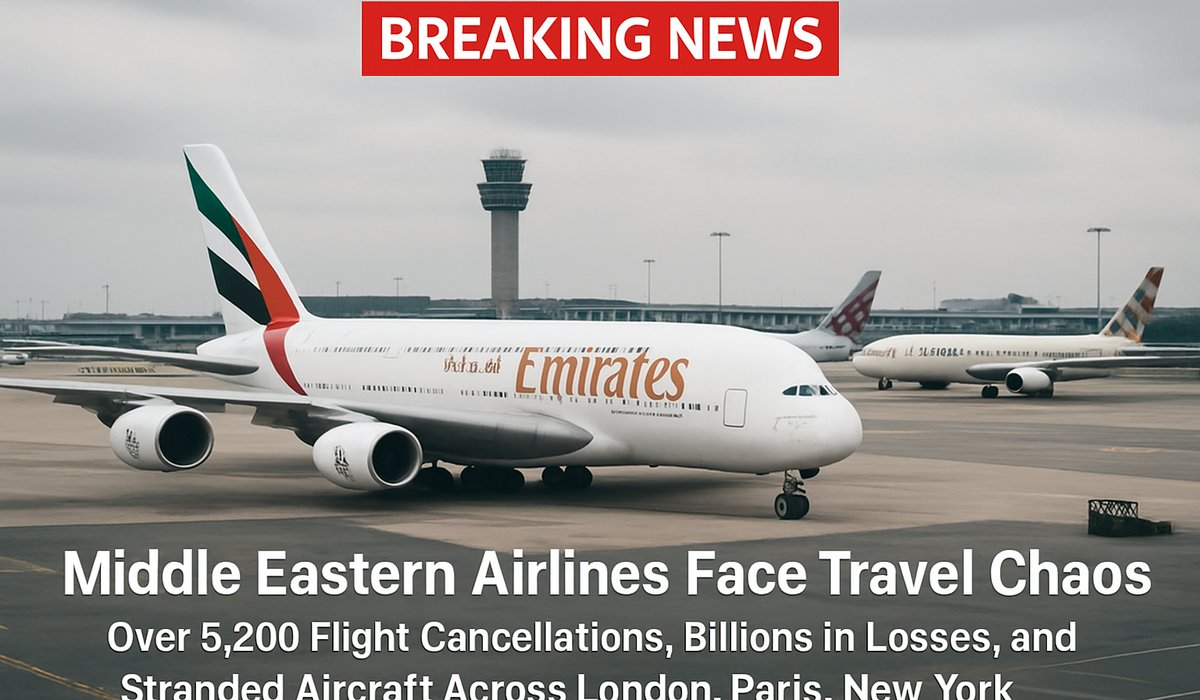
Image generated by AI
The aviation industry is reeling from an unprecedented crisis as major Middle Eastern carriers face a perfect storm of operational disruption. Between February 28 and April 5, 2026, over 5,200 flight cancellations have crippled the region's largest airlines, including Emirates, Qatar Airways, Etihad Airways, Flydubai, Saudia, Turkish Airlines, Air Arabia, Gulf Air, and Royal Jordanian. The cascading effect has triggered billions in airfare losses while airlines hemorrhage money on parking charges and grounding costs at premium international hubs. Travelers worldwide are experiencing unprecedented delays, missed connections, and travel nightmares as the crisis deepens across critical aviation corridors connecting Europe, Asia, and North America.
Emirates has absorbed the most severe impact, recording 7,400+ flight cancellations and incurring an estimated $48.5 million in grounding costs during the crisis period. The region's largest airline has seen its massive widebody fleet—including Airbus A380 and Boeing 777 aircraft—stranded at some of the world's most expensive aviation hubs: London Heathrow, Paris Charles de Gaulle, and New York JFK. These premium locations impose substantial parking charges and slot penalties that compound the financial hemorrhaging. The airline's heavy reliance on long-haul, widebody operations has intensified the operational strain, as these aircraft incur significantly higher maintenance and storage costs when grounded. To mitigate the crisis, Emirates has rapidly shifted to rerouting flights via the Southern Corridor over Oman and the Arabian Sea, though this strategy has increased flight durations by several hours, leading to higher fuel consumption and reduced aircraft utilization. The airline has extended flexible booking waivers until mid-April, sacrificing short-term revenue to preserve long-term customer loyalty, while maintaining aircraft in desert conditions requires continuous technical intervention including engine runs and system preservation.
Qatar Airways has experienced severe disruption with 6,800+ flight cancellations and approximately $42.2 million in grounding costs during the same period. The airline's hub-and-spoke model, centered on Doha's Hamad International Airport, has proven particularly vulnerable to airspace closures, effectively paralyzing its global connectivity network. At the peak of the crisis, a substantial portion of Qatar Airways' fleet was immobilized both at its Doha hub and at key international outstations including Singapore, creating operational bottlenecks and mounting financial pressure. The carrier has responded by gradually restoring operations through extended routing strategies that bypass restricted airspace, though these longer routes significantly increase fuel costs and reduce schedule efficiency. Qatar Airways has prioritized maintaining premium long-haul routes while suspending lower-yield services to ensure optimal fleet utilization under constrained conditions. The extension of full-refund and rebooking waivers has further impacted revenue streams but remains essential for customer retention. Fortunately, the airline's strong cargo division continues to generate revenue and partially offset passenger losses, providing a critical financial lifeline during this unprecedented disruption.
Etihad Airways has reported 2,600+ flight cancellations and approximately $18.1 million in grounding costs, reflecting a significant yet comparatively contained impact compared to larger Gulf carriers. The airline's smaller network and more focused operational model have provided a degree of resilience, limiting exposure relative to Emirates and Qatar Airways. However, key hubs such as Abu Dhabi and major international outstations like Frankfurt have still experienced substantial disruption. Flydubai, operating as a low-cost carrier with primarily narrow-body aircraft, has encountered significant challenges with 4,200+ flight cancellations and approximately $12.5 million in grounding costs. The airline's Boeing 737 fleet is not optimized for the longer distances required to bypass restricted airspace, leading to widespread route suspensions across key markets including Karachi and Riyadh. Flydubai's operational model, which relies on high aircraft utilization and quick turnarounds, has been severely affected by these disruptions, forcing the airline to focus on selective route restoration and strict cost control measures.
The broader Middle Eastern aviation ecosystem faces unprecedented strain as Saudia, Turkish Airlines, Air Arabia, Gulf Air, and Royal Jordanian also grapple with massive cancellations and financial losses. According to the International Air Transport Association (IATA), airspace closures and operational disruptions have created a cascading effect across international aviation networks. Travelers attempting to reach destinations across Europe, Asia, and North America are experiencing unprecedented delays and missed connections. The crisis has triggered billions in airfare losses as airlines implement flexible rebooking policies and full-refund waivers to maintain customer confidence. Parking charges at premium hubs like London Heathrow, Paris Charles de Gaulle, and New York JFK have become a significant financial burden, with some aircraft incurring thousands of dollars daily in storage fees. The U.S. Department of Transportation and international aviation authorities are monitoring the situation closely as the disruption threatens to disrupt global supply chains and tourism patterns.
For travelers currently affected by this crisis, immediate action is essential. Contact your airline directly through their official website or customer service hotline to understand your rebooking options and eligibility for compensation. Many carriers including Emirates, Qatar Airways, and Etihad Airways have implemented flexible booking waivers allowing free changes or full refunds. If you have upcoming travel plans to or from Middle Eastern hubs, consider rerouting through alternative carriers or airports if possible. Monitor your airline's official communications for real-time updates on flight status, and document all expenses related to cancellations or delays for potential compensation claims. Travel insurance with comprehensive coverage for airline disruptions may provide additional protection for future bookings.
Related Travel Guides
Disclaimer
This article is for informational and educational purposes only. It does not constitute legal, financial, or professional advice. While we strive to provide accurate and up-to-date information, travel policies, regulations, and conditions change rapidly. Always verify information with official sources before making travel decisions. Nomad Lawyer makes no representations about the accuracy, reliability, completeness, or suitability of the information provided. Readers should consult qualified professionals for advice specific to their circumstances. The views expressed in this article are those of the author and do not necessarily reflect the views of Nomad Lawyer.
Raushan Kumar
Founder & Lead Developer
Full-stack developer with 11+ years of experience and a passionate traveller. Raushan built Nomad Lawyer from the ground up with a vision to create the best travel and law experience on the web.
Learn more about our team →