
Middle East Aviation Gridlock: 518 Flight Cancellations and 1,869 Delays Hit Riyadh, Jeddah, and Gulf Hubs in October 2026
Over 500 flights were cancelled and nearly 1,900 delayed across Middle Eastern hubs as drone and missile strikes in Saudi Arabia triggered emergency airspace closures and airline suspensions from Riyadh to Dubai.

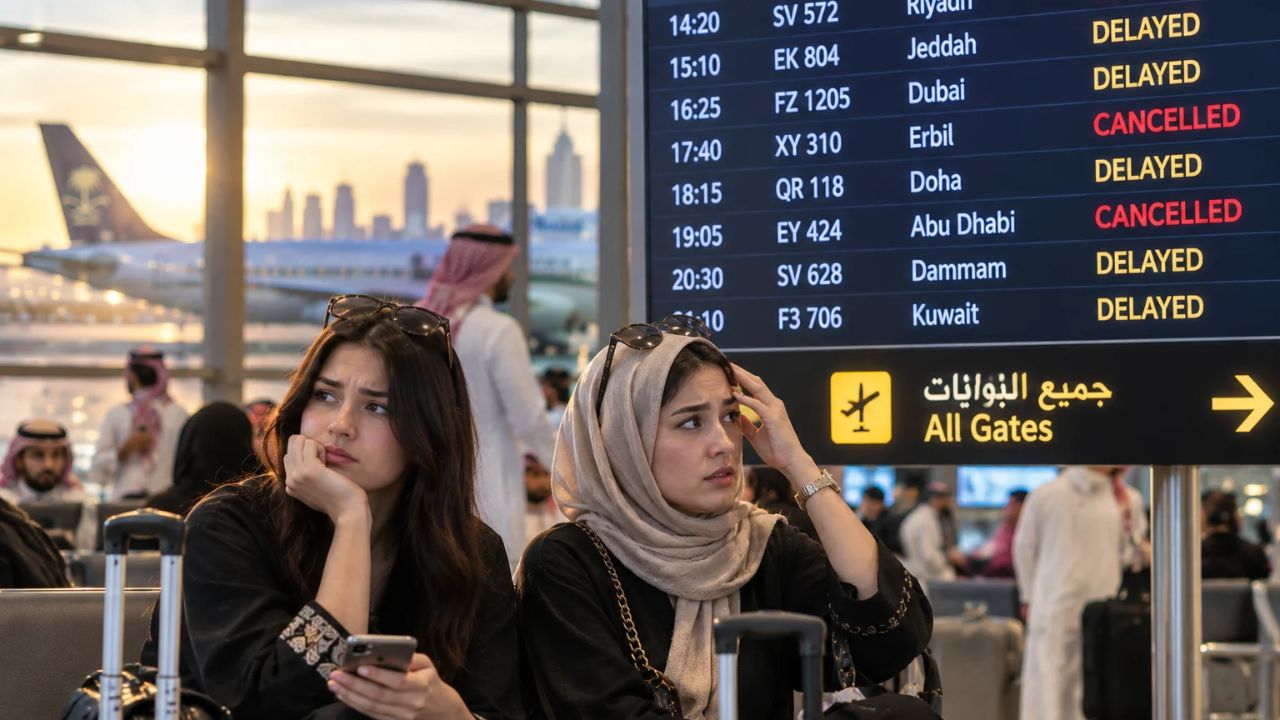
Security-induced airspace restrictions spark 518 cancellations and 1,869 delays across Middle Eastern transit corridors.
Saudi Arabian domestic and international terminals accounted for eighty-four percent of all regional flight cancellations in a single afternoon following targeted drone and missile strikes. Across the Middle East, a sharp wave of 518 cancellations and 1,869 flight delays disrupted travel across major transit nodes including Riyadh, Jeddah, Erbil, Dubai, Doha, and Cairo. While King Khalid International Airport in Riyadh absorbed a 42% origin cancellation rate, long-haul connecting banks in the United Arab Emirates, Qatar, and Turkey experienced severe rotational holding delays as carriers rerouted aircraft around restricted flight information regions.
The disruption escalated following reported Houthi missile and drone attacks on October 7–8, 2026, targeting aviation infrastructure in Riyadh and Abha. The security incidents resulted in casualties and prompted emergency airspace restrictions from the General Authority of Civil Aviation. International carriers moved swiftly to safeguard crews and passengers: the Lufthansa Group suspended all services to Riyadh through October 16, while Indian carriers Air India, IndiGo, and Akasa Air enacted immediate flight suspensions and cancellations between October 8 and 10. Travel advisories issued by international bodies, including the Australian Department of Foreign Affairs and Trade, cautioned travelers against heightened military strike risks across Riyadh and southern Saudi provinces including Asir, Jazan, and Najran.
Saudi Carriers Absorb the Brunt of Regional Cancellations
The operational fallout across Middle Eastern airspace was captured in real-time tracking data logged on October 8 at 5:38 pm US Eastern Time (October 9 at 1:38 am GST). The figures show extreme operational divergence: while Gulf mega-hubs in Dubai and Doha absorbed rolling departure delays, Saudi carriers bore nearly the entire cancellation volume of the crisis.
Across the four primary Saudi carriers—Saudia, Flyadeal, Flynas, and Riyadh Air—the data documented 247 cancellations and 279 delays, representing roughly 84% of all flight cancellations recorded across the 13 major regional airlines monitored:
- Saudia: 163 cancelled flights (29% of recorded operations) and 123 delays (22%).
- Flyadeal: 39 cancellations (20% of operations) alongside 60 delays (31%).
- Flynas: 34 cancellations (12% of operations) and 90 delays (31%).
- Riyadh Air: 11 cancellations (39% of operations, marking the highest cancellation percentage among all 13 tracked airlines) and 6 delays (21%).
Saudi Arabia's primary aviation gateways faced severe operational strain. At King Khalid International Airport (RUH) in Riyadh, destination cancellation rates reached 28% while origin cancellations surged to 42%. Jeddah’s King Abdulaziz International Airport (JED) registered a 10% destination and 8% origin cancellation rate. Regional domestic airfields were practically isolated: Bisha Domestic Airport (BHH) recorded an 80% destination cancellation rate, Yanbu (YNB) saw 75% of origin and destination flights scrubbed, Gurayat (URY) logged 60% cancellations in both directions, Arar (RAE) reported a 60% destination cancellation rate, al-Jouf (AJF) posted 40%, and Abha Regional Airport (AHB) registered a 32% destination and 20% origin cancellation rate. Northern hubs like Ha'il (HAS) recorded 21% cancellations and Tabuk Regional (TUU) recorded 16% destination and 10% origin cancellations, while Dammam's King Fahd International (DMM) recorded 9% destination and 5% origin cancellations, and Madinah (MED) logged 6% destination and 4% origin cancellations.
Gulf, Levant, and International Hubs Absorb Cascading Delays
Beyond the immediate Saudi airspace corridor, airlines across the United Arab Emirates, Qatar, Turkey, Jordan, and Egypt managed secondary network congestion as flight plans detoured around conflict zones.
In the United Arab Emirates, three carriers registered a combined 22 cancellations and 259 delays. Air Arabia, operating primarily through Sharjah International Airport (SHJ), posted an exceptional 36% delay rate (86 delayed flights and 4 cancellations), representing the highest delay percentage of any airline in the dataset. Emirates logged 99 delays (18%) and 6 cancellations (1%), while Flydubai recorded 74 delays (23%) and 12 cancellations (3%) across its Dubai International Airport (DXB) network.
Qatar Airways logged 118 delays (19%) and 4 cancellations (0% rounded) through Hamad International Airport (DOH) in Doha. In Turkey, Turkish Airlines recorded 158 delayed flights (10%) and 9 cancellations (0% rounded) through Istanbul Airport (IST), logging the highest raw delay count of any single airline. In Egypt, EgyptAir recorded 58 delays (20%) and 7 cancellations (2%) through Cairo International Airport (CAI), while Sharm El Sheikh (SSH) logged a 3% cancellation rate. In Jordan, Royal Jordanian reported 29 delays (19%) and 3 cancellations (2%), while Jordan Aviation logged 2 delays (15%) and 2 cancellations (15%) at Queen Alia International Airport (AMM). In Oman, Oman Air recorded 20 delays (17%) and 1 cancellation (0% rounded) out of Muscat International Airport (MCT).
Middle East Airport Disruption Breakdown
| Airport Name & Code | Country / Territory | Destination Cancelled % | Origin Cancelled % | Operational Impact Overview |
|---|---|---|---|---|
| Bisha Domestic (BHH) | Saudi Arabia | 80% | — | Heavy regional route suspension |
| Yanbu Domestic (YNB) | Saudi Arabia | 75% | 75% | Severe coastal sector cancellation |
| Gurayat Domestic (URY) | Saudi Arabia | 60% | 60% | Major northern border airspace pause |
| Arar Domestic (RAE) | Saudi Arabia | 60% | — | Northern domestic connection halted |
| King Khalid Int’l (RUH) | Saudi Arabia | 28% | 42% | Capital hub under security rerouting |
| al-Jouf Domestic (AJF) | Saudi Arabia | 40% | — | Northern domestic schedule frozen |
| Abha Regional (AHB) | Saudi Arabia | 32% | 20% | Southern sector security restrictions |
| Ha’il Regional (HAS) | Saudi Arabia | 21% | — | Central northern feeder suspensions |
| Tabuk Regional (TUU) | Saudi Arabia | 16% | 10% | Northwestern corridor delays & cuts |
| King Abdulaziz Int’l (JED) | Saudi Arabia | 10% | 8% | Major Red Sea hub managing backlog |
| King Fahd Int’l (DMM) | Saudi Arabia | 9% | 5% | Eastern Province schedule revisions |
| Prince Mohammad (MED) | Saudi Arabia | 6% | 4% | Pilgrimage traffic buffer delays |
| Queen Alia Int’l (AMM) | Jordan | 6% | 2% | Levant transit holding patterns |
| Cairo International (CAI) | Egypt | 3% | 1% | North African gateway schedule drift |
| Sharm El Sheikh (SSH) | Egypt | 3% | — | Sinai leisure flight delays |
| Dubai International (DXB) | UAE | 2% | 2% | Major connecting bank re-timings |
| Sharjah Int’l (SHJ) | UAE | 1% | 1% | High delay volume across low-cost network |
| Istanbul Airport (IST) | Turkey | 1% | 1% | Highest raw delay volume in region |
| Hamad International (DOH) | Qatar | 0% | 0% | Punctuality buffer absorption |
Visitor Insider Tips for Navigating Middle Eastern Airspace Disruptions
Passengers navigating transit corridors across the Arabian Peninsula can safeguard their itineraries with several practical mitigation protocols:
- Utilize High-Speed Rail for Western Saudi Arabia: If your domestic flight connecting Jeddah (JED), Mecca, or Medina (MED) is cancelled or delayed, do not wait at airport ticket counters. The Haramain High-Speed Railway operates hourly 300 km/h electric train services connecting King Abdulaziz International Airport directly to Medina in under two hours and Mecca in 54 minutes.
- Rebook via Northern or Southern Corridors: If connecting from Europe or South Asia through the Gulf, consult with ticketing agents to reroute through carriers operating outside the active Arabian Peninsula conflict vector, such as Turkish Airlines via Istanbul (IST) or Gulf carriers utilizing northern Iraq/Caspian corridors monitored by the International Air Transport Association.
- Proactive Airline Mobile Re-accommodation: In terminal hubs like Riyadh and Jeddah, customer service desks face queues exceeding four hours during sudden airspace closures. Use your carrier’s dedicated smartphone app to self-select alternative routing or request immediate electronic ticket refunds before airline inventory closes.
- Preserve Documentation for Travel Insurance: Obtain written cancellation statements and digital flight status timestamps from operating carriers. Comprehensive travel insurance policies provide trip delay coverage, meal stipends, and hotel accommodation reimbursement when flight halts result from geopolitical security advisories.
Cultural and Geopolitical Context of Arabian Aviation
The aviation infrastructure of the Arabian Peninsula serves as the critical aerial bridge between Europe, Asia, and Africa, while simultaneously powering the logistical engine of religious pilgrimage for millions of Hajj and Umrah travelers annually.
When military strikes and drone threats disrupt airspace near major population centers, civil aviation authorities must prioritize safety above schedule integrity. Detouring airliners around restricted military operational areas forces extended flight paths, increases fuel burn, and triggers rotational crew duty timeouts. Understanding these geopolitical constraints allows travelers to approach transit delays with realistic contingency planning and flexible routing strategies.
FAQ: Middle East Flight Disruptions 2026
Why were so many flights cancelled across Saudi Arabia in October 2026? Targeted drone and missile strikes in Riyadh and Abha forced civil aviation authorities to enact emergency airspace closures and prompted international airlines to suspend operations.
Which airlines suspended flights to Riyadh? Lufthansa Group suspended flights through October 16, while Indian carriers Air India, IndiGo, and Akasa Air enacted temporary service suspensions and cancellations between October 8 and 10.
How can I travel between Jeddah and Medina if my flight is cancelled? Travelers can take the Haramain High-Speed Railway directly from King Abdulaziz International Airport station to Medina in less than two hours.
Are international flights connecting through Dubai and Doha safe to take? Yes. Hubs in Dubai and Doha remain fully operational, though passengers should expect secondary schedule delays due to regional flight path rerouting.
When regional geopolitical tensions reshape the skies, agility, rail contingencies, and real-time flight tracking are an international traveler's most dependable tools.
Related Travel Guides
Wizz Air Delays Six Abu Dhabi Routes to January 2027 Due to EASA Airspace Advisory
The 10 Best Transit Hotels and Lounges in Middle East Airports, According To Reddit
Disclaimer
This article is for informational and educational purposes only. It does not constitute legal, financial, or professional advice. While we strive to provide accurate and up-to-date information, travel policies, regulations, and conditions change rapidly. Always verify information with official sources before making travel decisions. Nomad Lawyer makes no representations about the accuracy, reliability, completeness, or suitability of the information provided. Readers should consult qualified professionals for advice specific to their circumstances. The views expressed in this article are those of the author and do not necessarily reflect the views of Nomad Lawyer.
Raushan Kumar
Founder & Lead Developer
Full-stack developer with 11+ years of experience and a passionate traveller. Raushan built Nomad Lawyer from the ground up with a vision to create the best travel and law experience on the web.
Learn more about our team →