
Middle East Airspace Turmoil Hits Riyadh with 89 Flight Cancellations and 1,002 Delays in 2026
Severe airspace restrictions across the Middle East have triggered 89 cancellations and over 1,000 delays at Riyadh's King Khalid International Airport, disrupting regional travel.

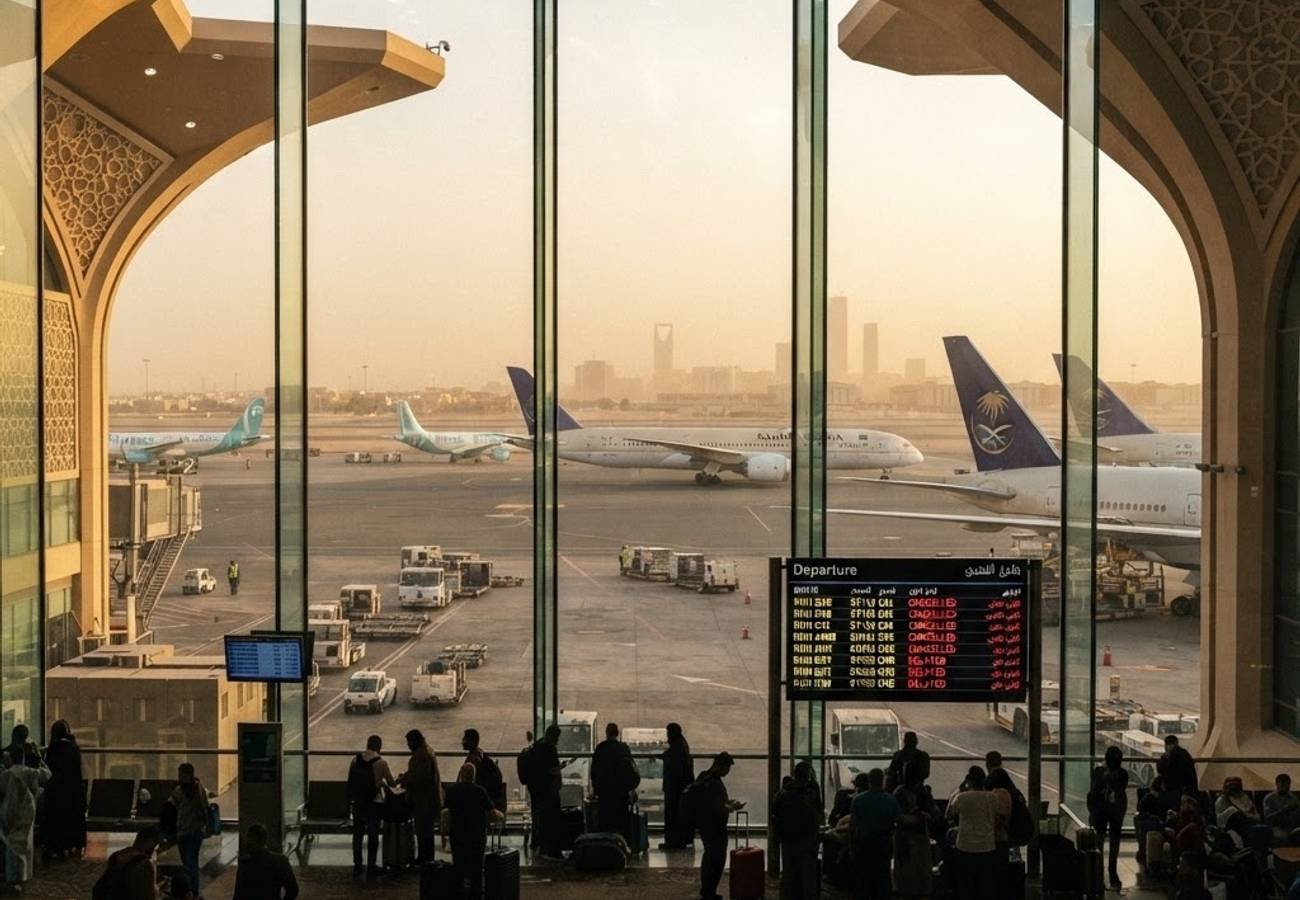
Image generated by AI
A sudden surge in Middle East airspace restrictions has paralyzed operations at Riyadh's King Khalid International Airport, resulting in 89 flight cancellations and 1,002 delays in a single 24-hour window. This operational collapse is impacting thousands of passengers and creating a domino effect across the Gulf and Levant aviation corridors.
The current volatility is not an isolated incident but part of a broader pattern of instability affecting regional hubs. As airspace constraints force aircraft into longer, more complex reroutings, the capacity of major airports to maintain schedules has plummeted, leaving travelers stranded and airlines struggling to recover their rotations.
Riyadh Emerges as Epicenter of Regional Flight Chaos
King Khalid International Airport is currently facing the brunt of these airspace adjustments. Recent data reveals a staggering 89 flights linked to the Saudi capital were scrapped in one day, while 1,002 other services suffered significant delays. This spike represents a sharp increase over the August 2026 average, which had previously hovered around 19 cancellations per active day.
The month of August has been particularly grueling for Riyadh. To date, the airport has recorded 254 total cancellations, split between 105 departing flights and 149 arrivals. Industry reports indicate that Saudia, the national carrier, has borne the majority of these cancellations. This is largely due to the airline's dominant market share in domestic and regional traffic; when a single aircraft rotation is broken, the resulting knock-on effect disrupts dozens of subsequent flights.
The most severe impacts are being felt on the southern network. Routes connecting Riyadh to Jizan Regional and Najran Domestic airports have emerged as the most disrupted, highlighting a critical vulnerability in Saudi Arabia's hub-and-spoke model where southern cities rely almost exclusively on the capital for connectivity.
Systemic Failures Across Major Middle East Hubs
The turmoil in Riyadh is mirrored across other strategic gateways. Operational tracking indicates that Dubai, Doha, and Kuwait City are experiencing similar pressures. In one recent wave of irregular operations, these four hubs combined saw over 180 cancellations and more than 1,200 delays.
These disruptions are driven by a combination of precautionary reroutings and tightened capacity management on specific flight corridors. When airspace segments are closed or restricted, airlines must lengthen their flight paths. This adds significant time to each journey, consuming more crew hours and aircraft availability. To prevent a total system collapse, carriers are prioritizing "trunk" services—high-capacity long-haul flights—while sacrificing lower-frequency regional routes.
Under standard operating conditions, Saudi hubs typically maintain a departure punctuality rate exceeding 80 percent. However, the current airspace crisis has eroded this buffer. Late-arriving aircraft and air traffic flow restrictions have created a cumulative delay effect that makes it nearly impossible for airports to return to a normal schedule once the initial disruption occurs.
Pressure Points in Saudi Domestic Aviation
The domestic aviation sector in Saudi Arabia is uniquely exposed to these shocks. Under the ambitious Saudi Vision 2030, the kingdom has seen aggressive growth in passenger volumes and flight frequencies from 2023 through 2025. While this expansion is a sign of economic growth, it has left the system with very little "slack."
As new entrants like Riyadh Air integrate into the airspace, the sensitivity to external shocks has increased. The tight turnaround times required for short-haul flights mean that a one-hour delay in the morning can result in a cancelled flight by evening. This is particularly evident on routes to Abha and Jizan, which already show above-average disruption patterns.
Furthermore, Riyadh's evolution into a global long-haul hub adds another layer of complexity. The Summer 2026 season introduced expanded services to Europe and Southeast Asia. Because these long-haul flights are high-revenue and high-priority, they are rarely cancelled. Instead, the disruption is shifted onto the "feeder" flights—the smaller regional planes that bring passengers from across the kingdom into Riyadh to catch those international jets.
Regulatory Warnings and Passenger Guidance
The scale of the disruption has prompted international regulators to step in. Malaysia’s Civil Aviation Authority recently issued a formal advisory urging all passengers traveling to or transiting through the Middle East to verify their flight status before departing for the airport. The authority warned that these schedule adjustments could persist through August, September, and October 2026.
Despite this current crisis, data from the Saudi General Authority of Civil Aviation suggests that the underlying infrastructure is sound. Punctuality reports from 2025 showed that Riyadh generally met or exceeded domestic standards, with most flights arriving or departing within 15 minutes of their scheduled time. This suggests that the current 89 cancellations and 1,002 delays are the result of an "external shock"—likely geopolitical or regulatory airspace changes—rather than a failure of airport management.
Flight tracking platforms are currently flagging an increase in eligible compensation claims. Passengers are being advised that if delays are caused by airline-controllable factors rather than "extraordinary circumstances" (such as sudden airspace closures), they may be entitled to financial redress under regional aviation laws.
Why This Matters: The Impact on the Modern Traveler
For the traveler, this situation transforms a routine connection into a high-risk gamble. When a hub like Riyadh experiences over 1,000 delays in a day, the "minimum connection time" listed on a ticket becomes irrelevant.
From a logistical standpoint, this creates a "bottleneck effect." If you are flying from a regional city like Najran to a destination in Europe via Riyadh, a delay in the first leg doesn't just make you late—it likely means you miss a long-haul flight that only operates once a day.
Moreover, the prioritization of long-haul flights over regional ones means that domestic travelers are essentially subsidizing the punctuality of international passengers. If you are on a short-haul route, your flight is the most likely to be cancelled to ensure a Boeing 777 or Airbus A350 can depart on time. Travelers should now build significant buffers into their itineraries, opting for overnight stays in Riyadh rather than tight connections.
As Middle East airspace remains volatile, the ability of regional hubs to absorb shocks will be the true test of the region's aviation ambitions.
Related Travel Guides
Disclaimer
This article is for informational and educational purposes only. It does not constitute legal, financial, or professional advice. While we strive to provide accurate and up-to-date information, travel policies, regulations, and conditions change rapidly. Always verify information with official sources before making travel decisions. Nomad Lawyer makes no representations about the accuracy, reliability, completeness, or suitability of the information provided. Readers should consult qualified professionals for advice specific to their circumstances. The views expressed in this article are those of the author and do not necessarily reflect the views of Nomad Lawyer.
Raushan Kumar
Founder & Lead Developer
Full-stack developer with 11+ years of experience and a passionate traveller. Raushan built Nomad Lawyer from the ground up with a vision to create the best travel and law experience on the web.
Learn more about our team →