
Breaking Airline News: Massive Travel Chaos Engulfs Newark Liberty as United and Republic Trigger 268 Transatlantic and Domestic Flight Disruptions
Breaking airline news: Amidst catastrophic operational fragility, Newark Liberty International Airport suffered massive flight cancellations and delays, plunging thousands of transatlantic and domestic passengers into severe travel chaos.

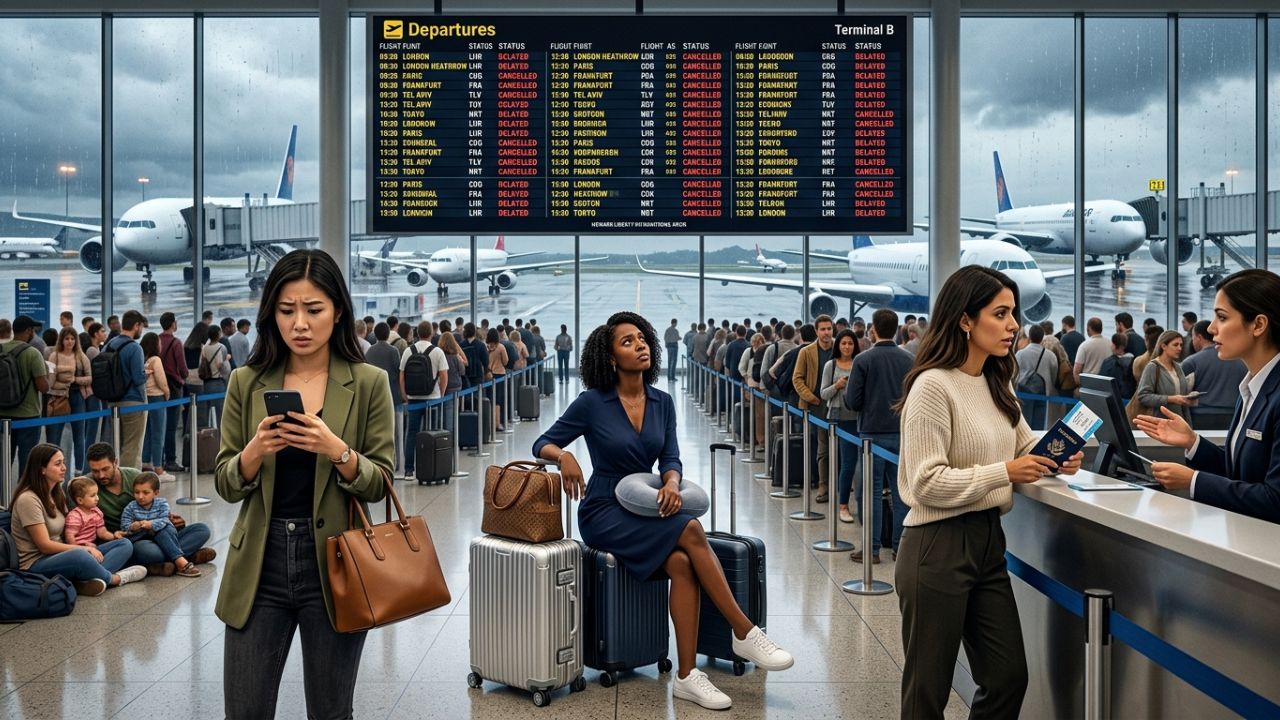
Image representing the intense infrastructural collapse at Newark Liberty International Airport, where 268 sudden flight disruptions have completely shattered global transit schedules, trapping thousands of passengers in a terrifying surge of travel chaos.
Breaking Airline News: Massive Travel Chaos Engulfs Newark Liberty as United and Republic Trigger 268 Transatlantic and Domestic Flight Disruptions
As paralyzing terminal bottlenecks, severe airspace congestion, and catastrophic operational fragility violently transform global transit into a grueling endurance test, a massive operational failure has just crippled one of the most vital transatlantic gateways in the United States. Today, Newark Liberty International Airport suffered an absolute infrastructural meltdown, plunging thousands of unsuspecting US, Canadian, and European passengers into a terrifying wave of travel chaos. Driven by severe, cascading scheduling failures across major carriers including United Airlines, Republic, Delta, Jazz, and Porter, the airport recorded an astonishing 229 flight delays alongside 39 hard flight cancellations. This massive logistical collapse has violently severed critical routes connecting Newark to major global hubs like Toronto, Chicago, Berlin, and Tokyo, transforming terminal concourses into overcrowded holding zones and leaving desperate travelers stranded without immediate recourse.
In a brutal demonstration of how highly vulnerable the US aviation network remains to sudden operational shocks, this localized crisis instantly radiated outward, severely fracturing both domestic and intercontinental flight schedules. Newark Liberty, designed to efficiently process immense passenger volumes as a primary eastern hub, was completely overwhelmed by the concentrated severity of these disruptions. Passengers attempting to navigate the resulting gridlock faced violently extended wait times at check-in counters and boarding gates, while exhausted airline personnel struggled frantically to manage the massive influx of desperate rescheduling requests. This terrifying incident underscores the absolute necessity for aggressive contingency planning, proving that escaping global travel chaos now requires intense operational discipline from every single passenger navigating the global transit grid.
Expanded Overview: The Anatomy of a Transatlantic Collapse
The terrifying reality of overwhelming passenger stress currently testing Newark brutally exposes the extreme consequences of fragile airline schedules. Serving as a critical connection point, the sudden loss of capacity forced the airport's infrastructure to its absolute breaking point, completely overwhelming ground operations.
Section-Wise Breakdown: Decoding the Newark Gridlock
To fully comprehend the massive logistical challenges facing the aviation industry, corporate travel planners and stranded passengers must rigorously review exactly how this explosive disruption tore through the network.
Newark Liberty: The Transatlantic Bottleneck To understand the absolute severity of this demand shock, one must look at the exact operational telemetry at the airport. Newark bore the full, violent brunt of these 268 combined disruptions. The sheer volume of stranded passengers resulted in massive congestion at gates and terminals. Operational teams were forced into a desperate, chaotic scramble to coordinate shifting gate assignments, rapidly mounting baggage handling failures, and frantic passenger notifications simultaneously. The disruption is largely concentrated on high-traffic routes and busy US domestic corridors, combined with severe bottlenecks in transatlantic traffic, heavily pointing toward systemic crew availability issues and severe airspace congestion.
The Severed Arteries: From Toronto to Tokyo The 39 absolute cancellations and 229 massive delays ruthlessly targeted critical global corridors. Origin airports feeding this chaos include massive domestic and international hubs: Toronto Pearson (YYZ), Seattle-Tacoma (SEA), Chicago O’Hare (ORD), Hartsfield-Jackson (ATL), Zurich (ZRH), Munich (MUC), and Berlin-Brandenburg (BER).
On the outbound side, the carnage is equally severe. Flights to Toronto Pearson (YYZ) saw the highest volume of localized cancellations. Crucial US destinations such as Dallas-Fort Worth (DFW), Reagan National (DCA), San Francisco (SFO), and Charlotte-Douglas suffered massive delays. The international gridlock violently impacted flights to Geneva (GVA), Tokyo Haneda (HND), and San Jose Costa Rica (SJO). Furthermore, terrifying operational telemetry reveals that smaller regional airports like Jackson Hole (JAC), Lovell Field (CHA), and Hilton Head (HXD) suffered 100% delay rates, effectively paralyzing those specific passenger corridors.
Operational Failure Matrix: Airline Disruption Data
To guarantee that travelers can aggressively track the specific carriers triggering this massive operational meltdown, the following matrix details the exact, verified disruption data tracked across the airport today.
| Airline | Cancelled | Delayed |
|---|---|---|
| Republic | 17 | 29 |
| United | 11 | 81 |
| Jazz (ACA) | 3 | 4 |
| Delta Air Lines | 2 | 9 |
| Alaska Airlines | 2 | 1 |
| JetBlue | 1 | 3 |
| Porter Airlines | 1 | 6 |
| BermudAir | 0 | 1 |
| Lufthansa | 0 | 3 |
| GoJet (UAL) | 0 | 24 |
| LOT Polish Airlines | 0 | 1 |
| American Airlines | 0 | 9 |
| Allegiant Air | 0 | 1 |
Data reflects the monumental logistical collapse severely impacting Newark Liberty International Airport.
Passenger Impact and Industry Analysis
The widespread impact across domestic, regional, and European carriers created an incredibly complex, chaotic operational scenario. Republic Airlines drove the highest cancellation volumes, grounding 17 flights. However, United Airlines, utilizing Newark as a primary fortress hub, experienced the highest volume of pure gridlock, suffering an astonishing 81 delayed flights alongside 11 cancellations.
The presence of European carriers such as Lufthansa and LOT Polish Airlines, alongside BermudAir, highlights the severe cross-border implications. Delays on transatlantic routes are particularly devastating, as they immediately destroy highly complex international itineraries, trap passengers overnight in foreign transit zones, and trigger massive financial losses for holidaymakers.
This terrifying failure highlights severe systemic constraints within the US airspace. The high delay percentages recorded at connecting hubs—such as Reagan National (77% delayed), Dallas-Fort Worth (36% delayed), and Charlotte-Douglas (40% delayed)—indicate widespread, catastrophic air traffic challenges that are actively crippling operations on the East Coast.
Conclusion: Surviving the Chaos
As the extremely critical domestic transit network braces for further instability, the collapse at Newark Liberty represents a massive warning. Travelers affected by flight cancellations must immediately execute aggressive survival strategies: bypass paralyzed check-in desks by utilizing official airline apps to rebook, aggressively leverage travel insurance for compensation, and carry essential supplies for surviving extended terminal lockouts. This intelligence proves that surviving the modern era of commercial aviation relies entirely on absolute operational readiness, proving that anticipating travel chaos is the only defense against a failing global transit grid.
Key Takeaways
- Massive Network Failure: Newark Liberty International Airport suffered an astonishing 229 flight delays and 39 absolute cancellations.
- Carrier Meltdown: United Airlines accounted for the vast majority of delays (81), while Republic Airlines led the complete cancellations (17).
- Global Severed Routes: Flights heavily connecting Newark to Toronto (YYZ), Chicago (ORD), Berlin (BER), Munich (MUC), and Tokyo (HND) were violently disrupted.
- Systemic Gridlock: The chaos radiated outward, heavily impacting connecting hubs like Reagan National (77% delayed) and Charlotte-Douglas (40% delayed).
- Passenger Survival: Stranded travelers must utilize digital rebooking tools and monitor airline alerts continuously to bypass the massive transatlantic terminal gridlock.
Related Travel Guides
- Air India A320neo Returns to Mumbai After Engine Stall Mid-Climb
- Aviation Updates: Vietnam Deploys Military to Accelerate $4.6B Long Thanh Mega-Airport to Eradicate Regional Travel Chaos
- Malaysia Airlines Adds April 2026 Flights on Kuala Lumpur-London Route as Asia-Europe Travel Surges 10%+ Year-on-Year
Disclaimer
This article is for informational and educational purposes only. It does not constitute legal, financial, or professional advice. While we strive to provide accurate and up-to-date information, travel policies, regulations, and conditions change rapidly. Always verify information with official sources before making travel decisions. Nomad Lawyer makes no representations about the accuracy, reliability, completeness, or suitability of the information provided. Readers should consult qualified professionals for advice specific to their circumstances. The views expressed in this article are those of the author and do not necessarily reflect the views of Nomad Lawyer.
Kunal K Choudhary
Co-Founder & Contributor
A passionate traveller and tech enthusiast. Kunal contributes to the vision and growth of Nomad Lawyer, bringing fresh perspectives and driving the community forward.
Learn more about our team →