
Martha's Vineyard Airport Flight Disruptions 12 Cancellations Hit Tradewind JetBlue Cape Air Republic July 2026
Twelve flight cancellations and twelve delays at Martha's Vineyard Airport disrupt regional connectivity across Northeast routes as Tradewind, JetBlue, Cape Air, and Republic face operational breakdowns.

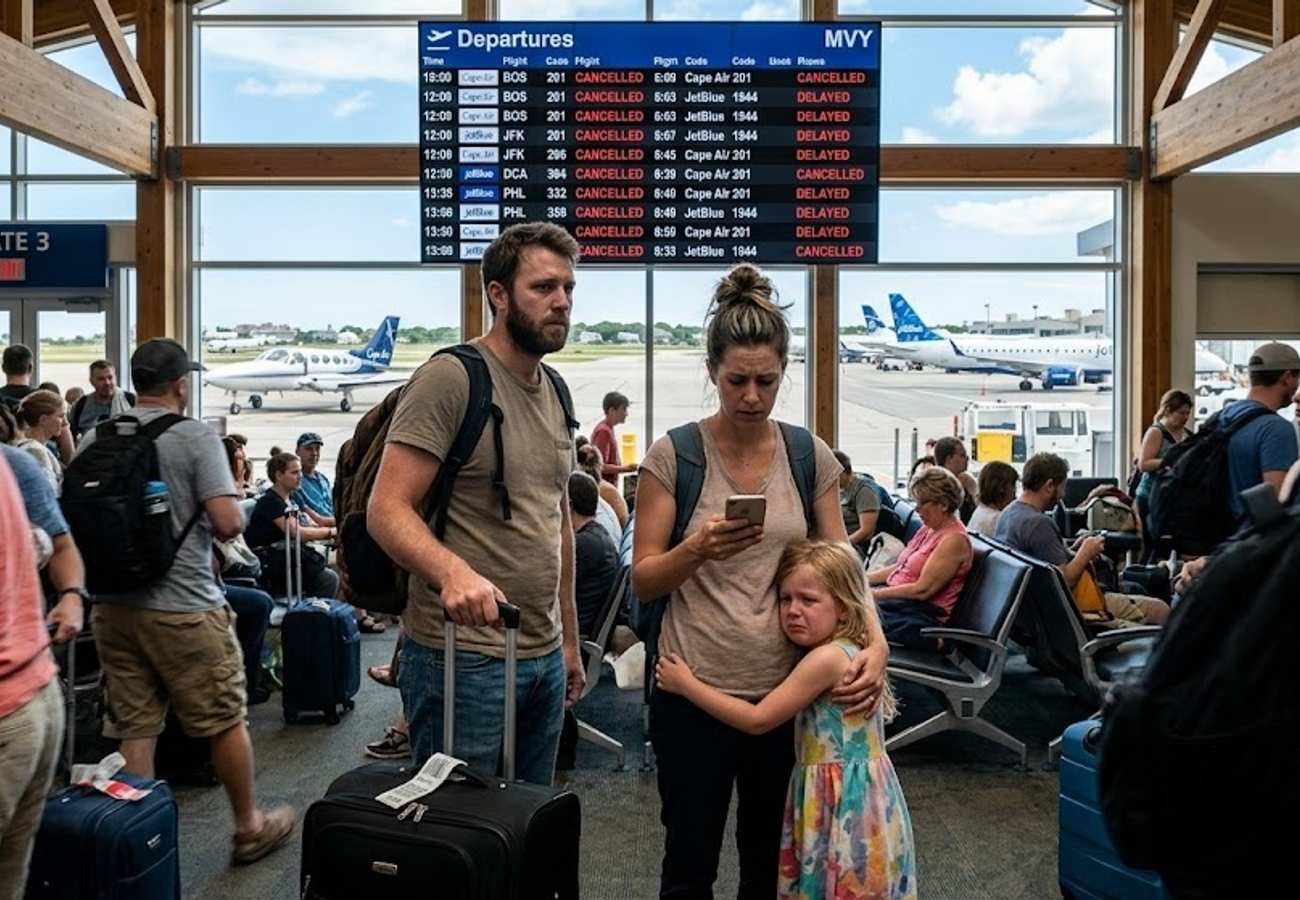
Image generated by AI
Martha's Vineyard Airport (MVY) faced significant operational disruption on July 5, 2026, as four regional carriers suspended or delayed a combined 24 flights, stranding passengers across the Northeast corridor. Tradewind Aviation, JetBlue Airways, Cape Air, and Republic Airways all reported schedule irregularities that rippled through key routes connecting the island to major metropolitan hubs.
The disruption hit during peak summer travel season, when Martha's Vineyard experiences its highest passenger volumes of the year. Twelve flights were cancelled outright, while another twelve faced delays, severely constraining regional connectivity at a critical moment for the island's tourism economy.
Flight Disruption Summary
| Airline | Cancelled Flights | Delayed Flights | Impact as % of Schedule |
|---|---|---|---|
| Tradewind Aviation | 10 | 0 | 43% |
| JetBlue Airways | 2 | 0 | 33% |
| Cape Air | 0 | 5 | Operational delays only |
| Republic Airways | 0 | 7 | Operational delays only |
| Total | 12 | 12 | — |
Tradewind Aviation Bears Heaviest Cancellation Load
Tradewind Aviation emerged as the primary source of cancellation activity, scrubbing 10 flights — representing 43% of its scheduled operations at Martha's Vineyard Airport (MVY). This made Tradewind the dominant contributor to the day's disruption, severely affecting regional connectivity to destinations including White Plains (HPN), Teterboro (TEB), and Bedford.
Tradewind's high cancellation rate raises serious questions about the carrier's operational resilience during peak demand periods. As a boutique scheduled charter operator serving premium leisure routes, Tradewind relies heavily on smaller aircraft that are particularly vulnerable to operational disruptions. When 43% of scheduled flights vanish in a single day, the cascading effect on passenger confidence and downstream bookings becomes a material business concern.
JetBlue's Proportionally Severe Impact
JetBlue Airways cancelled 2 flights, accounting for 33% of its scheduled services at MVY. While the absolute number is smaller than Tradewind's, the proportional impact is nearly identical. JetBlue connects Martha's Vineyard to New York City (JFK) and Boston (BOS), routes that carry substantial leisure traffic during summer months.
Passengers can monitor JetBlue's official flight status portal for real-time updates. The carrier's 33% cancellation rate, while affecting fewer total flights, still removed critical capacity from high-demand corridors during one of the busiest travel windows of the year.
Cape Air and Republic: Delays Without Cancellations
Cape Air and Republic Airways avoided cancellations entirely but contributed 5 and 7 delayed flights respectively. Cape Air, a regional carrier specializing in short-haul Northeast routes, maintained its departure schedule despite operational headwinds. Republic Airways, operating regional flights for major carrier partners, similarly kept cancellations at zero but saw nearly a dozen flights slip behind schedule.
The delay-only profile of these two carriers suggests different operational pressures than those facing Tradewind and JetBlue. Cape Air's 5 delays and Republic's 7 delays indicate that while aircraft remained available, scheduling constraints — potentially including air traffic control holds, crew availability, or weather factors — prevented on-time departures.
Strategic Business Impact on Regional Connectivity
The concentration of 12 cancellations across just two carriers reveals a structural vulnerability in Martha's Vineyard's regional air service model. When Tradewind and JetBlue account for 100% of cancellations, the airport's connectivity to major hubs like Philadelphia (PHL), New York City, and Boston becomes dangerously dependent on two operators' ability to maintain schedule integrity.
For an airport serving a premium seasonal destination, even a single day of 43% cancellation rates from its largest carrier can erode passenger trust. Business travelers and leisure passengers alike pay premium fares to access Martha's Vineyard during summer months. Repeated disruptions risk driving passengers toward alternative transportation — ferry services, private charters, or driving to alternative airports — permanently shifting market share away from commercial aviation.
The island's geographic isolation amplifies every cancellation's impact. Unlike a disruption at a major hub where passengers can rebook on competing carriers within the same terminal, stranded MVY passengers face limited alternatives. This dynamic gives the airport and its airline partners a narrow margin for operational failure before passengers seek permanent substitutes.
Affected Routes and Geographic Spread
The disruption extended well beyond Martha's Vineyard itself. Operational issues were reported across a broad geographic footprint:
- White Plains (HPN) — key Tradewind route
- New York City (JFK/LGA) — JetBlue and Cape Air routes
- Philadelphia (PHL) — regional connectivity
- Boston (BOS) — multiple carrier service
- Teterboro (TEB) — Tradewind private aviation route
- Bedford — regional service
- Chicago (ORD) — broader network impact
This geographic spread demonstrates how a single airport's operational failure can cascade across the entire Northeast regional aviation network. A passenger stranded at MVY cannot simply walk to another gate — the island's isolation makes every cancelled flight a logistical crisis.
Passenger Guidance During Disruptions
Passengers affected by the July 5 disruption should take several immediate steps. Monitor email, SMS, and airline apps for rebooking confirmations and schedule changes. Contact airline customer service directly — either at airport service desks or via phone and online chat to avoid physical queues.
Familiarize yourself with each carrier's cancellation policies before arriving at the airport. While U.S. domestic cancellation compensation differs from EU regulations under EC 261/2004, many airlines offer rebooking flexibility during operational disruptions they control. Consider alternative flights on competing carriers, or explore ground transportation options including bus and ferry services where geographically feasible.
The Martha's Vineyard Airport official website provides real-time flight information and airport operational updates. Passengers should verify flight status before departing for the airport, as conditions can change rapidly throughout the day.
Operational Outlook and Market Implications
The Martha's Vineyard disruption underscores how quickly airline-specific operational challenges can cascade through regional air travel during high-demand periods. With Tradewind and JetBlue accounting for all 12 cancellations, and Cape Air and Republic contributing 12 combined delays, the airport's total operational impact touched 24 flights in a single day.
All operational data was sourced from FlightAware and remains subject to real-time changes. Airlines actively modify schedules to maintain safety, and passengers should rely on current updates rather than historical snapshots when making travel decisions.
For the regional aviation market, this event highlights the fragility of concentrated carrier operations at seasonal destination airports. Airport authorities and airline planners must evaluate whether route diversification, additional carrier partnerships, or improved operational buffers could mitigate future disruption events of this magnitude.
Regional aviation resilience is measured not by the absence of disruption, but by the speed and coordination of recovery when systems falter.
Related Travel Guides
Disclaimer
This article is for informational and educational purposes only. It does not constitute legal, financial, or professional advice. While we strive to provide accurate and up-to-date information, travel policies, regulations, and conditions change rapidly. Always verify information with official sources before making travel decisions. Nomad Lawyer makes no representations about the accuracy, reliability, completeness, or suitability of the information provided. Readers should consult qualified professionals for advice specific to their circumstances. The views expressed in this article are those of the author and do not necessarily reflect the views of Nomad Lawyer.
Raushan Kumar
Founder & Lead Developer
Full-stack developer with 11+ years of experience and a passionate traveller. Raushan built Nomad Lawyer from the ground up with a vision to create the best travel and law experience on the web.
Learn more about our team →