
Manila and Asia-Pacific Airports Deploy Modular Runway Lighting to End Daylight-Only Flight Curfews
The deployment of portable Airfield Ground Lighting (P-AGL) is removing restrictive daylight-only operational windows at remote island airstrips, easing midday slot congestion at major hubs like Manila's NAIA.

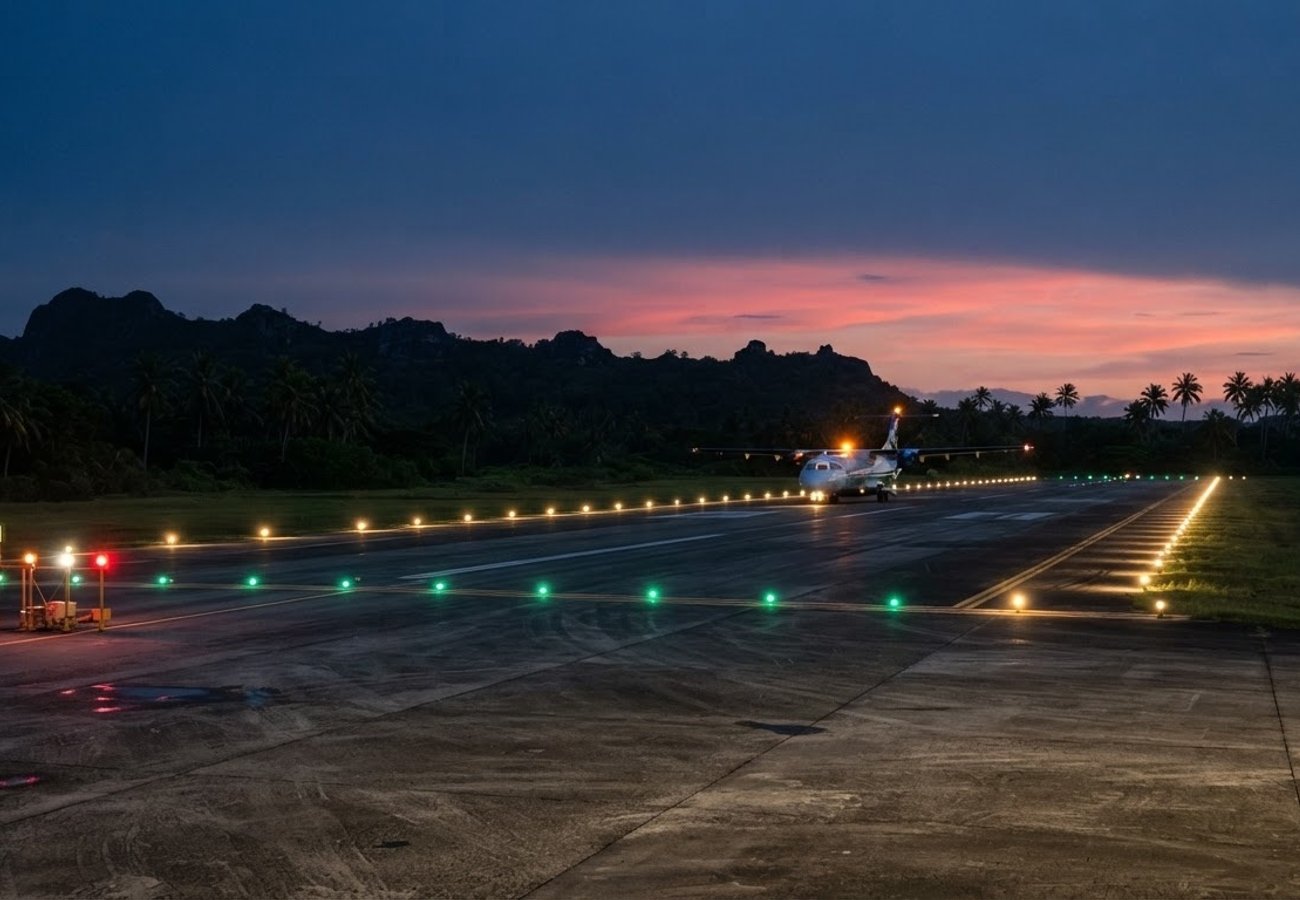
Image generated by AI
Commercial aviation across Asia-Pacific tropical archipelagos has long been throttled by a restrictive operational paradigm: strict daylight-only flight windows. Without certified Airfield Ground Lighting (AGL), remote island airstrips are typically limited to operations between 06:00 and 17:30.
This limitation creates a systemic bottleneck. Airlines are forced to compress their entire daily schedule into a narrow seven-hour window, leading to acute congestion between 10:00 and 15:00. The result is a "midday stampede" where terminal facilities, ground crews, and apron parking stands reach maximum capacity, while expensive runway infrastructure remains idle for over half the day.
The ripple effects extend to primary gateway hubs. Major airports—including Ninoy Aquino International Airport (NAIA) in Manila, Soekarno-Hatta in Jakarta, and Kempegowda in Bengaluru—experience intense midday slot bunching. Regional turboprops returning from unlit islands must compete for runway slots and air traffic control sequencing with long-haul widebody aircraft. This concentration increases airborne holding patterns, elevates jet fuel burn, and raises slot coordination fees.
The Daylight Curfew Cascade
| Step | Operational Phase | Description / Consequence |
|---|---|---|
| 1 | Daylight Operations | Limited window from 06:00–17:30 |
| 2 | Midday Slot Bunching | Severe congestion at island terminals and gateway hubs |
| 3 | Lower Fleet Utilization | Sub-optimal utilization (~8 Block Hours per Aircraft) |
| 4 | Economic Distortions | Inflated airfares and forced overnight hub layovers |
From a market perspective, these limits artificially cap seat capacity. High demand paired with restricted hours inflates base airfares, making secondary destinations less accessible. Furthermore, operational resilience is fragile; a single delay caused by tropical rain or coastal fog can push a flight past the 15:30 cutoff, resulting in cancellations and stranded passengers.
Infrastructure Comparison: Traditional vs. Portable AGL
Traditional engineering—extending asphalt or installing hard-wired Category I/II lighting—is often impossible in island environments. These airstrips are typically situated in fragile ecosystems, surrounded by mangroves, coral reefs, or volcanic terrain. Physical expansion requires land reclamation and sea wall construction, triggering lengthy environmental assessments and legal challenges.
The financial burden is equally steep. The Civil Aviation Authority of the Philippines (CAAP) estimates traditional night-rating upgrades cost approximately PHP 400 million (~USD 7.1 million) per airport.
| Feature | Traditional Hard-Wired AGL | Portable / Deployable AGL |
|---|---|---|
| Cost | Approx. PHP 400M (~USD 7.1M) | Fraction of hard-wired cost |
| Installation | Deep trenching & concrete ducting | Zero trenching / surface mount |
| Eco Impact | Saltwater intrusion & habitat damage | Zero ecological footprint |
| Deployment | 18–36 Months | 2–4 Weeks |
Technical Architecture of P-AGL Systems
Modern portable Airfield Ground Lighting (P-AGL) has evolved from emergency kits into certified infrastructure. These systems comply with ICAO Annex 14 (Volume 1 and 2) and FAA advisory circulars (AC 150/5345-46D and L-861), ensuring precise photometric output and mechanical durability.
System Component Breakdown:
- Central Wireless RF Controller (ALCMS): The primary command source located at the tower.
- Edge Lights: 800 cd Yellow/White; powered by solar or battery.
- Threshold Lights: Green/Red optics with IP67 frangible mounts.
- Portable PAPI: Wireless RF mesh for visual slope guidance.
The system utilizes a Wireless RF Mesh Network Topology, where the ATC tower sends signals to edge lights, which then act as bidirectional relays to threshold lights and PAPI units. This "zero-earthwork" approach allows operators to bypass years of litigation and massive capital outlays.
Why This Matters: Industry Implication
For aviation operators and regional governments, the shift to P-AGL is not just about lighting; it is about asset utilization.
Our analysis of the route map indicates that moving from a 7-hour window to 24-hour capability effectively doubles the potential throughput of secondary airstrips. From a logistical perspective, this means airlines can move "dead time" flights to evening slots, immediately relieving the midday pressure on NAIA and other major hubs.
Furthermore, the environmental angle is critical. In regions like the Maldives or the Lakshadweep Archipelago, traditional trenching ruins fresh groundwater lenses. P-AGL removes the conflict between aviation growth and ecological preservation, allowing "green" expansion in protected zones.
Forward Outlook
Expect a rapid acceleration of P-AGL adoption across the ASEAN region as airlines seek to optimize fleet utilization. As these modular systems become the standard for regional hubs, we anticipate a gradual decrease in "peak-hour" ticket pricing for island destinations. The next phase will likely involve integrating these wireless lighting grids with automated remote tower technology, further reducing the need for permanent on-site staffing at remote airstrips.
Modular infrastructure is turning the sunset curfew into a relic of the past.
Related Travel Guides
Disclaimer
This article is for informational and educational purposes only. It does not constitute legal, financial, or professional advice. While we strive to provide accurate and up-to-date information, travel policies, regulations, and conditions change rapidly. Always verify information with official sources before making travel decisions. Nomad Lawyer makes no representations about the accuracy, reliability, completeness, or suitability of the information provided. Readers should consult qualified professionals for advice specific to their circumstances. The views expressed in this article are those of the author and do not necessarily reflect the views of Nomad Lawyer.
Preeti Gunjan
Contributor & Community Manager
A passionate traveller and community builder. Preeti helps grow the Nomad Lawyer community, fostering engagement and bringing the reader experience to life.
Learn more about our team →