
Maldives Redefines Paradise Travel By Turning Remote Atoll Escapes Into Vibrant Sustainable Neighborhoods
Maldives Redefines Paradise Travel By Turning Remote Atoll Escapes Into Vibrant Sustainable Neighborhoods

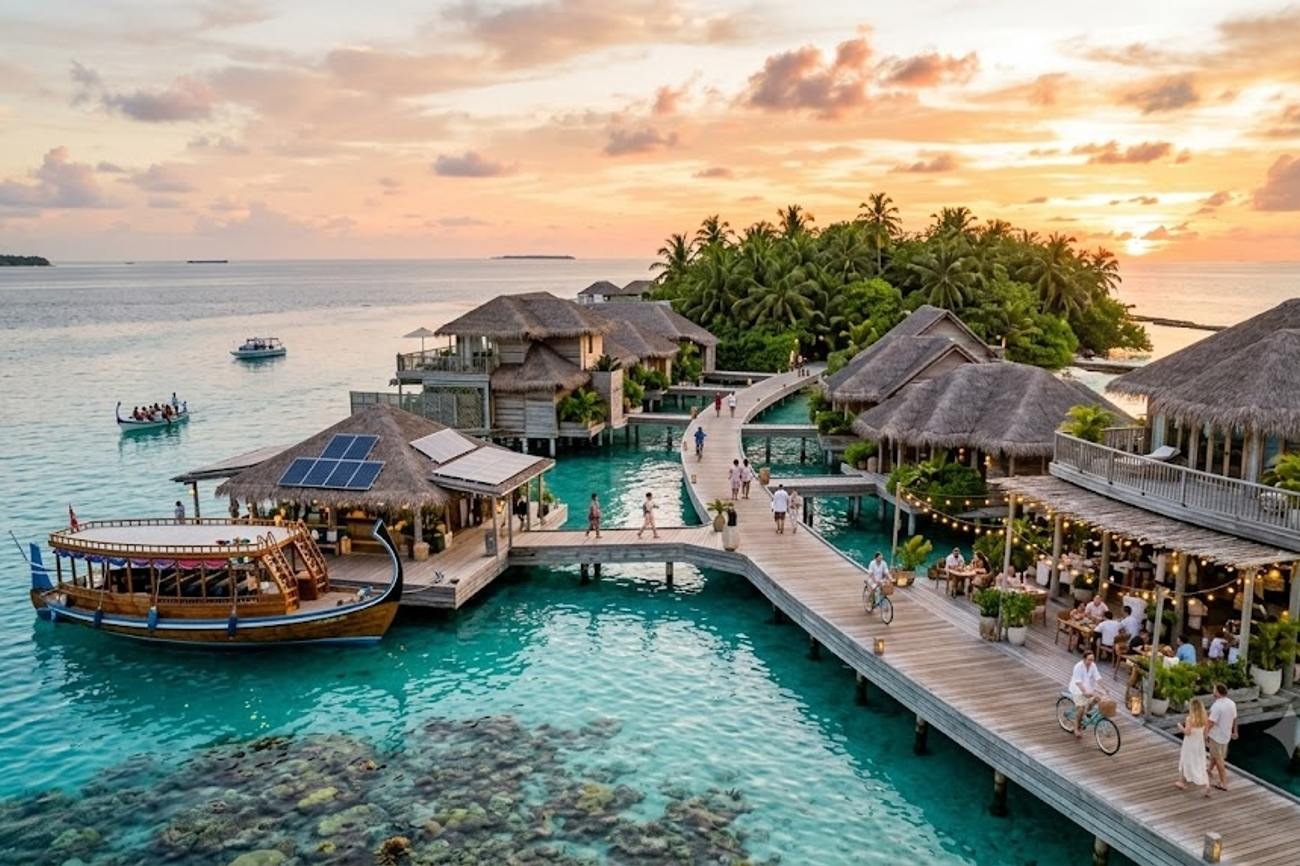
Image generated by AI
A 5% corporate tax rate for the first decade of operation within Special Economic Zones (SEZs) marks the beginning of a fundamental restructuring of the Maldivian economy. This fiscal incentive is the cornerstone of a broader legislative pivot designed to move the archipelago away from its historical reliance on "one island, one resort" tourism. By slashing tax burdens and amending labor laws, the Maldives is transitioning from a seasonal vacation destination into a permanent residential and professional hub for global capital and digital labor.
The Legislative Pivot Toward Permanent Residency
For decades, the Maldives operated on a bubble economy: tourists arrived, stayed in isolated luxury enclaves, and departed without significant integration into the local socio-economic fabric. This model is now being dismantled in favor of "Sustainable Townships." These are not merely expanded resorts but multi-sector urban centers governed by the Special Economic Zone (SEZ) legal framework.
The shift is underpinned by critical changes to the national labor and residency laws. In a move to attract a more diverse demographic, the government has altered regulations to allow Maldivian citizens and legal residents to work remotely from other countries, while simultaneously opening the door for foreigners to secure work visas specifically within the tourism industry. This bidirectional flow of labor signals a desire to professionalize the hospitality sector and integrate the Maldives into the global remote-work economy.
By integrating educational facilities, healthcare hubs, and renewable energy infrastructure into these townships, the state is creating an ecosystem that supports long-term residency rather than short-term visits. This removes the "resort ceiling," allowing the country to attract families, retirees, and high-net-worth individuals who require urban conveniences—such as hospitals and schools—alongside tropical luxury.
Capital Inflow and the SEZ Financial Architecture
The financing of this transformation has shifted from individual resort operators to "patient capital." This includes sovereign-linked entities, institutional investors, and large-scale joint ventures capable of funding multi-hundred-million-dollar projects. A primary example of this trend is the development of massive infrastructure projects in the Noonu Atoll, which serve as a blueprint for future foreign direct investment (FDI) in the region.
To secure this capital, the Maldives has introduced a Residence-by-Investment framework. By pairing real estate acquisitions within approved SEZ developments with long-term residency privileges, the government is effectively commoditizing residency to fund infrastructure.
The fiscal incentives for these developments are aggressive and designed for long-term stability:
| Fiscal Metric | First 10 Years (SEZ) | Subsequent 10 Years (SEZ) |
|---|---|---|
| Corporate Tax Rate | 5% | 10% |
| Residency Status | Linked to Real Estate Investment | Long-term tenure |
| Infrastructure Focus | Integrated Townships | Sustainable Urbanism |
This regulatory certainty is intended to provide a predictable exit mechanism for investors while ensuring that the International Air Transport Association (IATA) standards for connectivity are met through improved marine and air transportation networks funded by this institutional capital.
Expert Analysis: The Death of the "Resort Bubble"
For travelers and investors, the direct consequence of this shift is the erosion of the "resort bubble." Traditionally, the Maldives was a curated experience where the traveler never encountered the actual machinery of the state or the reality of local life. The introduction of Sustainable Townships transforms the traveler from a guest into a resident.
The pricing pressure created by this shift will likely bifurcate the market. On one hand, the opening of the islands to "lower incomes" and families through diversified housing will democratize access to the archipelago. On the other hand, the Residence-by-Investment schemes will create a new tier of ultra-luxury gated communities that function as offshore tax havens and permanent bases for the global elite.
From a logistical standpoint, the integration of healthcare and education means that the Maldives is no longer a "fly-in, fly-out" destination. For the digital nomad, this means the ability to maintain lifestyle consistency—high-speed internet, medical security, and professional networking—without sacrificing the geographic isolation of the Indian Ocean. However, the risk remains that these "townships" could become sterilized corporate colonies if the promised integration with local populations is not strictly enforced.
Key Takeaways
- Tax Incentives: New SEZ developments benefit from a 5% corporate tax rate for the first 10 years, rising to 10% for the following decade.
- Labor Law Shifts: Foreigners can now obtain work visas for the tourism sector, and residents are permitted to work remotely from abroad.
- Investment Path: Residency is now structurally linked to real estate investment within approved multi-sector townships.
- Infrastructure Expansion: The model is moving from isolated resorts to integrated hubs featuring hospitals, schools, and clean energy grids.
- Target Demographic: The strategy specifically targets institutional capital, high-net-worth residents, and the global remote-work community.
FAQ: Maldives Residency and Travel 2025
Can I now work remotely from the Maldives? Yes. The government has amended laws to encourage remote work and has introduced visas and infrastructure specifically designed to support digital nomads and foreign employees in the tourism sector.
How does the Residence-by-Investment program work? Eligible foreigners can secure long-term residency privileges by purchasing real estate within approved Special Economic Zone (SEZ) developments, turning a vacation property into a legal base of residence.
Are the Maldives becoming more affordable for families? Yes. The shift from exclusive, single-island resorts to integrated Sustainable Townships is designed to attract a wider range of clientele, including families and those with lower income brackets.
What are "Sustainable Townships" in the Maldives? Unlike traditional resorts, these are multi-use developments that include permanent housing, healthcare, education, and renewable energy, creating self-sufficient communities rather than temporary tourist stops.
The Maldives is no longer selling a vacation; it is selling a sovereign lifestyle.
Tags: Maldives-SEZ-2025, Noonu-Atoll-Development, Residence-by-Investment-Maldives, Maldives-Labor-Law-Reform, Sustainable-Townships-Indian-Ocean
Related Travel Guides
- Spain Unites With Tanzania and Others as New EU Greenwashing Rules Reshape Sustainable Travel Marketing in 2026
- UK Tourism Breakthrough as Coventry Attracts Millions of Visitors and Creates a Record £1 Billion Boom
- Italy Follows Others as Rome Esquilino Joins Europe’s Coolest Neighbourhoods for Authentic Travel Experiences
Disclaimer
This article is for informational and educational purposes only. It does not constitute legal, financial, or professional advice. While we strive to provide accurate and up-to-date information, travel policies, regulations, and conditions change rapidly. Always verify information with official sources before making travel decisions. Nomad Lawyer makes no representations about the accuracy, reliability, completeness, or suitability of the information provided. Readers should consult qualified professionals for advice specific to their circumstances. The views expressed in this article are those of the author and do not necessarily reflect the views of Nomad Lawyer.
Raushan Kumar
Founder & Lead Developer
Full-stack developer with 11+ years of experience and a passionate traveller. Raushan built Nomad Lawyer from the ground up with a vision to create the best travel and law experience on the web.
Learn more about our team →