
Major Delays Cairo: 106 Flights Disrupt Regional Links Amid Middle East Airspace Crisis
Cairo International Airport faces major delays affecting 106 flights in April 2026 as Middle East airspace restrictions force regional routing concentrations. Travelers to Gulf and Levant destinations face significant disruptions.

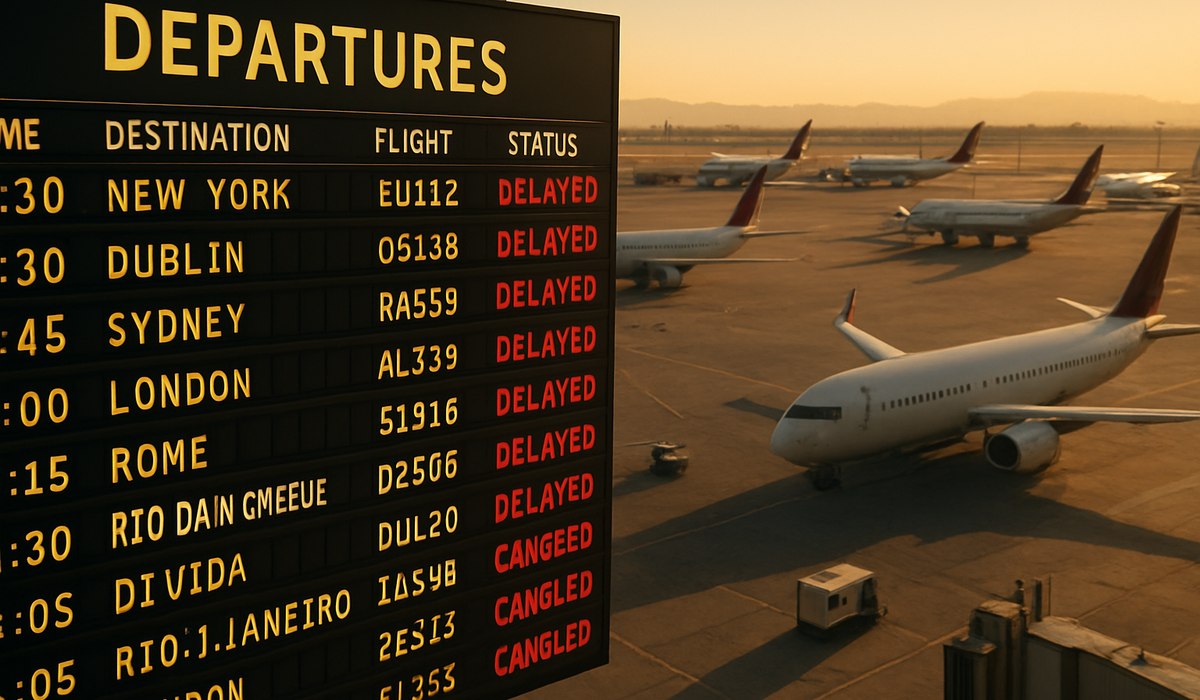
Image generated by AI
Cairo International Airport Grinds Under Strain
Cairo International Airport has emerged as the Middle East's most critical bottleneck, with 106 flights experiencing delays, cancellations, or diversions during early April 2026. The disruption stems from a perfect storm of airspace restrictions across neighboring countries and surging traffic concentration through Egyptian airspace. Tens of thousands of passengers—including nomadic workers, business travelers, and families—have faced extended waits and broken connections across Gulf, Levant, and European routes.
The cascading effect has transformed Cairo from a smooth transit hub into a flashpoint where minor delays amplify into widespread disruptions. Aircraft arriving late from congested hubs like Dubai and Istanbul push back outbound regional flights, security screening backlogs extend check-in queues, and crew duty-time violations force last-minute schedule changes.
Cairo Airport Emerges as Middle East Disruption Flashpoint
The concentration of major delays at Cairo reflects broader geopolitical realities reshaping Middle East aviation. Since early 2026, airspace closures in Bahrain, Iraq, Israel, Kuwait, Qatar, Syria, and the United Arab Emirates have forced airlines to redesign route networks entirely. Egypt's position—geographically central to Europe-Africa-Asia corridors—has made Cairo the unavoidable waypoint for airlines seeking alternatives to restricted airspace.
This routing concentration has overwhelmed Cairo's ground infrastructure during peak hours. Check-in counters, security screening lanes, and aircraft ramp operations all function near maximum capacity. When a single flight arrives 90 minutes late from Istanbul, that delay ripples through the next 8-12 departures sharing the same gates, ground crews, and catering teams. The timetable cascade means passengers connecting to Amman, Riyadh, or Doha often miss their onward flights entirely.
Airlines including EgyptAir, Emirates, Etihad, and Qatar Airways have publicly acknowledged the strain. Some carriers have preemptively suspended services to certain regional cities to prevent widespread schedule failures. This conservative approach stabilizes operations but leaves travelers stranded and forces costly rebooking onto alternative routing.
106 Flights Delayed Across Gulf and European Routes
The specific routes most affected by major delays in Cairo involve high-traffic regional links. Cairo-Dubai, Cairo-Abu Dhabi, and Cairo-Doha flights have experienced the longest average delays, often exceeding three hours. These routes normally serve connecting passengers from Europe and Africa heading to Gulf business and logistics hubs.
Levant services from Cairo to Amman, Beirut, and Damascus have seen comparable disruption. The dual impact—airspace restrictions limiting direct routing from Europe plus Cairo's congestion—means passengers face either multi-hour delays or rerouting via Istanbul or Gulf alternatives. Long-haul European connections originating from Cairo have also suffered, with passengers missing onward flights to London, Paris, and Frankfurt due to gate delays and slow boarding processes.
Medium-haul routes to Turkish and Israeli destinations present additional complexity. Some flights divert to secondary Egyptian airports including Luxor, Hurghada, or Sharm El Sheikh, requiring passengers to navigate ground transfers and rebooking scenarios. The 106 delayed or canceled flights represent an estimated 15,000-18,000 affected passengers across a five-day window.
Aircraft utilization data from FlightAware shows that regional narrowbody aircraft—the backbone of Gulf and Levant networks—are experiencing 45-minute average turnarounds stretched to 90 minutes due to ground congestion. This compounds crew duty-time violations, forcing schedule adjustments that cascade across multi-leg itineraries.
Airspace Restrictions Force Traffic Concentration Through Egypt
The causal mechanism driving major delays in Cairo is straightforward: neighboring airspace restrictions have eliminated routing options. Airlines previously flew diverse paths around the Arabian Peninsula, through Israeli and Jordanian airspace, and via direct Iraq-Syria corridors. These options now carry prohibitive risk or remain completely closed.
Egyptian airspace, by contrast, remains open to commercial traffic. This geographic reality has created a funnel effect where traffic intended for Dubai, Abu Dhabi, and Saudi Arabia now concentrates on fewer flight paths and converges at Cairo. The airport lacks the redundancy to absorb this surge without delays.
Compounding factors include longer block times on rerouted flights. A Cairo-Dubai routing that previously flew direct now requires deviation around restricted sectors, adding 20-30 minutes of flight time. This stretches aircraft utilization cycles and compresses turnaround windows at Cairo, where rapid turnarounds were already challenging.
The FAA and international aviation bodies have issued guidance acknowledging these constraints, effectively validating airlines' decisions to reduce capacity on affected routes rather than risk further cascading delays. Cairo's infrastructure—while adequate for normal traffic flows—lacks surge capacity for the emergency rerouting volumes.
Impact on Nomadic Workers and Regional Connectivity
Nomadic professionals working across Middle East hubs have been disproportionately affected by major delays in Cairo. Consultants, financial services workers, and digital nomads with meetings in Dubai, Doha, or Abu Dhabi have faced missed connections and forced route changes costing significant time and money. A Cairo-Dubai connection intended to reach a 2 PM meeting now arrives the following morning, disrupting client relationships and project timelines.
Family visitors traveling from Europe to Gulf destinations report multi-day delays in reunion plans. A parent flying from London to visit children in Saudi Arabia might spend an unplanned night in Cairo due to disrupted onward connections. The emotional and logistical toll compounds the direct flight delay impact.
Regional remote workers based in Cairo serving European and North American clients have also experienced internet and mobility constraints. If their planned travel was disrupted, backup communication infrastructure became essential. Coworking spaces in Cairo reported elevated usage from stranded travelers managing work amid flight delays.
Traveler Action Checklist
If your travel involves Cairo or regional Middle East destinations, take these immediate steps:
-
Check your airline's schedule status at FlightAware before arriving at the airport; major delays in Cairo often mean schedule changes 24-48 hours in advance.
-
Add 4-6 hours to your planned connection time in Cairo; normal 2-hour connections are insufficient amid current congestion.
-
Book flexible tickets allowing rebooking without penalty; airfare purchase options emphasizing schedule flexibility protect against cascade delays.
-
Register with your airline's delay alert system to receive real-time notifications of schedule changes or cancellations.
-
Carry essential medications, chargers, and valuables in your carry-on; checked luggage may be delayed or rerouted separately.
-
Review your airline's delay compensation policy at US DOT to understand your financial rights for flights exceeding three hours late.
-
Identify alternative routing options via Istanbul, Beirut, or secondary Egyptian airports before your travel date.
-
Contact your airline's customer service 72 hours before departure to confirm flight status and discuss alternative routing if delays appear likely.
| Metric | Impact | Timeline |
|---|---|---|
| Delayed/Canceled Flights | 106 movements | Early April 2026 |
| Average Delay Duration | 2-4 hours | Ongoing |
| Estimated Affected Passengers | 15,000-18,000 | 5-day window |
| Primary Affected Routes | Cairo-Dubai, Cairo-Doha, Cairo-Abu Dhabi | Daily |
| Secondary Airports Used | Luxor, Hurghada, Sharm El Sheikh | As needed |
| Aircraft Turnaround Extension | 45 minutes → 90 minutes | Baseline comparison |
What This Means for Travelers
The major delays in Cairo signal a fundamental shift in Middle
Disclaimer
This article is for informational and educational purposes only. It does not constitute legal, financial, or professional advice. While we strive to provide accurate and up-to-date information, travel policies, regulations, and conditions change rapidly. Always verify information with official sources before making travel decisions. Nomad Lawyer makes no representations about the accuracy, reliability, completeness, or suitability of the information provided. Readers should consult qualified professionals for advice specific to their circumstances. The views expressed in this article are those of the author and do not necessarily reflect the views of Nomad Lawyer.
Raushan Kumar
Founder & Lead Developer
Full-stack developer with 11+ years of experience and a passionate traveller. Raushan built Nomad Lawyer from the ground up with a vision to create the best travel and law experience on the web.
Learn more about our team →