
Lufthansa Debuts Airbus A350-1000 on Asian Routes from Munich: Allegris Cabin Breakdown and Fleet Strategy

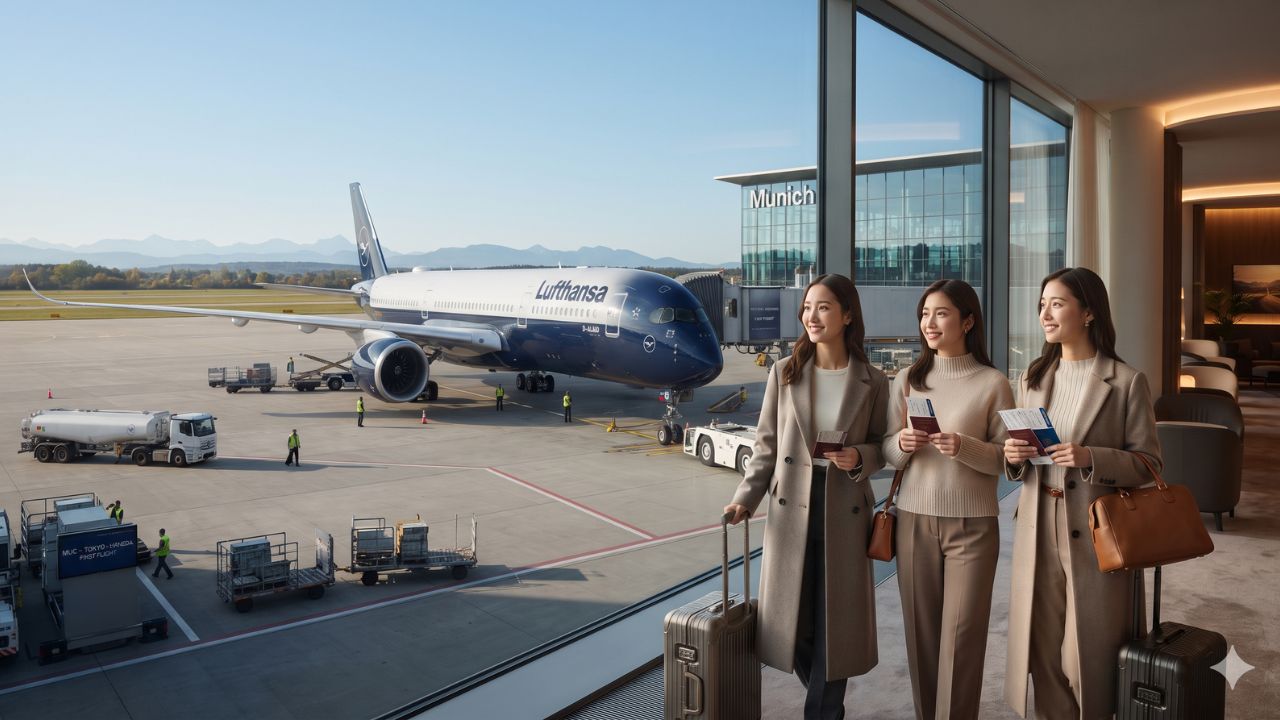
Marking the 700th Airbus aircraft delivered to the Lufthansa Group and launching a 15-frame wide-body commitment through 2030, Lufthansa will introduce its flagship Airbus A350-1000 into commercial passenger service on 3 December 2026 on the Munich–Tokyo Haneda corridor. The maiden commercial flight of the stretched twin-aisle wide-body—carrying registration D-AIFA and christened "Deutschland"—arrives from Airbus final assembly lines in Toulouse, France, in mid-November, entering service as the seventh member of Lufthansa’s designated centenary fleet celebrating 100 years of airline operations. Stationed exclusively at Munich Airport, the first 10 of the group's 15 ordered A350-1000s will anchor long-haul operations from Bavaria, expanding to Shanghai and Singapore in subsequent weeks with a 300-seat, four-class Allegris interior.
The aircraft introduction represents a structural evolution in German long-haul fleet deployment. Measuring 73.8 meters in length—approximately seven meters longer than the baseline A350-900—the A350-1000 combines superior range economics with substantial passenger capacity. For corporate travelers flying between Central Europe and Asia, premium fliers seeking private suites, and loyalty members tracking fleet upgrades, the rollout introduces new seating options alongside operational complexities tied to aircraft scheduling rotations.
Munich's Long-Haul Ascension: Fleet Modernization and Asian Gateway Strategy
Lufthansa’s decision to base its initial A350-1000 fleet at Munich Airport reinforces the Bavarian gateway as the group’s primary premium long-haul transfer hub. Operating alongside Frankfurt, Munich handles high-yield intercontinental traffic connecting Western Europe with key commercial centers in East and Southeast Asia.
The route sequence mirrors commercial travel priorities across the continent:
- Tokyo Haneda (HND): Selected as the inaugural commercial route launching on 3 December 2026, serving high-yield corporate finance, manufacturing, and diplomatic traffic between Germany and Japan.
- Shanghai Pudong (PVG): Follows in subsequent weeks, supporting extensive industrial trade ties between German automotive and chemical sectors and China’s primary commercial engine.
- Singapore Changi (SIN): Completes the initial deployment wave, connecting European travelers into Southeast Asia's pre-eminent aviation and maritime logistics hub.
However, airline operations will not feature the A350-1000 on every scheduled departure. Lufthansa plans to alternate the new A350-1000 with its existing fleet of A350-900 aircraft on these three corridors. Consequently, daily aircraft assignments remain fluid, meaning passenger seat maps and onboard amenities will vary depending on specific flight dates and operational equipment availability.
Across the wider airline group, 15 Airbus A350-1000 aircraft are scheduled for delivery through 2030. The first 10 aircraft are dedicated strictly to Lufthansa’s mainline operations in Munich, with subsequent deliveries providing capacity to replace older, four-engine wide-body aircraft while optimizing long-range seat-mile fuel efficiency.
| Cabin Dimension & Aircraft Metric | Baseline Airbus A350-900 Benchmark | Flagship Airbus A350-1000 Standard | Allegris Configuration Specifics | Passenger & Commercial Significance |
|---|---|---|---|---|
| Fuselage Dimensions | 66.8 meters overall length | 73.8 meters overall length (+7.0 meters) | Stretched composite fuselage structure | Provides additional floor area for multi-class cabins without sacrificing seat pitch |
| Total Passenger Capacity | 266–293 seats (varying legacy layouts) | 300 seats total passenger capacity | Four distinct travel service classes | Balances high-density economy seating with high-yield premium luxury suites |
| First Class Suites | 3 or 4 legacy seats | 4 passenger seats (Allegris First Class) | Two individual suites + one central Suite Plus | Floor-to-ceiling privacy walls, individual lighting, and personalized heating |
| Business Class Seating | 38 to 48 lie-flat seats | 49 passenger seats (Allegris Business) | Direct aisle access with closing privacy doors | Offers multiple seating options, including extra-long beds and double suites |
| Premium Economy Cabin | 21 to 24 seats | 35 passenger seats (Allegris Premium) | Fixed-shell seating with integrated privacy shields | Captures intermediate corporate travel demand with enhanced recline angles |
| Economy Class Seating | 201 to 224 standard seats | 212 passenger seats (Allegris Economy) | Ergonomic slimline seating with 4K monitors | Accounts for more than two-thirds (70.6%) of total passenger capacity |
| Historical Fleet Milestone | Standard operational induction | 700th Airbus delivered to Lufthansa Group | Registration D-AIFA, christened "Deutschland" | Joins specially designated centenary fleet as its seventh official member |
| Operational Home Base | Shared across Munich and Frankfurt | Munich Airport (First 10 frames allocated) | Dedicated Bavarian intercontinental hub | Strengthens Munich's role as five-star hub competing against Gulf transit carriers |
This spatial configuration illustrates how stretched twin-engine aircraft enable network airlines to carry high passenger volumes while dedicating substantial square footage to premium suites.
Allegris Cabin Architecture: Four Classes and 300 Seats
The interior of Lufthansa's A350-1000 showcases the complete installation of the Allegris product line across four travel tiers. Designed to capture divergent market segments, the 300-seat layout allocates floor space strategically between ultra-premium luxury and high-density long-haul economy.
At the front of the aircraft, the First Class cabin contains just four passenger seats. The layout features two private individual suites alongside a central "Suite Plus," an expansive private compartment featuring two independently steerable seats that convert into a single double bed for couples. Each suite features ceiling-high acoustic partitions, individual temperature controls, wireless charging pads, and personal wardrobe compartments.
The Business Class cabin accommodates 49 passengers in a modular arrangement where every passenger enjoys direct aisle access. Seats incorporate closing sliding doors, personal minibars, and individually heated or cooled cushions. Passengers can select from different seat options within the cabin, including front-row suites, extra-space seats, and elongated lie-flat beds measuring up to 2.2 meters in length.
Positioned behind Business Class, the Premium Economy cabin houses 35 passengers in fixed-shell seats. The fixed-back structure ensures that reclining the seat does not intrude into the personal space of the passenger seated behind, while providing adjustable calf rests and enhanced storage.
The Economy Class section accommodates 212 passengers, representing over two-thirds of the aircraft's total capacity. Outfitted with ergonomic seats, tablet holders, USB-C high-power charging ports, and 4K high-definition seatback entertainment monitors with Bluetooth audio connectivity, the cabin is engineered for sustained passenger comfort on non-stop journeys exceeding 12 hours.
Expert Analysis: The Alternating Fleet Gamble, Allegris Complexity, and Hub Economics
For travelers booking flights between Munich and Tokyo, Shanghai, or Singapore, the direct consequence of Lufthansa's decision to alternate the A350-1000 with existing A350-900 frames is significant cabin lottery risk. Until additional A350-1000 frames are delivered across 2027, passenger seat maps will remain volatile. A traveler reserving a flight months in advance may book expecting the brand-new Allegris First Class Suite Plus or an enclosed Business Class suite, only to experience an aircraft swap to an older A350-900 outfitted with legacy 2-2-2 business class seating.
The seat assignment complexity this creates means corporate travel managers and frequent flyers must monitor equipment designations continuously. Furthermore, the Allegris cabin architecture introduces complex seat pricing tiers. Within the 49-seat Business Class cabin, Lufthansa unbundles premium attributes, levying surcharge fees for passengers who want to reserve front-row suites, extra-long beds, or private window seats prior to the standard check-in window.
From an airline network perspective, allocating the first 10 A350-1000 frames exclusively to Munich rather than Frankfurt is a calculated commercial decision. Frankfurt Airport faces chronic runway slot constraints, terminal congestion, and air traffic control delays. In contrast, Munich offers an integrated terminal facility, superior on-time departure reliability, and access to southern Germany's affluent industrial corporate customer base.
By deploying its flagship 300-seat A350-1000 against premier Asian hubs, Lufthansa directly challenges Gulf hub carriers that route Asian traffic through Middle Eastern transit hubs. Offering non-stop flights aboard quiet, fuel-efficient twin-engine composite aircraft allows Lufthansa to undercut connecting flight times by up to four hours while providing premium suites that match international luxury standards.
Key Takeaways
- Commercial Debut on 3 December 2026: Lufthansa begins passenger flights with its first Airbus A350-1000 on the Munich–Tokyo Haneda route, following delivery from Toulouse in mid-November.
- Subsequent Asian Deployments: Shanghai and Singapore will join the A350-1000 network in the weeks following the Tokyo inaugural flight.
- Alternating Equipment Scheduling: The A350-1000 will alternate with existing A350-900 aircraft on Asian routes, making daily aircraft verification vital for travelers.
- 300-Seat Allegris Configuration: The four-class layout features 4 First Class suites (including the Suite Plus), 49 Business Class seats, 35 Premium Economy seats, and 212 Economy Class seats.
- Historical Milestone: Registered D-AIFA ("Deutschland"), the aircraft represents the 700th Airbus delivered to the Lufthansa Group and joins the airline's centennial fleet.
FAQ: Lufthansa Airbus A350-1000 and Allegris Asian Routes 2026
When does Lufthansa begin flying the Airbus A350-1000 with passengers?
The Airbus A350-1000 enters commercial passenger service on 3 December 2026, operating its inaugural flight between Munich Airport (MUC) and Tokyo Haneda (HND).
Which Asian cities will receive Lufthansa's new A350-1000 aircraft?
The aircraft will serve three primary Asian gateways from Munich: Tokyo Haneda starting 3 December 2026, followed by Shanghai Pudong and Singapore Changi in subsequent weeks.
How many seats are on Lufthansa's Airbus A350-1000, and what are the classes?
The aircraft is configured with 300 seats across four classes: 4 First Class suites, 49 Business Class seats, 35 Premium Economy seats, and 212 Economy Class seats.
Will every flight to Tokyo, Shanghai, and Singapore feature the new A350-1000?
No. Lufthansa will alternate the A350-1000 with existing A350-900 aircraft, meaning specific cabin interiors and seat layouts will vary by departure date.
By uniting stretched twin-engine efficiency with private suite luxury, Lufthansa elevates Munich's Asian bridge into a formidable global corridor.
Related Travel Guides
Disclaimer
This article is for informational and educational purposes only. It does not constitute legal, financial, or professional advice. While we strive to provide accurate and up-to-date information, travel policies, regulations, and conditions change rapidly. Always verify information with official sources before making travel decisions. Nomad Lawyer makes no representations about the accuracy, reliability, completeness, or suitability of the information provided. Readers should consult qualified professionals for advice specific to their circumstances. The views expressed in this article are those of the author and do not necessarily reflect the views of Nomad Lawyer.
Preeti Gunjan
Contributor & Community Manager
A passionate traveller and community builder. Preeti helps grow the Nomad Lawyer community, fostering engagement and bringing the reader experience to life.
Learn more about our team →