
Massive Travel Chaos Paralyzes London: British Airways and easyJet Trigger 16 Flight Cancellations Amid 479 Airport Disruptions: Latest Airline News
London's aviation grid is completely suffocating under severe travel chaos, as Heathrow and Gatwick report 16 sudden flight cancellations and 479 massive airport disruptions.

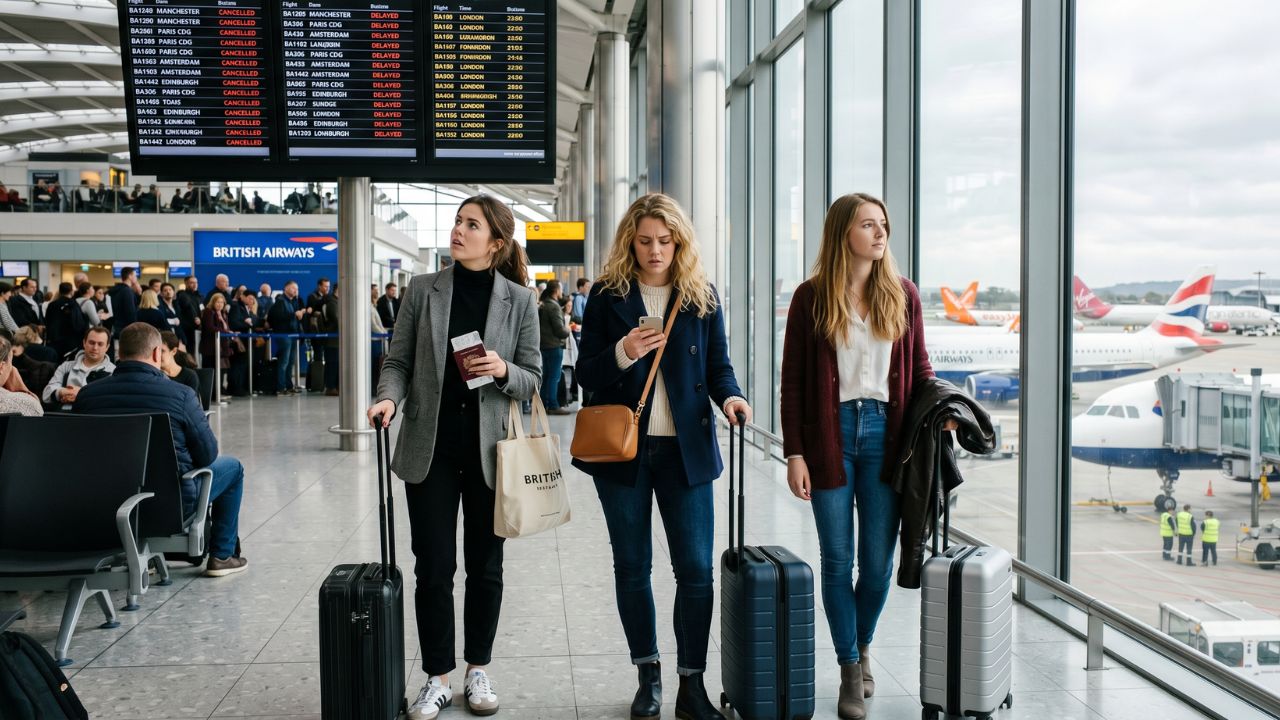
Image generated by AI
A massive wave of systemic travel chaos is violently tearing through the United Kingdom's primary aviation grid today, completely paralyzing operations at London’s most vital international gateways. Reported on June 19, 2026, terminal departure boards across both Heathrow and Gatwick are bleeding red, displaying a devastating 16 sudden flight cancellations alongside an agonizing 479 severe airport disruptions. Major legacy and low-cost carriers, prominently including British Airways, Virgin Atlantic, and easyJet, are actively struggling to manage a massive backlog of stranded passengers. As the intense concentration of rolling delays instantly severs critical domestic and European routes connecting London, Manchester, Paris, and Amsterdam, tens of thousands of travelers are currently trapped in chaotic, highly stressed terminal environments. As desperately overwhelmed airline ground crews attempt to reset their operational boards, the resulting ripple effect across the European continent is driving today's most crucial headline in breaking airline news and essential global aviation updates.
By introducing direct passenger coordination and dynamic scheduling backups, the regional aviation hubs target growing passenger demand across vital commerce sectors. The choice to coordinate flight departures in phases helps to manage gate capacity, supporting the country's broader regional transportation network.
Context: The Collapse of the UK Transit Grid
For the British commercial aviation sector, the sudden, massive travel chaos at Heathrow and Gatwick perfectly illustrates the extreme fragility of the UK's heavily consolidated transit infrastructure.
Historically, traveling by air in and out of London’s major international airports requires razor-thin operational precision. Today, however, that precision has collapsed, transforming the passenger experience into an absolute nightmare. Official flight data monitored by the UK Civil Aviation Authority (CAA) and the National Air Traffic Services (NATS) confirms that the combined 479 delays have pushed the system well past its breaking point. Because both airports are the most critical components of London’s international transport system, even a minor disruption can quickly paralyze travel networks in the UK and abroad. Today's massive operational failure guarantees mathematically that connecting passengers will miss their onward flights. As aircraft rotation delays, crew scheduling adjustments, and severe air traffic sequencing constraints rapidly compound, the knock-on effects are destroying meticulously planned business and leisure itineraries.
To view live flight schedules, verify the active delay status of your specific UK or European itinerary, or to track active regional airspace restrictions, travelers must consult official aviation directories. For direct updates regarding how this massive travel chaos affects specific route abandonments and current flight cancellations out of London, travelers should aggressively utilize the official portals of British Airways, Virgin Atlantic, and easyJet. To explore live flight tracking and monitor the exact severity of the cascading bottlenecks at competitor European mega-hubs, passengers can consult the official FlightAware tracking service.
Section-Wise Breakdown: The Epicenters of Gridlock
The Heathrow Meltdown: Long-Haul Paralysis
The absolute epicenter of the flight cancellations is heavily concentrated at London Heathrow, Europe's busiest long-haul hub. Operating with an incredibly dense mix of intercontinental traffic, Heathrow recorded 14 outright canceled flights alongside a massive 224 delayed departures and arrivals. Because major international carriers like British Airways and Virgin Atlantic are heavily exposed here, the delays on high-frequency transatlantic and Asia-bound routes immediately trap premium and corporate travelers, severing London's most lucrative global commerce links.
The Gatwick Blockade: Short-Haul Devastation
Simultaneously, massive operational challenges have struck London Gatwick, completely disrupting the short-haul and European leisure markets. While Gatwick suffered fewer total cancellations (only 2 flights), it recorded a significantly larger disruption rate of 255 delayed flights. Because low-cost operators like easyJet rely on rapid, back-to-back aircraft turnaround cycles, 255 delays mathematically guarantee that flight crews will eventually time out, threatening a massive wave of sudden evening flight cancellations for tourists attempting to reach Paris or Amsterdam.
Technical Roster: London Aviation Disruption Data
To ensure absolute factual accuracy regarding the exact parameters of this massive systemic collapse and the specific metrics driving the regional flight cancellations, the following matrix details the verified operational data impacting London:
London Hub Disruption Matrix
| Airport Hub | Delayed Flights | Canceled Flights | Total Impact |
|---|---|---|---|
| London Heathrow (LHR) | 224 | 14 | 238 |
| London Gatwick (LGW) | 255 | 2 | 257 |
| Combined London Totals | 479 | 16 | 495 |
Total verified disruption across both hubs currently stands at 16 flight cancellations and 479 delays. Primary carriers severely impacted include British Airways, easyJet, and Virgin Atlantic, directly disrupting routes across London, Manchester, Paris, and Amsterdam. Data utilized from UK CAA, NATS, and FlightAware telemetry.
Passenger Impact: The Eradication of the Connecting Itinerary
For the tens of thousands of travelers attempting to utilize London as a primary transit hub today, the massive volume of 479 delays guarantees a highly stressful, heavily compromised journey.
The immediate passenger impact of this structural travel chaos is the complete destruction of the connecting itinerary. When a massive flagship carrier like British Airways delays over two hundred flights, it completely destroys the intricate web of transatlantic and European connections. A passenger flying from New York into Heathrow who intended to connect onward to Manchester or Amsterdam is now mathematically stranded in London. Because 495 total flights are simultaneously off-schedule, the terminals at Heathrow and Gatwick are overflowing with panicked passengers competing for a highly limited number of customer service agents. The financial toll is catastrophic; inbound tourism flows into London are severely disrupted, affecting hotel check-ins, tour schedules, and cross-country travel itineraries. Corporate business travelers are experiencing massive efficiency losses due to missed meetings, while families are forced to absorb the massive out-of-pocket costs of emergency airport accommodations.
Industry Analysis: The Fragility of UK Airspace
Aviation industry analysts view the systemic breakdown at London Heathrow and Gatwick as definitive proof that the UK aviation grid is highly vulnerable to rapid, unmanageable capacity saturation.
Analysts note that the disturbance during these concurrent disruptions captures the extreme fragility of the UK’s aviation system. The massive volume of 479 delays indicates a fundamental failure in air traffic flow control restrictions, runway utilization limits, and airspace balancing measures overseen by national aviation authorities. The disruption is actively punishing both the legacy full-service network (British Airways, Virgin Atlantic) and the point-to-point low-cost network (easyJet). Industry experts warn that repeated disruption events of this magnitude rapidly destroy passenger confidence, especially during peak travel seasons when airport congestion levels are already violently elevated. Analysts predict that until the systemic congestion is resolved, airlines will be forced to operate with zero operational buffer, guaranteeing that any minor friction instantly triggers massive travel chaos.
Actionable Advice for Navigating the London Gridlock
While standard passengers cannot control NATS air traffic flow restrictions or airline crew scheduling delays, you can execute this strategic survival checklist to actively bypass the travel chaos currently suffocating London:
- Stay Updated via the App, Not the Board: Do not rely on physical terminal screens during massive airport disruptions. Monitor your airline’s mobile app obsessively. When a flight officially cancels, the app will offer digital rebooking options minutes before the terminal screens update, allowing you to secure a seat before the physical crowd panics.
- Audit Your Fare Class Protections: Rebooking flexibility is heavily dependent on ticket conditions and fare classes. If you are flying easyJet on a basic economy fare out of Gatwick, your rebooking priority is mathematically lower than a premium passenger. Immediately familiarize yourself with your specific disruption policy to understand if you are entitled to meal vouchers or hotel stays.
- Bypass the Customer Service Queue: If you are stranded at Heathrow and need to rebook a canceled British Airways or Virgin Atlantic flight, do not join the massive physical line at the service desk. Immediately call the airline’s international customer service number or use their online chat system. Phone agents have identical rebooking power and answer significantly faster.
- Utilize Ground Transport Alternatives: If you are flying domestically within the UK (e.g., London to Manchester) or utilizing the Eurostar route (e.g., London to Paris/Amsterdam) and your flight cancels, immediately abandon the airport and secure a rail ticket. When the UK aviation grid collapses, the high-speed rail network serves as a highly efficient backup that completely bypasses terminal travel chaos.
FAQ: London Airport Disruptions
Why are London Heathrow and Gatwick experiencing massive travel chaos?
The massive UK hubs are suffering from severe operational disruptions resulting in 16 flight cancellations and a staggering backlog of 479 delayed flights, crippling domestic, European, and transatlantic routes.
Which airlines are responsible for the highest number of delays and cancellations?
The disruptions are severely impacting a broad mix of legacy and low-cost carriers, prominently including British Airways, Virgin Atlantic, and easyJet across both major airports.
What should stranded passengers at LHR or LGW do immediately?
Passengers should immediately monitor their airline mobile apps for instant rebooking options, avoid physical customer service lines by utilizing online chat, and actively explore high-speed rail alternatives for domestic or European travel.
The Reality of Combating Hub Saturation
The severe operational gridlock currently paralyzing London Heathrow and Gatwick proves definitively that massive European transit hubs remain entirely susceptible to catastrophic, rolling travel chaos. By absorbing 479 massive delays and 16 flight cancellations across a diverse coalition of legacy and low-cost carriers, the UK demonstrates the extreme volatility of back-to-back scheduling. As British Airways, Virgin Atlantic, and easyJet desperately attempt to shuffle crews to recover their destroyed itineraries—frequently stranding passengers overnight in heavily congested terminals—travelers must accept a critical new reality: surviving the British skies requires aggressive digital rebooking tactics, a thorough understanding of compensation rights, and a ruthless willingness to abandon the airport for the train station the moment the departure board flashes red.
Key Takeaways
- Massive London Gridlock: London Heathrow and Gatwick are currently suffocating under severe travel chaos, reporting a combined 479 delays and 16 flight cancellations.
- Heathrow Cancellations: Heathrow suffered the heaviest cancellation burden, grounding 14 flights alongside 224 severe delays, devastating long-haul transatlantic routes.
- Gatwick Paralyzed: The massive short-haul hub suffered a massive delay footprint, recording 255 delayed departures, threatening sudden low-cost flight cancellations.
- Major Carriers Hit: Legacy carriers British Airways and Virgin Atlantic, along with low-cost giant easyJet, are actively trapped in the operational gridlock.
- Connecting Routes Destroyed: The massive volume of delayed aircraft guarantees missed connections, severing critical routes connecting London, Manchester, Paris, and Amsterdam.
Related Travel Guides
Massive Travel Chaos Paralyzes Chicago O'Hare with 1,425 Disruptions
Disclaimer
This article is for informational and educational purposes only. It does not constitute legal, financial, or professional advice. While we strive to provide accurate and up-to-date information, travel policies, regulations, and conditions change rapidly. Always verify information with official sources before making travel decisions. Nomad Lawyer makes no representations about the accuracy, reliability, completeness, or suitability of the information provided. Readers should consult qualified professionals for advice specific to their circumstances. The views expressed in this article are those of the author and do not necessarily reflect the views of Nomad Lawyer.
Kunal K Choudhary
Co-Founder & Contributor
A passionate traveller and tech enthusiast. Kunal contributes to the vision and growth of Nomad Lawyer, bringing fresh perspectives and driving the community forward.
Learn more about our team →