
London Airspace Breakdown: 900+ Flights Disrupted at Heathrow and Gatwick
Severe thunderstorms cause widespread flight cancellations and delays at LHR and LGW. Analysis of the UK airspace breakd

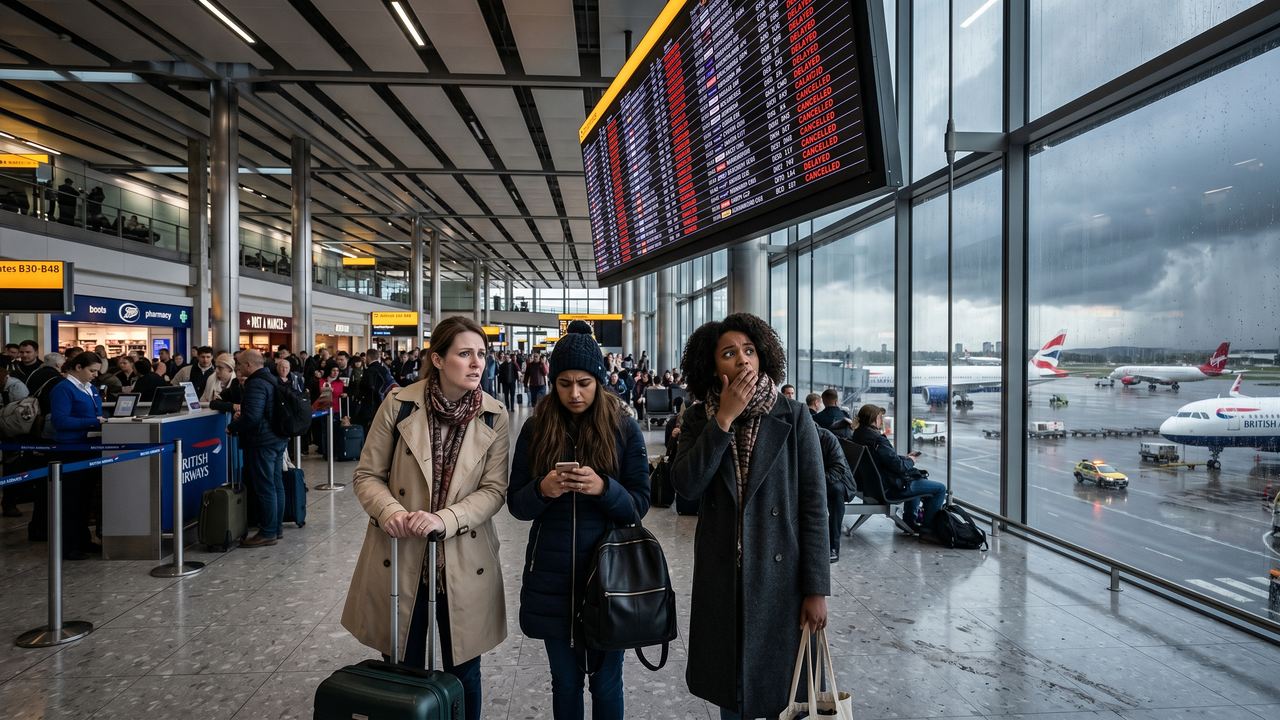
Image generated by AI
The Core Development
On June 29, 2026, a sudden collision between an extreme heatwave and violent storm systems triggered a massive operational failure across London's airspace. The disruption centered on London Heathrow (LHR) and London Gatwick (LGW), where a "capacity compression effect" severely limited runway throughput.
Industry data indicates that the disruption extends beyond simple weather delays. The rapid transition of air masses forced NATS (UK air traffic authority) to implement mandatory aircraft spacing increases and reroute flights around large storm cells. This created a cascading failure affecting aircraft rotations, crew positioning, and gate availability.
Key Facts Breakdown
- Total Disruption: 900+ flights delayed or cancelled.
- Heathrow Impact: 474 flights affected.
- Gatwick Impact: 439 flights affected.
- Passenger Experience: Delays exceeding four hours and sudden cancellations without immediate rebooking.
- Primary Cause: Atmospheric instability moving from extreme heat to thunderstorms.
- Network Effect: Congestion stretching across multiple North-West European countries via Eurocontrol monitoring.
Operational Impact Data
| Airport | Flights Affected | Primary Operational Constraint |
|---|---|---|
| London Heathrow (LHR) | 474 | Reduced runway throughput / Safety spacing |
| London Gatwick (LGW) | 439 | Reduced runway throughput / Safety spacing |
| Total | 913+ | Airspace Fragmentation |
Why This Matters (Analysis)
Our analysis suggests this event is not a standard weather delay but a symptom of "Climate-ATC Compression." The aviation industry is facing a new structural risk where the speed of weather transitions—rather than the severity of the storm itself—outpaces traditional scheduling models.
Market trends indicate that the "hidden layer" of this crisis is Air Traffic Control (ATC) fragmentation. When airspace is dynamically restructured to avoid storm cells, the resulting reduction in air corridor availability creates a bottleneck that persists long after the weather clears.
Furthermore, this event underscores a critical legal friction point regarding EU261 compensation. Because these disruptions are categorized as "extraordinary circumstances" due to ATC safety restrictions, airlines are not legally mandated to provide financial compensation. This creates a significant gap between passenger expectations and regulatory reality.
Industry Outlook
Recovery will not be instantaneous. Full operational stability depends on the efficiency of aircraft repositioning and the resetting of crew duty timers.
Observers expect a rise in "contingency scheduling" as airlines attempt to absorb the backlog. Long-term, this event serves as a warning that aviation resilience in Europe is increasingly compromised by climate volatility, necessitating a shift toward more flexible, real-time operational planning to avoid total network saturation.
Related Travel Guides
Disclaimer
This article is for informational and educational purposes only. It does not constitute legal, financial, or professional advice. While we strive to provide accurate and up-to-date information, travel policies, regulations, and conditions change rapidly. Always verify information with official sources before making travel decisions. Nomad Lawyer makes no representations about the accuracy, reliability, completeness, or suitability of the information provided. Readers should consult qualified professionals for advice specific to their circumstances. The views expressed in this article are those of the author and do not necessarily reflect the views of Nomad Lawyer.
Kunal K Choudhary
Co-Founder & Contributor
A passionate traveller and tech enthusiast. Kunal contributes to the vision and growth of Nomad Lawyer, bringing fresh perspectives and driving the community forward.
Learn more about our team →