
Lithuania Shuts Kaunas Airport and Scrambles NATO Eurofighters After Airborne Drone Incursion Strikes Civilian Vehicle
Kaunas Airport was temporarily closed and NATO scrambled two Italian Eurofighter jets after an unidentified drone entered Lithuanian airspace, leaving debris near Juodzionys.

Air traffic surveillance radar and civil aviation control towers monitoring Baltic regional airspace
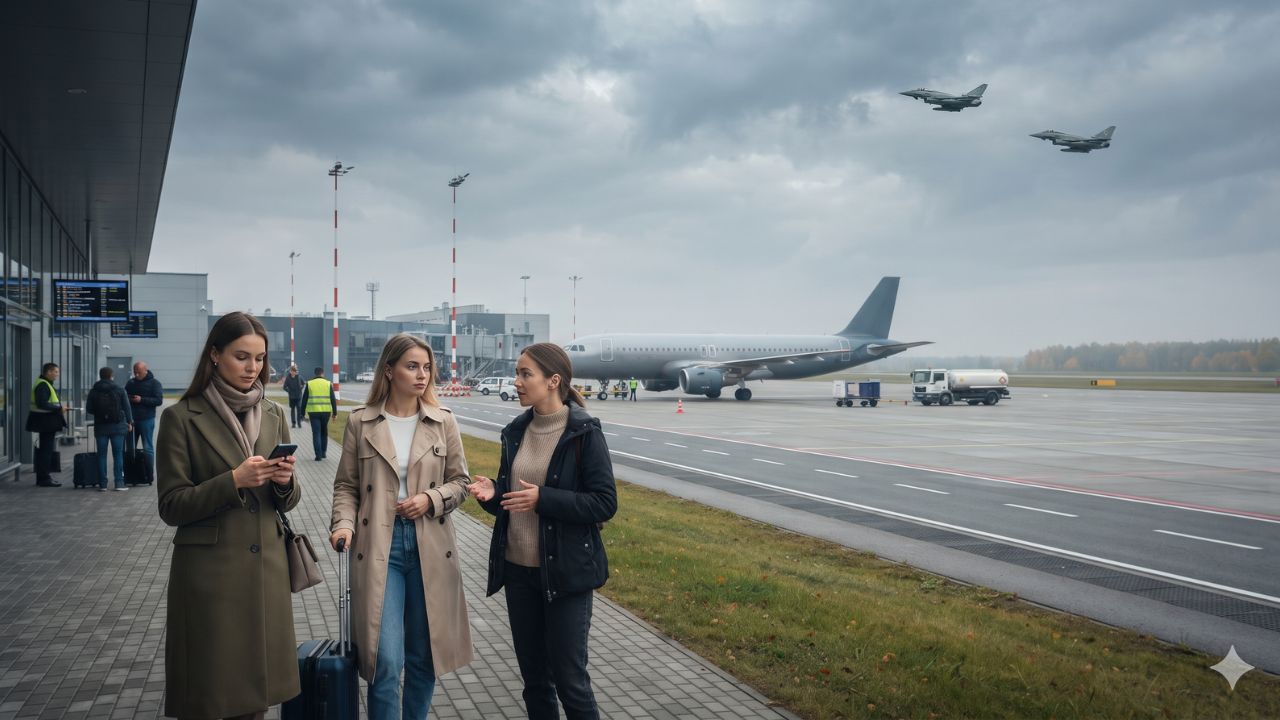
Prompting a mandatory one-hour civilian shelter-in-place order and the emergency suspension of all commercial flight operations at Kaunas Airport, NATO scrambled two Italian Eurofighter Typhoon jets on Sunday, 18 October 2026, following the unauthorized incursion of an unidentified airborne drone into Lithuanian airspace. The security escalation, confirmed by Lithuanian Defence Minister Robertas Kaunas and the National Crisis Management Centre, triggered regional military alerts across the eastern flank of the European Union after the radar contact vanished and physical debris struck a civilian vehicle near the northern village of Juodzionys. While flights across the Baltic nation resumed following the temporary grounding, the incident underscores the vulnerability of civilian air corridors operating adjacent to tense geopolitical frontiers.
The airspace closure illustrates how rapidly military reconnaissance threats can paralyze commercial aviation logistics. With the North Atlantic alliance enforcing Baltic air sovereignty from regional forward operating bases, civil aviation authorities are implementing immediate ground stops whenever uncoordinated radar tracks intersect commercial descent paths, leaving commercial travelers to navigate severe flight rotations, missed connections, and complex passenger protection exemptions.
Chronology of the Airspace Incursion: From Polish Border to Juodzionys Debris
The security alert unfolded on the morning of 18 October 2026, when national radar installations detected an unverified airborne object tracking northeastward. Lithuanian Defence Minister Robertas Kaunas stated that initial telemetry indicated the object crossed into Lithuanian sovereign airspace from the direction of Poland. However, Poland’s military command reported that its domestic radar arrays recorded no confirmed cross-border transit into Lithuania, initiating a multi-jurisdictional verification inquiry.
In response to the potential aerial hazard, NATO Allied Air Command deployed two Italian Air Force Eurofighter Typhoon aircraft operating under the alliance’s Baltic Air Policing detachment. Because dense autumn cloud cover severely restricted horizontal sightlines, the fighter pilots were unable to make definitive visual confirmation before the target disappeared from tracking monitors. Simultaneously, emergency sirens and civil defense broadcasts instructed residents across central and northern administrative districts to seek immediate indoor shelter for approximately one hour. Forensic investigators subsequently cordoned off a debris impact zone near the northern village of Juodzionys, where metal fragments struck a civilian motor vehicle without causing reported casualties.
| Incident Event & Operational Milestones | Documented Timeline / Metric Total | Sovereign Agency & Military Asset | Strategic Civil Aviation Impact |
|---|---|---|---|
| Airspace Intrusion Detection | Sunday morning, 18 October 2026 | Lithuanian Armed Forces Radar | Triggered emergency threat assessment across central and northern sectors |
| Commercial Airport Suspension | Precautionary ground stop enacted | Kaunas Airport (KUN) Administration | Direct suspension of passenger check-in, apron boarding, and incoming arrivals |
| NATO Interception Sortie | 2x Italian Eurofighter Typhoons | NATO Baltic Air Policing Detachment | Scrambled to intercept; visual contact prevented by dense low cloud cover |
| Civil Protection Shelter Order | Approx. 1-hour duration | National Crisis Management Centre | Instructed population to take shelter until radar contact dissipated |
| Debris Impact Site | Juodzionys village, northern Lithuania | Forensic & Defence Ministry Teams | Debris recovered after striking an unoccupied civilian motor vehicle |
| Regional Cross-Border Alert | Yellow air warning enacted | Latvian Civil Aviation & Polish Military | Heightened border surveillance along Suwalki corridor and Baltic approaches |
Regional Spillover: Latvian Air Warnings and the Suwalki Corridor
The incident rapidly reverberated across neighboring flight information regions (FIRs). In response to the unconfirmed flight trajectory, aviation and military authorities in neighboring Latvia briefly enacted a yellow air alert across administrative sectors bordering Lithuania. Simultaneously, Polish air defense units conducted comprehensive sweeps of their eastern border surveillance data to eliminate the possibility of secondary airborne targets traversing the sensitive Suwalki Gap.
For civilian flight operations managed by Lithuanian Airports (LTOU), the temporary ground stop at Kaunas—which serves as the nation’s second-busiest international airport and a vital base for ultra-low-cost European carriers—generated immediate downstream friction. Although Vilnius International Airport (VNO) maintained standard operating status throughout the morning, aircraft turnarounds and crew duty-time limitations triggered cumulative delays across regional connections into Scandinavia, the United Kingdom, and Central Europe.
Legal Framework: Passenger Protections Under EU261 and EASA Guidelines
For commercial passengers caught in sudden airspace shutdowns, navigating statutory rights requires understanding the strict boundary between airline negligence and sovereign security interventions monitored by the European Union Aviation Safety Agency (EASA):
The "Extraordinary Circumstances" Cash Compensation Exclusion
Under European Regulation (EC) No 261/2004, flight cancellations or multi-hour delays caused by military alerts, sovereign airspace closures, or government-mandated airport shutdowns are classified as "extraordinary circumstances." Because these security directives originate entirely outside an airline’s operational control and could not have been avoided even if all reasonable measures were taken, carriers are legally exempt from paying statutory cash compensation (which normally ranges from €250 to €600 per passenger).
The Inviolable Airline "Duty of Care"
However, the exemption from cash compensation does not absolve operating airlines of their mandatory duty of care. Regardless of the military nature of the delay, airlines remain legally obligated to provide stranded passengers with:
- Complimentary meals and refreshments proportionate to the waiting time.
- Two free telephone calls, faxes, or email communications.
- Hotel accommodation and ground transport if a flight is rescheduled for the following day.
- Free rerouting to the final destination on the earliest available flight or a full cash refund of unused ticket coupons if the delay exceeds five hours.
Expert Analysis: The Geopolitical Tightrope of Baltic Commercial Aviation
The Kaunas Airport closure reveals how the normalization of military airspace incursions is quietly reshaping European route economics. For travelers booking this route, the direct consequence is that airlines operating in the Baltic corridor must carry higher fuel reserves and build conservative buffer times into flight schedules to absorb sudden holding patterns and reroutings.
The pricing pressure this creates means air carriers face escalating operational costs that will inevitably filter into baseline ticket prices. When civilian airports close on short notice due to unverified drone tracks, airliners are forced into extended holding patterns or diverted to alternate hubs like Vilnius, Riga, or Warsaw. These unplanned diversions incur steep auxiliary charges for unscheduled ground handling, emergency deplaning, and overnight passenger accommodation, eroding the razor-thin margins of budget carriers that dominate regional travel.
Furthermore, the Baltic region's geographic positioning means air corridors are increasingly constrained between NATO defense patrols and closed Russian and Belarusian airspace. If unauthorized drone incursions become frequent occurrences, aviation insurers may begin re-evaluating risk premiums for regional operators, while commercial airlines may curtail late-evening departures to minimize the risk of stranded crews. Independent travelers transiting the Baltic states must recognize that geopolitical friction points can instantly interrupt standard timetables, making same-day, multi-ticket flight connections inadvisable.
Key Takeaways
- Airport Ground Stop: Kaunas Airport was temporarily closed on 18 October 2026 after an unidentified drone incursion compromised sovereign Lithuanian airspace.
- NATO Scramble: Two Italian Eurofighter Typhoon jets under NATO command were deployed to intercept the object, which evaded visual tracking in heavy cloud cover.
- Civilian Debris Damage: Physical fragments from the airborne object struck a civilian vehicle near the northern village of Juodzionys after the target vanished from radar.
- Emergency Shelter Order: Civil defense authorities instructed citizens across central and northern Lithuania to shelter indoors for approximately one hour during the incident.
- EU261 Compensation Rules: While military airspace shutdowns exempt airlines from paying statutory cash compensation under "extraordinary circumstances," carriers remain legally bound to provide food, drinks, and hotel lodging.
FAQ: Lithuania Airspace Alert and Kaunas Airport Disruption 2026
Why was Kaunas Airport closed on 18 October 2026?
Kaunas Airport temporarily suspended commercial flight operations after military radar detected an unidentified airborne drone, prompting NATO fighter jets to scramble and assess potential airspace threats.
Are passengers entitled to cash compensation for delays caused by the Lithuania airspace alert?
No. Military airspace closures and sovereign security alerts are classified as "extraordinary circumstances" under EU Regulation 261/2004, exempting airlines from paying statutory cash compensation.
What assistance must airlines provide during a military-related flight delay?
Under EU law, airlines must provide a mandatory duty of care, including free food, refreshments, communication access, and complimentary hotel accommodation with transfers if an overnight delay occurs.
What should travelers do if their Baltic flight is affected by an airspace alert?
Passengers should monitor official airline apps and airport departure boards, confirm connecting itineraries on single tickets, and request rebooking or hotel vouchers directly from carrier customer service.
As low-altitude drones challenge conventional air defenses, the Baltic skies demonstrate that civilian travel freedom remains inextricably tied to regional sovereign security.
Related Travel Guides
Paris Louvre Museum Closure and Refund Rights: Visitor Disruption Guide
Bratislava Airport Transit Hub Expansion and Central European Cross-Border Rail Links
10 Best Travel and Safety Tips for Exploring Vilnius and Kaunas, According To Reddit
Disclaimer
This article is for informational and educational purposes only. It does not constitute legal, financial, or professional advice. While we strive to provide accurate and up-to-date information, travel policies, regulations, and conditions change rapidly. Always verify information with official sources before making travel decisions. Nomad Lawyer makes no representations about the accuracy, reliability, completeness, or suitability of the information provided. Readers should consult qualified professionals for advice specific to their circumstances. The views expressed in this article are those of the author and do not necessarily reflect the views of Nomad Lawyer.
Raushan Kumar
Founder & Lead Developer
Full-stack developer with 11+ years of experience and a passionate traveller. Raushan built Nomad Lawyer from the ground up with a vision to create the best travel and law experience on the web.
Learn more about our team →