
LaGuardia Airport Collapse: 404 Cancelations Halt 615+ Flights as Endeavor, Delta, American, JetBlue Network Fails
LaGuardia Airport (LGA) experienced its worst day on record with 404 flights canceled and 211 delayed on March 16, 2026, leaving thousands stranded. Endeavor Air, Republic Airways, American Airlines, Delta, and JetBlue bore brunt as New York, Los Angeles, Chicago, and international routes collapsed.

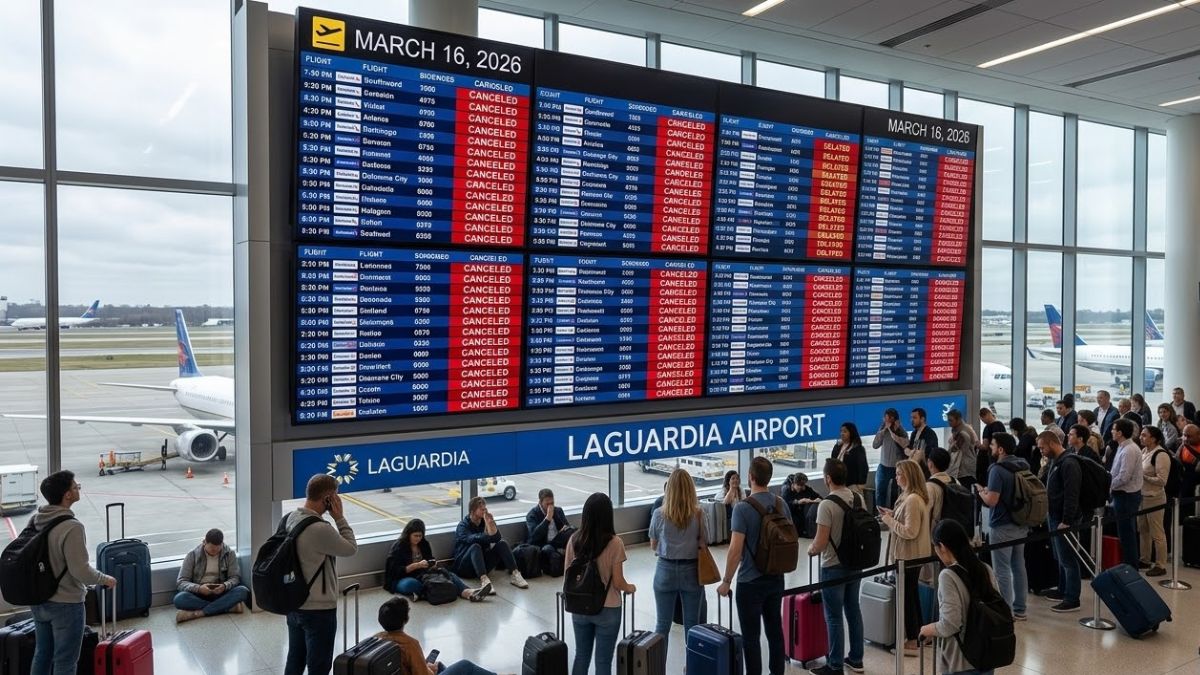
Image generated with AI
Quick Summary
- LaGuardia Airport (LGA) experienced its worst operational day on record with 404 flights canceled and 211 delayed on March 16, 2026, affecting 615+ total disruptions across all terminals
- Carrier breakdown: Endeavor Air canceled 152 flights (74%); Republic Airways 125 cancellations (32%); American Airlines 45 cancellations (45%); Delta 34 cancellations (20%); JetBlue 10 cancellations (35%)
- Network-wide impact: Disruptions radiating from New York to Los Angeles, Chicago, Miami, Washington D.C., Boston, London, and Toronto — affecting thousands of passengers and cascading through international connectivity
- Tourism crisis: New York City losing millions in same-day revenue as hotel bookings, restaurant reservations, and tour operations collapsed; passengers stranded worldwide facing 24-48 hour rebooking queues
LaGuardia Airport descended into complete operational failure on March 16, 2026, when simultaneous disruptions across multiple carriers created a perfect storm that grounded 404 flights and delayed 211 additional departures in a single day. The scale represents the worst aviation disruption at the New York hub in modern history, leaving thousands of passengers stranded across terminals and triggering cascading downstream failures across North America and Atlantic routes.
The collapse proved particularly brutal for Endeavor Air — operating as a regional feeder for Delta Air Lines — which canceled 152 of its own flights (74% of its entire schedule) alongside 13 additional delays (6%). This near-complete network failure triggered a domino effect across the broader regional airline ecosystem.
The Scope of the Catastrophe: 404 Cancellations Across All Carriers
The sheer magnitude separates this disruption from typical operational challenges. A single airport canceling 404 flights represents elimination of an entire day's worth of service for multiple carriers simultaneously. The concurrent 211 delays created a secondary crisis as aircraft scheduled for multiple rotations missed subsequent flight slots, compounding network strain exponentially.
The statistics per carrier reveal the systematic nature of the collapse:
| Carrier | Cancellations | % of Schedule | Delays | % Delayed |
|---|---|---|---|---|
| Endeavor Air | 152 | 74% | 13 | 6% |
| Republic Airways | 125 | 32% | 64 | 16% |
| American Airlines | 45 | 45% | 21 | 21% |
| Delta Air Lines | 34 | 20% | 48 | 28% |
| Southwest Airlines | 16 | 23% | 20 | 29% |
| Spirit Airlines | 12 | 33% | 10 | 27% |
| JetBlue Airways | 10 | 35% | 7 | 25% |
| Other carriers | 10 | — | 28 | — |
Endeavor Air's 74% cancellation rate stands as the most catastrophic single-airline performance, reflecting systemic network-wide failure rather than isolated equipment or staffing problems.
Root Causes: Weather, Maintenance, and Hub Gridlock
Airport officials attributed the cascading failure to converging operational pressures. Severe weather systems across the Northeast created upstream bottlenecks at connecting hub airports. Unscheduled maintenance incidents on critical aircraft pulled key equipment from circulation during peak travel windows. Air traffic control delays at capacity-constrained LaGuardia forced pre-emptive cancellations to prevent exponential downstream cascades.
For regional carriers like Endeavor and Republic, the margin for operational flexibility vanished entirely. A single weather event becoming a maintenance issue becoming an ATC delay created irreversible scheduling collapse.
Network Ripple Effects: From New York to Los Angeles to London
The disruption at LaGuardia didn't remain localized. Flights bound for Los Angeles, Chicago, Miami, Washington D.C., Boston, London, and Toronto all faced cancellations and delays, creating a nationwide disruption pattern.
Transatlantic connectivity proved particularly hard-hit. Business travelers with London connections missed meetings. Leisure travelers lost first nights of European vacations. Tourists from London-Gatwick and Heathrow attempting to reach New York discovered their flights were canceled mid-journey, stranded in incorrect cities.
Canadian routes to Toronto also suffered severe disruptions, affecting North American business connectivity during critical trading week periods.
The Human Catastrophe: Thousands Stranded, Services Overwhelmed
With 615+ total disruptions affecting a single airport hub serving millions monthly, the passenger impact proved massive. Families arriving 3+ hours early for flights discovered gates already closed before boarding began. Business travelers destined for critical meetings rebooked onto flights arriving 24-48 hours later.
Airline customer service centers became overwhelmed as rebooking queues extended 2-3 hours. Many passengers reported:
- Terminal congestion — 10,000+ stranded passengers simultaneously seeking rebooking assistance
- Food service collapse — Airport restaurants exhausted inventory; many closed due to overwhelmed staff
- Hotel availability crisis — Every airport hotel booked solid within 2 hours; stranded passengers forced to drive to outer boroughs
- Ground transportation gridlock — Ride-sharing apps surged pricing 3-5x as demand overwhelmed supply
- Emotional toll — Reports of passengers sleeping on terminal floors, families splitting across multiple rebooking dates, honeymoon delays
Airline-by-Airline Breakdown: Which Carriers Hit Hardest
Endeavor Air bore the most catastrophic impact with 152 cancellations representing 74% of its LaGuardia schedule. Operating as Delta's primary regional feeder, Endeavor's near-total network collapse cascaded directly into Delta's mainline connections, creating compounding failures.
Republic Airways recorded 125 cancellations (32% of schedule) plus 64 delays (16%), indicating systemic operational vulnerability across its entire LaGuardia-based operation.
American Airlines canceled 45 flights (45% cancellation rate) with 21 additional delays (21%), suggesting carrier-specific operational challenges beyond weather or ATC issues.
Delta Air Lines recorded 34 cancellations (20%) plus 48 delays (28%), indicating weather and downstream cascading from Endeavor Air failures rather than primacy issues.
JetBlue, despite lower raw numbers, canceled 10 flights (35% rate), suggesting concentrated impact on specific routes rather than network-wide failure.
NYC Tourism Sector Faces Millions in Lost Revenue
LaGuardia's operational collapse reverberated through New York City's tourism ecosystem in real-time. The city's $70+ billion annual tourism economy depends on reliable airport connectivity — a dependency that evaporated on March 16.
Hotel cancellations cascaded as stranded passengers rebooked onto flights arriving 12-24+ hours late, losing hotel night deposits and advance reservations. Hotels lost same-day revenue from guests forced to overnight in alternative cities.
Restaurant reservations vanished as tourists destined for that evening's Broadway dinner shows and fine dining experiences never arrived. The ripple extended through Times Square attractions, Central Park tours, Empire State Building observation decks — all dependent on international and domestic visitor arrival.
Tour operator disruptions became particularly acute. Group tours scheduled for sightseeing rotations had to reschedule, creating cascading cancellations through Statue of Liberty ferry services, museum tours, bus company bookings — rippling through the entire local economy.
Corporate meeting disruptions impacted business corridors. Executives missing flights to critical deals, conferences, and client meetings created estimated millions in lost business productivity alone.
Passenger Rights Under DOT Regulations
Affected travelers qualify for significant consumer protections under DOT guidelines:
- Full refunds if rebooking is rejected or involves 3+ hour delays
- Meal, hotel, and ground transportation reimbursement for overnight delays
- Compensation ranging from $250-$1,350 depending on delay length and cause classification
Passengers should document all expenses, retain receipts, and maintain airline communications for potential reimbursement claims. Weather and mechanical issues typically qualify as "extraordinary circumstances," potentially limiting compensation — but refunds and care expenses remain guaranteed.
Frequently Asked Questions
Q: What caused the mass cancellations? A: Converging weather systems, unscheduled maintenance, and air traffic control delays combined to create cascading operational failure across multiple carriers simultaneously.
Q: How long will recovery take? A: Typically 24-72 hours post-resolution. However, cascading delays often create secondary disruption waves. Expect elevated delay percentages for 48-96 hours.
Q: Should I avoid LaGuardia for upcoming travel? A: Avoid if possible. Book through alternative NYC-area airports (Newark (EWR), JFK) if schedule flexibility exists. LaGuardia remains capacity-constrained even during normal operations.
Q: Will airlines compensate me if my flight was canceled? A: Yes, typically with rebooking on next available flights at no additional charge. DOT compensation eligibility depends on delay length and cause classification.
Q: What's my best strategy if rebooking on another carrier? A: Contact your original airline first — they often have unbooked premium cabin availability and partner airline codes not visible on consumer booking sites. Agents at call centers access inventory unavailable on apps.
Q: How do I claim expenses for delays? A: Document everything — hotel receipts, meal invoices, ground transportation records. Submit claims to airline within 60 days with supporting documentation. Include FlightAware screenshots confirming cancellation/delay.
Bottom Line
LaGuardia Airport's March 16 collapse represents a systemic failure affecting not just aviation but tourism, commerce, and the broader New York economy. As covered by CNN Travel, Reuters, and Bloomberg, the disruption reveals critical vulnerabilities in regional aviation infrastructure when multiple carriers face simultaneous operational constraints.
Passengers should treat major hub airports like LaGuardia with heightened caution. Build 4+ hour layovers on critical connections, maintain flexible booking policies, and monitor weather systems 48 hours pre-departure. Book through FlightAware to track real-time disruption patterns.
For New York-bound travel, strongly consider alternative airports. Newark and JFK offer greater operational redundancy despite longer ground times. The 30-minute additional ground transportation often proves superior to missing flights entirely at LaGuardia's congested terminals.
Monitor airline communications obsessively, arrive absurdly early, and prepare for operational volatility as the new normal at America's most capacity-constrained major airport.
Disclaimer
This article is for informational and educational purposes only. It does not constitute legal, financial, or professional advice. While we strive to provide accurate and up-to-date information, travel policies, regulations, and conditions change rapidly. Always verify information with official sources before making travel decisions. Nomad Lawyer makes no representations about the accuracy, reliability, completeness, or suitability of the information provided. Readers should consult qualified professionals for advice specific to their circumstances. The views expressed in this article are those of the author and do not necessarily reflect the views of Nomad Lawyer.
Kunal K Choudhary
Co-Founder & Contributor
A passionate traveller and tech enthusiast. Kunal contributes to the vision and growth of Nomad Lawyer, bringing fresh perspectives and driving the community forward.
Learn more about our team →