
KLM Introduces Free Starlink High-Speed Wi-Fi on All Intercontinental Flights Starting Mid-2027
KLM Royal Dutch Airlines will roll out complimentary Starlink low-orbit satellite Wi-Fi across its entire long-haul widebody fleet starting in mid-2027, granting free gate-to-gate high-speed internet to all Flying Blue members.

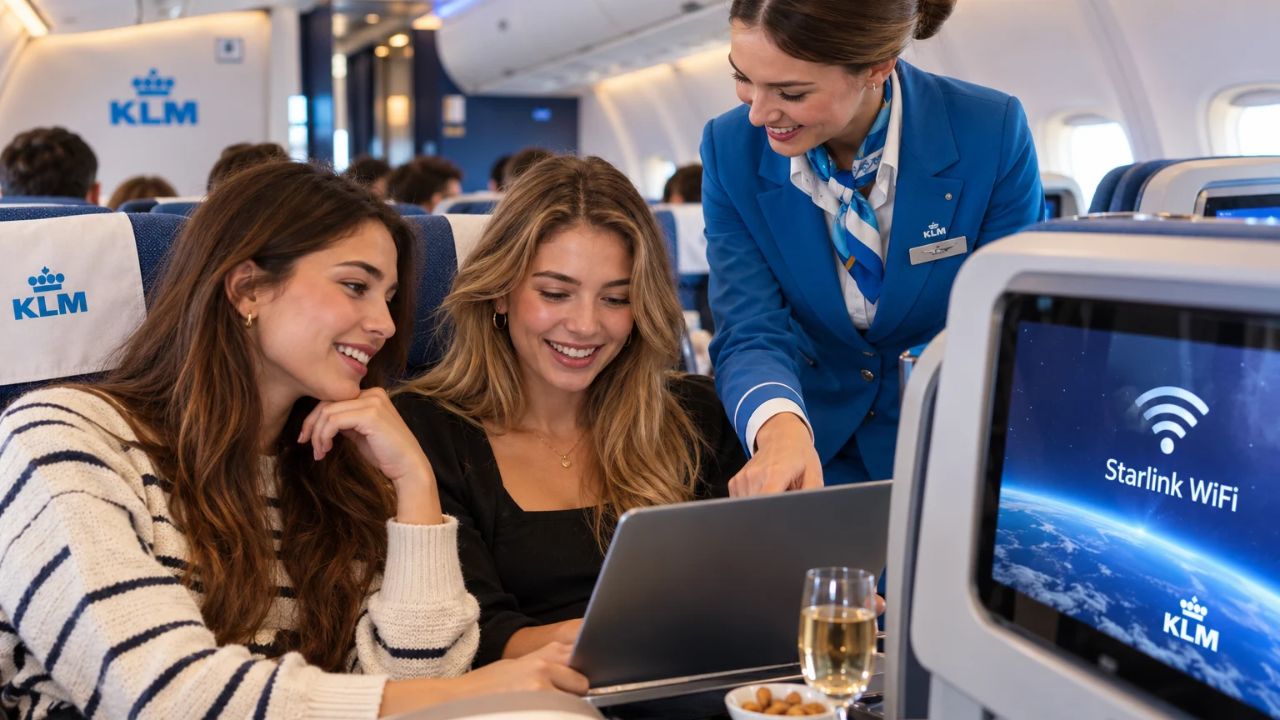
KLM confirms fleet-wide rollout of free high-speed Starlink satellite Wi-Fi across long-haul routes starting mid-2027.
Transatlantic airline passengers have paid up to thirty dollars per flight for sluggish, geostationary satellite internet capped at basic text messaging, but European long-haul aviation is finally abolishing the in-flight paywall. Starting in mid-2027, KLM Royal Dutch Airlines will outfit its complete intercontinental widebody fleet with SpaceX Starlink satellite hardware, offering high-speed, low-latency broadband free of charge to all passengers enrolled in its loyalty program across every cabin tier.
The decision builds on the Dutch flag carrier's earlier deployment of low Earth orbit satellite equipment across its European short and medium-haul fleet at the beginning of 2026. By extending the technology to long-haul routes connecting Amsterdam Airport Schiphol with North America, Latin America, Africa, and Asia, KLM eliminates signal dropouts over oceanic routes while dismantling the legacy practice of treating basic onboard internet as an expensive luxury add-on.
KLM Expands Free High-Speed Connectivity Across Long-Haul Fleet
Operating across lengthy oceanic corridors has long posed significant telecommunication hurdles for commercial air transport. Traditional in-flight Wi-Fi setups connect to geostationary satellites orbiting approximately 35,786 kilometers above Earth. These extreme signal distances create latency exceeding 600 milliseconds, resulting in severe packet loss, buffering delays, and disabled VPN tunnels whenever an aircraft enters sparse satellite coverage zones.
By transitioning to Starlink’s low Earth orbit network orbiting between 540 and 570 kilometers above the planet, KLM reduces airborne ping times down to 25 to 50 milliseconds. This low-orbit mesh network allows travelers to stream 4K video, conduct high-definition Zoom and Teams video calls, transmit large data archives, and play real-time online games at cruising altitudes of 38,000 feet.
Under the rollout framework, access is completely complimentary for all passengers enrolled in the carrier’s Flying Blue Programme, regardless of whether they hold entry-level Explorer status or top-tier Platinum credentials. Passengers who are not yet members can register instantly through the onboard browser portal during flight without incurring any activation fees.
What Makes KLM's Intercontinental Starlink Upgrade Different
The implementation across KLM’s intercontinental fleet marks a fundamental philosophical change in European airline customer service models. Historically, full-service network carriers restricted complimentary Wi-Fi to first-class and business-class suites, requiring economy passengers to purchase hourly passes that often failed to load basic web pages.
KLM's strategy integrates hardware across all widebody platforms, including the Boeing 777-200ER, Boeing 777-300ER, Boeing 787-9, Boeing 787-10 Dreamliners, and Airbus A350 aircraft scheduled to join the fleet. Certified under stringent safety frameworks overseen by the European Union Aviation Safety Agency, the phased-array antennae mount directly onto the aircraft fuselage, eliminating motorized moving parts and minimizing aerodynamic drag.
The initiative mirrors broader fleet modernizations across the Air France-KLM Group, following sister carrier Air France’s commitment to identical network architecture. Other major international airline alliances and groups, including International Airlines Group (IAG), Lufthansa Group, SAS Scandinavian Airlines, Singapore Airlines, and Emirates, are accelerating similar LEO satellite adoptions. Ground transport networks are also embracing the standard, with Italian high-speed rail operator Italo deploying comparable satellite connections across its train fleet starting in mid-2026.
Inflight Internet Evolution: Legacy Systems Versus Starlink Broadband
| Feature / Metric | Legacy Geostationary Inflight Wi-Fi | KLM Starlink Intercontinental Wi-Fi (Mid-2027) |
|---|---|---|
| Satellite Orbit Altitude | ~35,786 km (Geostationary GEO) | ~550 km (Low Earth Orbit LEO) |
| Network Latency | 600 ms – 1,000 ms (high lag) | 25 ms – 50 ms (broadband parity) |
| Download Speeds | 5 Mbps – 25 Mbps shared per plane | Up to 220 Mbps per terminal |
| Pricing Model | Paid tiers (€10 to €30 per flight) | Free for all Flying Blue loyalty members |
| Cabin Availability | Often restricted to Business / First Class | Universal access across Economy, Premium Comfort, and Business |
| Oceanic & Polar Reliability | Frequent dead zones over North Atlantic/Pacific | Continuous coverage via inter-satellite laser links |
| Supported Tasks | Basic messaging, text emails | Live streaming, cloud uploads, VPN access, video calls |
Visitor Insider Tips for Flying Long-Haul on KLM
Travelers booking long-haul flights through Amsterdam Airport Schiphol can maximize their connectivity, comfort, and productivity with several practical insider strategies:
- Sign Up for Flying Blue Before Heading to the Gate: While in-flight registration is available through the portal, pre-linking your Flying Blue number to your booking reservation ensures instant one-click login the moment you board, avoiding sign-up bottlenecks during the initial climb.
- Power Management in KLM Cabins: High-bandwidth data usage drains smartphone and laptop batteries rapidly. KLM’s Boeing 787 Dreamliners and retrofitted Boeing 777 cabins feature universal 110V AC power sockets and high-output USB-A/USB-C ports at every seat in World Business Class, Premium Comfort, and standard Economy. Keep a dedicated USB-C charging cord in your personal cabin bag rather than overhead luggage.
- Optimizing Secure Work Connections: If connecting to corporate networks while crossing the Atlantic, ensure your IT department supports WireGuard or modern IPSec configurations. Older OpenVPN tunnels running over TCP can experience brief renegotiation delays during satellite beam handovers.
- Schiphol Transit Optimization: When transferring between long-haul intercontinental flights and Schengen European hops at Amsterdam Schiphol, use the airport’s automated Privium and self-service passport e-gates to clear border controls rapidly between Piers D, E, F, and G.
Cultural and Aviation Technology Context
The shift toward free, high-speed airborne connectivity represents a decisive turning point for global business travelers and digital nomads. Long-haul intercontinental flights are no longer dead time where work pauses and communication ceases. Instead, the aircraft cabin becomes a fully functioning remote workspace.
By eliminating paywalls through loyalty membership, European aviation is acknowledging that reliable internet is a fundamental passenger expectation rather than a luxury revenue stream. As low Earth orbit satellite constellations expand, the historical performance disparity between terrestrial fiber connections and airborne browsing is rapidly closing, enabling travelers to cross oceans without disconnecting from their professional and personal lives.
FAQ: KLM Free Starlink Wi-Fi Rollout 2027
When will free Starlink Wi-Fi launch on KLM intercontinental flights? Hardware installations on KLM widebody long-haul aircraft begin in mid-2027, rolling out progressively across intercontinental routes connecting Amsterdam with worldwide destinations.
Is KLM Starlink Wi-Fi really free for all passengers? Yes. High-speed access is completely free across Economy, Premium Comfort, and World Business Class for all members enrolled in the Flying Blue loyalty program.
Do I need elite loyalty status to get free Wi-Fi on KLM? No. Free access is available to all Flying Blue members, including free-to-join entry-level Explorer members who sign up before or during the flight.
Will Starlink Wi-Fi work over the middle of the ocean? Yes. Starlink satellites utilize space-based optical laser links to transmit data across oceans and remote polar areas where ground-based base stations do not exist.
Long-haul travel across vast oceans is entering an era where cruising at 38,000 feet feels just as connected as sitting in a downtown cafe.
Related Travel Guides
American Airlines Equips Over 1,000 Aircraft With Starlink Wi-Fi in 2027 Mainline Expansion
Wizz Air Delays Six Abu Dhabi Routes to January 2027 Due to EASA Airspace Advisory
The 10 Best Airlines for In-Flight Wi-Fi in Europe, According To Reddit
Disclaimer
This article is for informational and educational purposes only. It does not constitute legal, financial, or professional advice. While we strive to provide accurate and up-to-date information, travel policies, regulations, and conditions change rapidly. Always verify information with official sources before making travel decisions. Nomad Lawyer makes no representations about the accuracy, reliability, completeness, or suitability of the information provided. Readers should consult qualified professionals for advice specific to their circumstances. The views expressed in this article are those of the author and do not necessarily reflect the views of Nomad Lawyer.
Raushan Kumar
Founder & Lead Developer
Full-stack developer with 11+ years of experience and a passionate traveller. Raushan built Nomad Lawyer from the ground up with a vision to create the best travel and law experience on the web.
Learn more about our team →