
Kenya Airports Authority Issues Urgent Advisory as Aviation Strike Triggers Major Flight Delays in 2026
The Kenya Airports Authority has issued an urgent advisory following widespread flight delays and cancellations at JKIA and other hubs due to aviation workers' strikes.

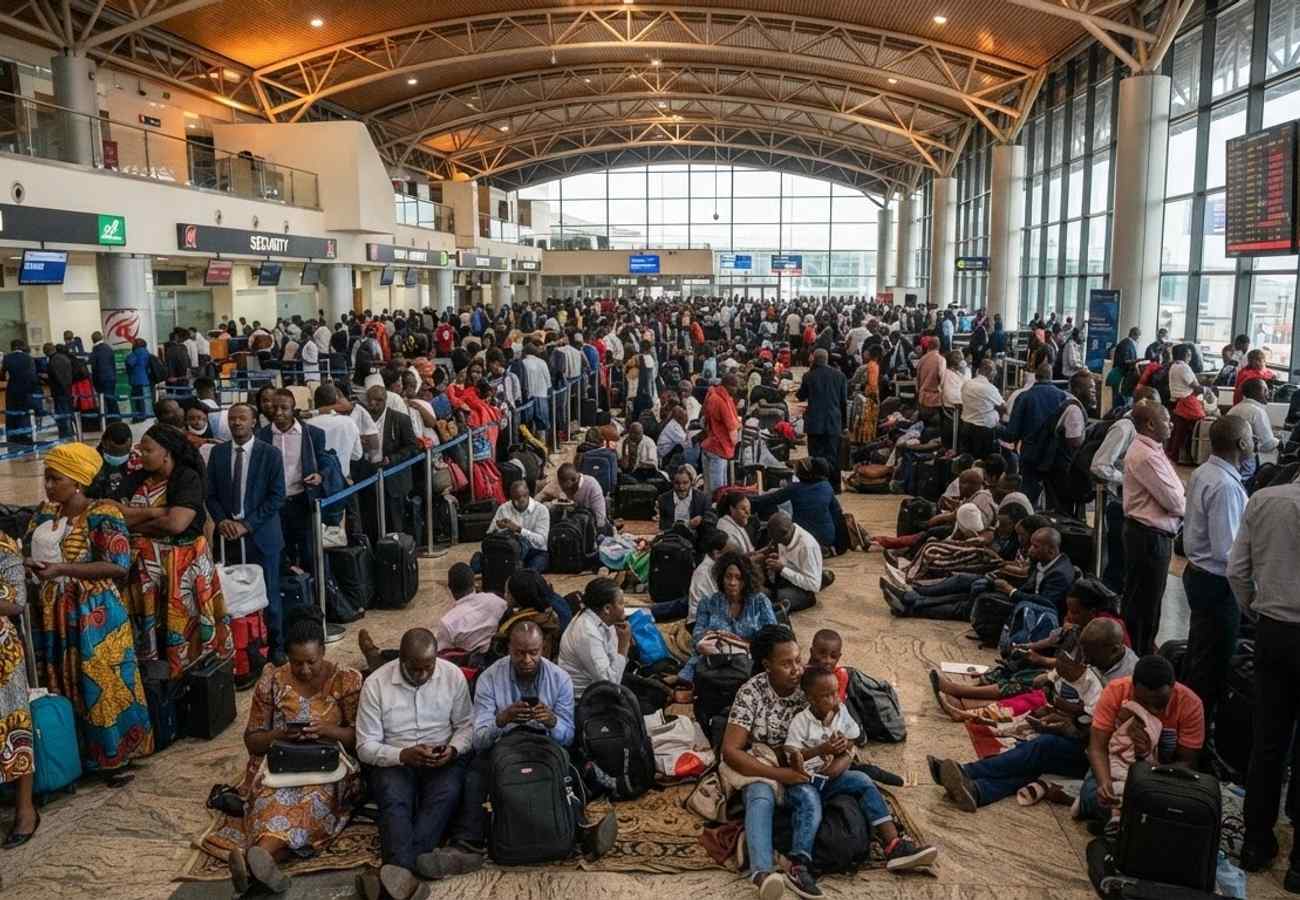
Image generated by AI
Thousands of passengers are stranded across Kenya's primary aviation hubs as a coordinated strike by aviation workers and critical air traffic control constraints trigger systemic flight delays. The Kenya Airports Authority (KAA) issued an urgent advisory on Sunday, August 30, warning that operations at Jomo Kenyatta International Airport (JKIA) and other regional gateways are severely compromised.
Widespread Disruptions Hit JKIA and Regional Hubs
The crisis began to peak on August 30, with the KAA notifying the public that departing flights nationwide are facing prolonged delays. While the impact is felt across the network, the epicenter of the chaos is Nairobi’s Jomo Kenyatta International Airport (JKIA), the primary international gateway for the region.
Reports from the ground describe a scene of mounting frustration, with terminals reaching capacity and passengers facing hours of uncertainty. Flights scheduled for early morning departures on August 30 remained grounded well into the afternoon, creating a backlog that has cascaded through the rest of the flight schedule.
The instability is not limited to the capital. Moi International Airport in Mombasa and Kisumu International Airport in western Kenya have both reported significant operational breakdowns. These regional hubs are particularly affected on routes connecting to Nairobi, as the Nairobi terminal airspace—the central coordination point for the country's aviation traffic—is currently unable to handle standard volumes.
Because JKIA serves as the primary conduit for traffic between Africa, Asia, Europe, and the Middle East, any failure at this central node inevitably ripples outward. Even airports not directly experiencing staff shortages are seeing delays because the central control systems in Nairobi are overwhelmed.
Labor Disputes and Air Traffic Control Failures
The current operational collapse is the result of a two-pronged crisis: industrial action and technical capacity constraints. Members of the Kenya Aviation Workers Union (KAWU) have initiated a strike centered on disputes over remuneration, staffing levels, and deteriorating working conditions.
This labor action has manifested as "go-slows" and complete work stoppages among essential personnel, including:
- Ground handling staff
- Cargo handlers
- Airport support personnel
These shortages have created bottlenecks at critical touchpoints, specifically during check-in, immigration processing, and the boarding sequence at both JKIA and Moi International Airport.
Simultaneously, air traffic control (ATC) limitations have crippled the ability of aircraft to depart on time. Kenya Airways issued a customer update on August 30, explicitly citing ATC constraints at JKIA. The airline reported that departures were facing average delays of two to three hours, though some flights experienced significantly longer wait times.
Industry observers note that the crisis involves a complex overlap of issues affecting both the Kenya Airports Authority and the Kenya Civil Aviation Authority. The latter is responsible for air navigation and traffic control. Long-standing grievances regarding promotions and pay have finally culminated in coordinated action, stripping the airports of their ability to process normal traffic volumes.
Passenger Hardships and Overnight Strands
By August 31, the situation escalated as the strike entered its second day without a resolution in sight. Hundreds of travelers were forced to spend the night in the terminals at JKIA. While some airlines attempted to mitigate the crisis by organizing hotel transfers, many passengers were left on standby with no clear timeline for their departure.
The experience in Mombasa and Kisumu mirrored the chaos in Nairobi, albeit on a smaller scale. At Moi International Airport, the combination of staffing gaps and limited ATC capacity led to rolling delays and outright cancellations for both international tourists and domestic flyers. In Kisumu, passengers reported a severe lack of real-time information, with flights to Nairobi and Mombasa being postponed for several hours without adequate notice.
The human cost of the disruption has been significant. Travelers have reported via social media and local news outlets that the crisis has led to:
- Missed international connections
- Cancelled business engagements
- Abandoned vacation itineraries
- Delays exceeding six hours for single legs of travel
Airlines have maintained that despite the scheduling collapse, safety remains the priority. Carriers insist that flight decisions—whether to delay or cancel—are based on the ability to maintain safe operations under the current staffing constraints.
KAA Directives for Affected Travelers
In response to the volatility, the KAA has urged all passengers to bypass general airport information and contact their airlines directly for route-specific updates. The authority stated it is coordinating with aviation agencies and stakeholders to stabilize operations, but the primary burden of verification currently rests with the traveler.
The official advisory recommends the following:
- Confirm flight status via airline apps or websites before leaving for the airport.
- Allocate significantly more time for security and check-in processes.
- Monitor official airline communication channels for rescheduling notices.
Aviation analysts suggest that this strategy reflects a broader trend of infrastructure operators shifting the responsibility of real-time monitoring to the consumer. In Kenya, where mobile data is the primary source of information, the effectiveness of this approach depends entirely on the responsiveness of the individual airline's digital infrastructure.
Systemic Vulnerabilities in Kenyan Aviation
This crisis has brought renewed scrutiny to the resilience of Kenya's aviation infrastructure. Planning documents from earlier in 2026 had already predicted a surge in traffic through Wilson Airport and JKIA, stressing the urgent need for contingency plans to protect air navigation services from localized labor disruptions.
The current failure highlights a critical vulnerability: the extreme centralization of air traffic control in Nairobi. When the central hub falters, the entire national network—and by extension, regional connectivity—collapses. The inability of the state to resolve labor disputes with the KAWU before they reached a breaking point suggests a fragility in the relationship between the government and the frontline staff who maintain the country's most vital transport link.
As negotiations continue between the unions and state entities, thousands of travelers remain in a state of limbo, waiting for the skies over Nairobi to clear.
Related Travel Guides
Disclaimer
This article is for informational and educational purposes only. It does not constitute legal, financial, or professional advice. While we strive to provide accurate and up-to-date information, travel policies, regulations, and conditions change rapidly. Always verify information with official sources before making travel decisions. Nomad Lawyer makes no representations about the accuracy, reliability, completeness, or suitability of the information provided. Readers should consult qualified professionals for advice specific to their circumstances. The views expressed in this article are those of the author and do not necessarily reflect the views of Nomad Lawyer.
Kunal K Choudhary
Co-Founder & Contributor
A passionate traveller and tech enthusiast. Kunal contributes to the vision and growth of Nomad Lawyer, bringing fresh perspectives and driving the community forward.
Learn more about our team →