
Japan Travel Chaos: Thousands Stranded as Typhoon Jangmi Triggers 439 Flight Cancellations and 458 Delays Across Tokyo and Naha
As severe Typhoon Jangmi paralyzes Japanese aviation hubs, desperate passengers face terrifying travel chaos and massive flight cancellations from All Nippon, ANA Wings, and Jetstar Japan.

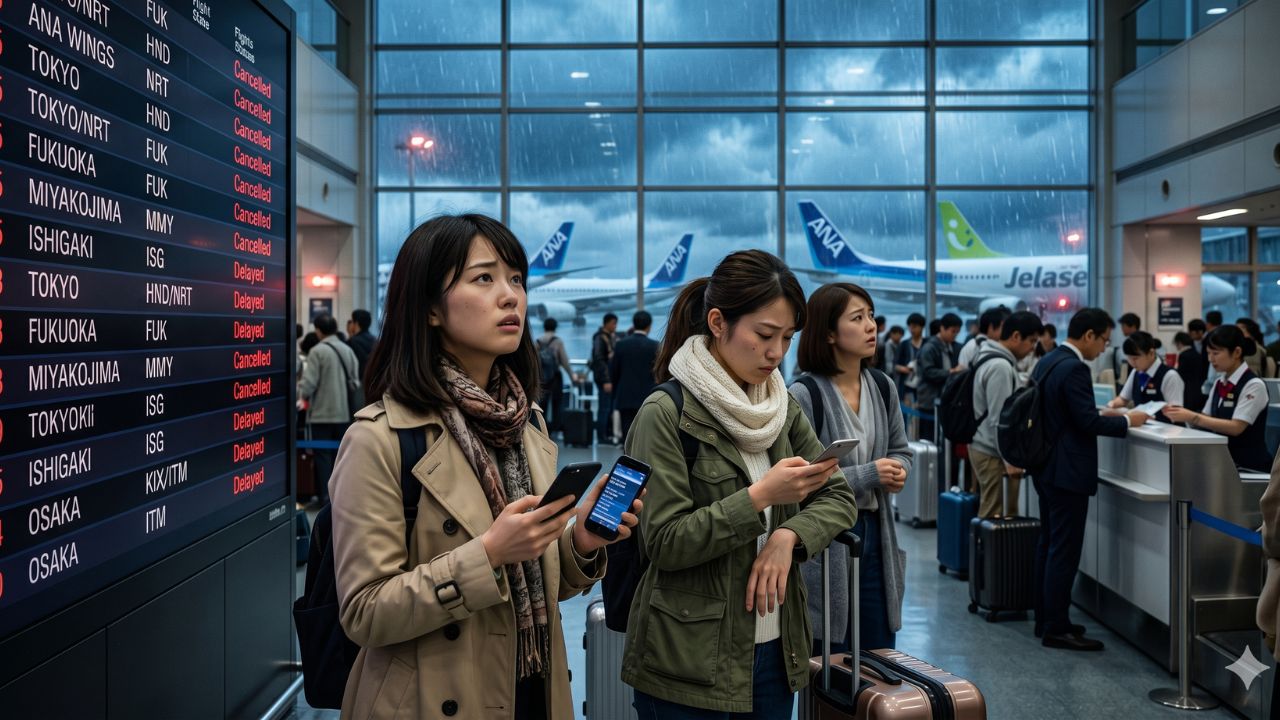
Image generated by AI
A Massive Meteorological Crisis Plunges Japan into Gridlock
While massive sectors of the global passenger network frequently battle highly unpredictable operational bottlenecks, synchronized extreme weather events at major Asian transit hubs remain the absolute most terrifying catalyst for sudden, unmanageable terminal congestion. Delivering highly urgent, breaking airline news, verified international aviation trackers confirm that a catastrophic meteorological crisis is actively generating severe, cascading travel chaos across Japan. Today, May 31, 2026, severe travel distress forcefully emerged as Typhoon Jangmi aggressively advanced along the Pacific coast, forcing massive legacy and regional carriers—including ANA Wings, All Nippon, Solaseed, and Jetstar Japan—to abruptly trigger an astonishing 439 severe flight cancellations and 458 brutal delays, violently paralyzing the nation's critical aviation gateways.
While desperate travelers already attempt to navigate sudden, terrifying airport disruptions caused by massive summer volumes, these exclusive aviation updates reveal that this localized Japanese crisis is aggressively rippling across the entire hemisphere. Thousands of highly vulnerable passengers have been brutally stranded, creating massive disruption for commuters travelling through Naha, Tokyo, Fukuoka, Miyakojima, and beyond. The widespread issues highlight exactly how quickly extreme weather can severely cripple an incredibly fragile interconnected air network, forcing major carriers to violently ground aircraft and completely destroying the itineraries of thousands of domestic and international tourists.
Expanded Overview: The Scale of the Typhoon Crisis
The sudden, highly publicized execution of this massive operational shutdown serves as an undeniable example of how rapidly the world's most critical transit hubs can completely disintegrate under extreme weather threats. According to incredibly urgent official reports from the Japan Meteorological Agency, exceptionally heavy rain at severe warning-level thresholds is forcefully forecast to impact massive areas stretching from the southwestern island of Kyushu all the way to the Kanto region, which directly encompasses the massive capital city of Tokyo.
The terrifying, severe atmospheric conditions are currently being massively aggravated by a highly stagnant frontal system that has completely stalled just north of the typhoon, causing incredibly significant precipitation to violently fall in some areas even before the core of the storm makes its definitive, catastrophic landfall. Exceptionally high cumulative rainfall totals—brutally surpassing 200 to 300 millimetres in specific zones—are heavily anticipated. Consequently, authorities have violently urged strict caution regarding terrifyingly violent winds, massive storm surges, and potentially devastating landslides, resulting in a sweeping, absolute halt to aviation schedules across the entire country.
Section-Wise Breakdown of the Connectivity Crisis
The absolute scale of this terrifying disruption is evidenced by a massive total of 439 flight cancellations and 458 delays officially recorded across several key regional gateways in Japan.
Naha Airport (Serving Naha, Okinawa)
As the massive typhoon approaches the highly vulnerable southern islands, the absolute heaviest initial operational toll was brutally absorbed by Naha Airport. This crucial gateway violently suffered 222 total cancellations and 76 total delays. Japan Transocean Air Co. violently canceled 47 flights (78%), ANA Wings canceled 39 (76%), and All Nippon canceled 35 (68%).
| Airline | Cancelled | Cancelled (%) | Delayed | Delayed (%) |
|---|---|---|---|---|
| Japan Transocean Air | 47 | 78% | 8 | 13% |
| ANA Wings | 39 | 76% | 7 | 13% |
| All Nippon | 35 | 68% | 14 | 27% |
| Skymark | 30 | 76% | 11 | 28% |
| Japan Airlines | 24 | 77% | 11 | 35% |
| Solaseed | 19 | 73% | 5 | 19% |
| Jetstar Japan | 10 | 83% | 3 | 25% |
| Hong Kong Express | 4 | 66% | 1 | 16% |
| Hong Kong Airlines | 4 | 100% | 2 | 50% |
| Japan Air Commuter | 4 | 100% | 0 | 0% |
| Starlux | 2 | 33% | 0 | 0% |
| Korean Air | 2 | 100% | 1 | 50% |
| China Eastern | 2 | 100% | 0 | 0% |
| Thai Vietjet Air | 0 | 0% | 2 | 100% |
| Asiana | 0 | 0% | 1 | 50% |
| Tway Air | 0 | 0% | 1 | 50% |
| Peach Aviation | 0 | 0% | 3 | 8% |
| Eastarjet | 0 | 0% | 1 | 50% |
| Jeju Air | 0 | 0% | 1 | 50% |
| Jin Air | 0 | 0% | 2 | 50% |
| Spring Airlines Japan | 0 | 0% | 1 | 50% |
| Tigerair | 0 | 0% | 1 | 11% |
Tokyo Haneda (Serving Tokyo)
As a primary international and domestic hub, incredibly massive scheduling backlogs were created here, violently logging 72 absolute flight cancellations and 207 massive flight delays. All Nippon and Japan Airlines led the delays with 74 and 73 delayed flights respectively.
| Airline | Cancelled | Cancelled (%) | Delayed | Delayed (%) |
|---|---|---|---|---|
| All Nippon | 30 | 7% | 74 | 18% |
| Japan Airlines | 21 | 4% | 73 | 16% |
| Skymark | 10 | 12% | 11 | 14% |
| Solaseed | 5 | 9% | 4 | 7% |
| Japan Transocean Air | 5 | 41% | 0 | 0% |
| ANA Wings | 1 | 1% | 9 | 9% |
| Air Japan | 0 | 0% | 3 | 20% |
| British Airways | 0 | 0% | 1 | 25% |
| China Airlines | 0 | 0% | 1 | 25% |
| Cathay Pacific | 0 | 0% | 1 | 25% |
| China Southern | 0 | 0% | 1 | 16% |
| Lufthansa | 0 | 0% | 2 | 50% |
| EVA Air | 0 | 0% | 1 | 25% |
| Garuda Indonesia | 0 | 0% | 2 | 100% |
| Philippine Air Lines | 0 | 0% | 4 | 100% |
| Qantas | 0 | 0% | 2 | 50% |
| SAS | 0 | 0% | 2 | 100% |
| StarFlyer | 0 | 0% | 2 | 3% |
| United | 0 | 0% | 4 | 33% |
| Asiana | 0 | 0% | 2 | 25% |
| Air Do | 0 | 0% | 4 | 8% |
| Air France | 0 | 0% | 2 | 33% |
Fukuoka Airport (Serving Fukuoka)
Located on the highly vital southwestern island of Kyushu, this incredibly massive transport link faced considerable operational hindrances, resulting in 27 flight cancellations and 63 severe delays.
| Airline | Cancelled | Cancelled (%) | Delayed | Delayed (%) |
|---|---|---|---|---|
| ANA Wings | 11 | 26% | 4 | 9% |
| Japan Transocean Air | 9 | 75% | 1 | 8% |
| Skymark | 4 | 11% | 9 | 25% |
| Solaseed | 2 | 100% | 0 | 0% |
| All Nippon | 1 | 2% | 10 | 20% |
| China Airlines | 0 | 0% | 3 | 60% |
| Cathay Pacific | 0 | 0% | 2 | 50% |
| Hong Kong Airlines | 0 | 0% | 2 | 100% |
| Eastarjet | 0 | 0% | 3 | 23% |
| EVA Air | 0 | 0% | 3 | 50% |
| Greater Bay Airlines | 0 | 0% | 1 | 25% |
| Hong Kong Express | 0 | 0% | 3 | 37% |
| Vietnam Airlines | 0 | 0% | 1 | 50% |
| Ibex | 0 | 0% | 2 | 12% |
| Japan Airlines | 0 | 0% | 5 | 6% |
| Jeju Air | 0 | 0% | 1 | 7% |
| Jetstar Japan | 0 | 0% | 2 | 8% |
| Jin Air | 0 | 0% | 2 | 16% |
| Korean Air | 0 | 0% | 1 | 12% |
| Oriental Air Bridge | 0 | 0% | 3 | 11% |
| Philippine Air Lines | 0 | 0% | 1 | 50% |
| Thai Airways | 0 | 0% | 1 | 50% |
| Tigerair | 0 | 0% | 1 | 25% |
| Amakusa Airlines | 0 | 0% | 1 | 16% |
| Thai AirAsia | 0 | 0% | 1 | 50% |
Miyako Airport (Serving Miyakojima)
The regional airfield brutally experienced severe constraints due to its southern geographic position, with 32 cancellations and 4 massive delays recorded.
| Airline | Cancelled | Cancelled (%) | Delayed | Delayed (%) |
|---|---|---|---|---|
| Japan Transocean Air | 15 | 78% | 3 | 15% |
| ANA Wings | 13 | 92% | 1 | 7% |
| All Nippon | 4 | 100% | 0 | 0% |
Kagoshima Airport (Serving Kirishima)
Operations were violently restricted by the advancing storm front, leading to 20 cancellations and 33 delays being heavily documented.
| Airline | Cancelled | Cancelled (%) | Delayed | Delayed (%) |
|---|---|---|---|---|
| Japan Air Commuter | 14 | 36% | 16 | 42% |
| Japan Airlines | 4 | 8% | 7 | 14% |
| Solaseed | 2 | 12% | 0 | 0% |
| All Nippon | 0 | 0% | 2 | 18% |
| Jetstar Japan | 0 | 0% | 2 | 100% |
| Skymark | 0 | 0% | 1 | 4% |
| ANA Wings | 0 | 0% | 5 | 31% |
New Ishigaki Airport (Serving Ishigaki)
Pre-emptive safety measures violently resulted in a notable suspension of services, with 32 flight cancellations and 7 flight delays officially registered.
| Airline | Cancelled | Cancelled (%) | Delayed | Delayed (%) |
|---|---|---|---|---|
| Japan Transocean Air | 13 | 72% | 4 | 22% |
| ANA Wings | 13 | 92% | 1 | 7% |
| All Nippon | 4 | 80% | 0 | 0% |
| Solaseed | 2 | 50% | 1 | 25% |
Central Japan International Airport / Centrair (Serving Tokoname)
Flight paths through the Chubu region were visibly, terrifyingly compromised, leading to 22 cancellations and 25 delays.
| Airline | Cancelled | Cancelled (%) | Delayed | Delayed (%) |
|---|---|---|---|---|
| Japan Transocean Air | 5 | 71% | 1 | 14% |
| Skymark | 5 | 31% | 3 | 18% |
| ANA Wings | 5 | 17% | 1 | 3% |
| All Nippon | 3 | 18% | 3 | 18% |
| Jetstar Japan | 2 | 25% | 2 | 25% |
| Solaseed | 2 | 20% | 0 | 0% |
| Fuji Dream | 0 | 0% | 2 | 33% |
| Vietnam Airlines | 0 | 0% | 1 | 25% |
| Ibex | 0 | 0% | 1 | 5% |
| Japan Airlines | 0 | 0% | 5 | 31% |
| Philippine Air Lines | 0 | 0% | 1 | 50% |
| Singapore Airlines | 0 | 0% | 1 | 20% |
| Starlux | 0 | 0% | 1 | 50% |
| Unknown Owner | 0 | 0% | 2 | 200% |
| China Airlines | 0 | 0% | 1 | 20% |
Osaka International Airport / Itami (Serving Itami)
Significant network-wide knock-on effects were heavily felt at this massive domestic base, where 12 cancellations and 43 massive delays were officially finalized.
| Airline | Cancelled | Cancelled (%) | Delayed | Delayed (%) |
|---|---|---|---|---|
| All Nippon | 8 | 13% | 9 | 15% |
| Japan Airlines | 3 | 1% | 19 | 11% |
| ANA Wings | 1 | 0% | 11 | 8% |
| Amakusa Airlines | 0 | 0% | 1 | 50% |
| Ibex | 0 | 0% | 2 | 11% |
| Japan Air Commuter | 0 | 0% | 1 | 16% |
Passenger Impact: Navigating the Weather Emergency
For the modern domestic and international commuter attempting to navigate this highly volatile Japanese corridor, the passenger impact of this massive meteorological meltdown is completely exhausting. The substantial disruption across key aviation nodes is heavily expected to violently influence travel patterns and logistical planning within Japan for the entire remainder of the week.
- Avoid the Airports: Travel to violently affected airports—including those located in Miyakojima, Kirishima, Ishigaki, Tokoname, and Itami—should generally be completely avoided if a cancellation has already been explicitly confirmed.
- Demand Rebooking: When flight cancellations or major delays are violently caused by force majeure events such as Typhoon Jangmi, standard alternative arrangements or massive full cash refunds are generally offered by legacy carriers like All Nippon and Jetstar Japan.
- Stay Informed: Regular weather updates are published by the Japan Meteorological Agency regarding the terrifying path of the typhoon.
Conclusion: A Highly Volatile Japanese Crisis
The massive, highly publicized operational failure of the Japanese aviation network represents a severe, terrifying crisis for the Asian travel sector. By actively forcing passengers to endure 439 flight cancellations and 458 severe delays amidst Typhoon Jangmi, the airline industry guarantees an incredibly stressful, highly exhausting journey. As the operational teams frantically battle this massive terminal gridlock, passengers are heavily urged to aggressively monitor their bookings, strictly remain indoors, and fully expect massive, cascading flight disruptions amidst unprecedented Pacific travel chaos.
Key Takeaways
- Massive Network Meltdown: Severe weather triggered 439 complete flight cancellations and 458 massive delays across Japan.
- Naha Airport Severed: The crucial southern gateway violently suffered 222 cancellations and 76 severe delays.
- Tokyo Hub Gridlock: Tokyo Haneda brutally experienced 72 cancellations and an incredibly terrifying 207 delays.
- Carrier Operations Crippled: All Nippon, ANA Wings, Solaseed, and Jetstar Japan radically grounded hundreds of their massive jets.
- Passenger Survival Tactics: Travelers are aggressively urged to avoid traveling to affected airports and rapidly demand massive weather-related refunds.
Disclaimer: The specific cancellation metrics, delayed flight volumes, and airline operational failures presented in this report are based on verified flight tracking data from FlightAware regarding the Japanese network disruption caused by Typhoon Jangmi on May 31, 2026. Official airline routing, terminal congestion levels, and final ticket rebooking options are highly volatile and subject to continuous, real-time update based on active carrier operational directives and federal weather emergency mandates. Prospective passengers are urgently advised to fiercely monitor their specific booking status and verify active flight schedules directly via the airline's official portal prior to airport arrival.
Disclaimer
This article is for informational and educational purposes only. It does not constitute legal, financial, or professional advice. While we strive to provide accurate and up-to-date information, travel policies, regulations, and conditions change rapidly. Always verify information with official sources before making travel decisions. Nomad Lawyer makes no representations about the accuracy, reliability, completeness, or suitability of the information provided. Readers should consult qualified professionals for advice specific to their circumstances. The views expressed in this article are those of the author and do not necessarily reflect the views of Nomad Lawyer.
Kunal K Choudhary
Co-Founder & Contributor
A passionate traveller and tech enthusiast. Kunal contributes to the vision and growth of Nomad Lawyer, bringing fresh perspectives and driving the community forward.
Learn more about our team →