
Japan Enacts Sweeping 2026 Inflight Battery Ban, Outlawing Power Bank Usage Inthe Cabin as Lithium-Ion Fire Fears Escalate
As of April 2026, Japan has implemented strict new aviation safety regulations prohibiting the use and charging of power banks on all flights within and departing from the country. The sweeping measures aim to mitigate the rising threat of catastrophic lithium-ion battery fires and thermal runaway in aircraft cabins.

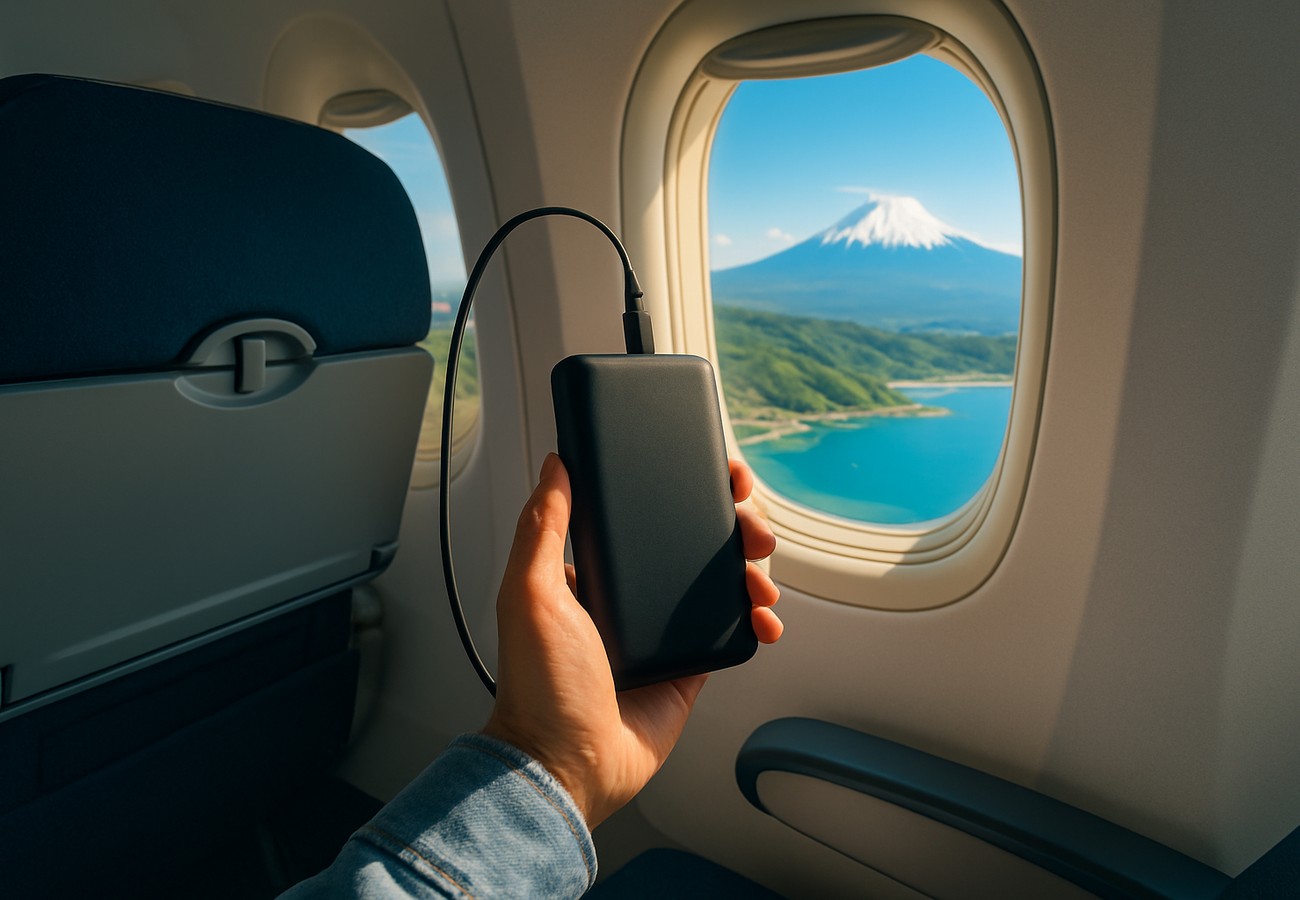
Image generated by AI
Japan Enacts Sweeping 2026 Inflight Battery Ban, Outlawing Power Bank Usage In the Cabin as Lithium-Ion Fire Fears Escalate
In a Major Implementation of Aviation Safety Guidelines, Passengers on Flights To and From Japan Are Now Strictly Prohibited from Charging Electronic Devices Using Personal Power Banks Mid-Flight
TOKYO, Japan — Air travel to, from, and within Japan has fundamentally changed regarding how passengers manage their personal electronics. Effective April 2026, Japanese aviation authorities have rolled out sweeping new safety regulations targeting one of the industry's fastest-growing threats: lithium-ion battery fires. Under the new directive, the inflight use and charging of all personal power banks is strictly prohibited on all flights operating within and departing from Japan. While passengers are still permitted to carry compliant power banks in their cabin baggage, the act of plugging a device into a power bank — or plugging the power bank into an aircraft's seat outlet — is now an actionable safety violation. The proactive move positions Japan at the forefront of a global regulatory shift aimed at eliminating the catastrophic risk of "thermal runaway" in confined aircraft cabins.
Quick Summary
- New Regulation: Starting April 2026, Japan has banned the use and charging of power banks during flights.
- Scope: Applies to all flights operating within Japan and departing from Japan.
- Carriage Limits: Power banks may still be brought onboard, but strict new limits on watt-hour capacity and the number of devices per passenger are now heavily enforced at security checkpoints.
- The Threat: The regulations are designed to prevent thermal runaway — a chain reaction that causes lithium-ion batteries to overheat, catch fire, or explode.
- Enforcement: Major hubs like Tokyo and Osaka have deployed extensive signage, and flight crews have been granted enhanced training to monitor and enforce the ban mid-flight.
The Ban on Inflight Charging: Why Now?
The cornerstone of Japan's 2026 aviation update is the absolute prohibition on utilizing power banks while airborne. Passengers are explicitly instructed that power banks must remain disconnected from both personal devices (such as smartphones and laptops) and the aircraft's own power outlets for the entire duration of the flight.
The rationale is rooted in thermal dynamics. Aviation safety experts have identified that lithium-ion batteries are most vulnerable to malfunctioning when they are actively discharging energy (charging a phone) or receiving energy (being charged via a seat outlet). In the highly pressurized, confined environment of an aircraft cabin, an actively venting battery poses an unpredictable and severe fire hazard. By forcing power banks to remain dormant during flight, authorities dramatically reduce the mathematical probability of a battery entering a hazardous state.
Thermal Runaway: The Invisible Threat
The scientific catalyst driving these stricter measures is a phenomenon known as thermal runaway. When a lithium-ion battery is damaged, improperly manufactured, or exposed to excessive heat, its internal temperature cascades uncontrollably. This chemical chain reaction cannot easily be extinguished with standard water or chemical extinguishers, often resulting in sudden, violent fires and the emission of highly toxic gases.
While the International Civil Aviation Organization (ICAO) and the International Air Transport Association (IATA) have heavily documented these risks globally, Japan's approach represents a proactive, rather than reactive, regulatory stance. Rather than waiting for a major domestic tragedy to dictate policy, Japanese authorities are preemptively removing the highest-risk variable from the cabin environment.
Tighter Limits on Capacity and Quantity at Security
Alongside the inflight usage ban, Japan has tightened the rules on getting power banks onto the plane in the first place. Pre-boarding checks at airports across Japan now rigorously enforce new limitations:
- Watt-Hour Thresholds: Devices must fall within specified, globally aligned safe watt-hour (Wh) limits. High-capacity external batteries frequently used by photographers or remote workers face heightened scrutiny and potential outright prohibition.
- Quantity Caps: Passengers are now limited in the total number of battery devices they can carry, addressing the cumulative risk of having dozens of lithium-ion cells clustered in overhead bins.
- Cabin Baggage Only: As per existing global standards, all loose lithium-ion batteries and power banks must never be placed in checked luggage.
At major hubs like Tokyo Haneda, Tokyo Narita, and Osaka Kansai, airport authorities have saturated terminals with informational signage, while airlines are actively pushing awareness campaigns during the ticket booking and digital check-in processes to prevent confiscation bottlenecks at security.
What This Means for Passengers Traveling in 2026
For the modern traveler highly reliant on constant connectivity, the ban fundamentally alters travel preparation. If you are flying to, from, or within Japan, you must adjust your inflight habits:
- Board Fully Charged: You can no longer rely on your personal power bank to resurrect a dead smartphone battery mid-flight. Ensure all devices are at 100% before boarding.
- Use Aircraft Power (If Available): Passengers may still plug their devices directly into the aircraft's built-in USB or AC seat power outlets using a standard plug or cable. You just cannot use your own external battery pack.
- Check Device Specifications: Before heading to the airport, read the fine print printed on your power bank. If the watt-hour (Wh) rating is rubbed off or illegible, security agents in Japan will likely confiscate it.
A Global Precedent for Aviation Safety
As electronic devices become increasingly ubiquitous, the aviation industry faces a difficult balancing act between passenger convenience and uncompromising safety. Japan's 2026 regulations signal that when those two concepts conflict, safety will definitively override convenience. Given Japan's influential status in global aviation, industry analysts expect other national aviation authorities to closely monitor the success of this policy, likely using it as a blueprint to implement similar inflight battery bans globally over the coming decade.
FAQ: Japan's 2026 Inflight Battery Regulations
Q: Can I still bring my power bank on a flight to Japan? A: Yes. You are still permitted to carry power banks in your carry-on baggage only. However, they must meet strict watt-hour capacity limits, and there is a cap on how many you can bring. They must never be placed in checked luggage.
Q: What exactly does the new inflight ban prohibit? A: Starting in April 2026, you are strictly prohibited from using or charging your power bank while onboard the aircraft. You cannot plug it into your phone to charge it, nor can you plug the power bank into the plane's seat outlet to recharge the battery itself.
Q: Can I use the aircraft's USB ports or power outlets to charge my phone? A: Yes. The ban specifically targets personal lithium-ion power banks. Plugging your phone directly into the aircraft's built-in seat power system using a standard charging cable remains permissible.
Q: Why was this rule introduced? A: To prevent thermal runaway — a chain reaction that causes lithium-ion batteries to overheat and catch fire. Batteries are at their highest risk of malfunctioning while actively discharging or receiving power.
Q: Does this apply to all airlines? A: The regulation applies to all flights operating domestically within Japan and all international flights departing from Japanese airports, regardless of the airline carrier.
Disclaimer
This article is for informational and educational purposes only. It does not constitute legal, financial, or professional advice. While we strive to provide accurate and up-to-date information, travel policies, regulations, and conditions change rapidly. Always verify information with official sources before making travel decisions. Nomad Lawyer makes no representations about the accuracy, reliability, completeness, or suitability of the information provided. Readers should consult qualified professionals for advice specific to their circumstances. The views expressed in this article are those of the author and do not necessarily reflect the views of Nomad Lawyer.
Raushan Kumar
Founder & Lead Developer
Full-stack developer with 11+ years of experience and a passionate traveller. Raushan built Nomad Lawyer from the ground up with a vision to create the best travel and law experience on the web.
Learn more about our team →