
Japan Airlines and ANA to Implement First Coordinated Domestic Flight Schedules in 2026
Japan Airlines and All Nippon Airways are ending decades of head-to-head competition to align domestic timetables, aiming to reduce airport congestion and improve regional connectivity across Japan.

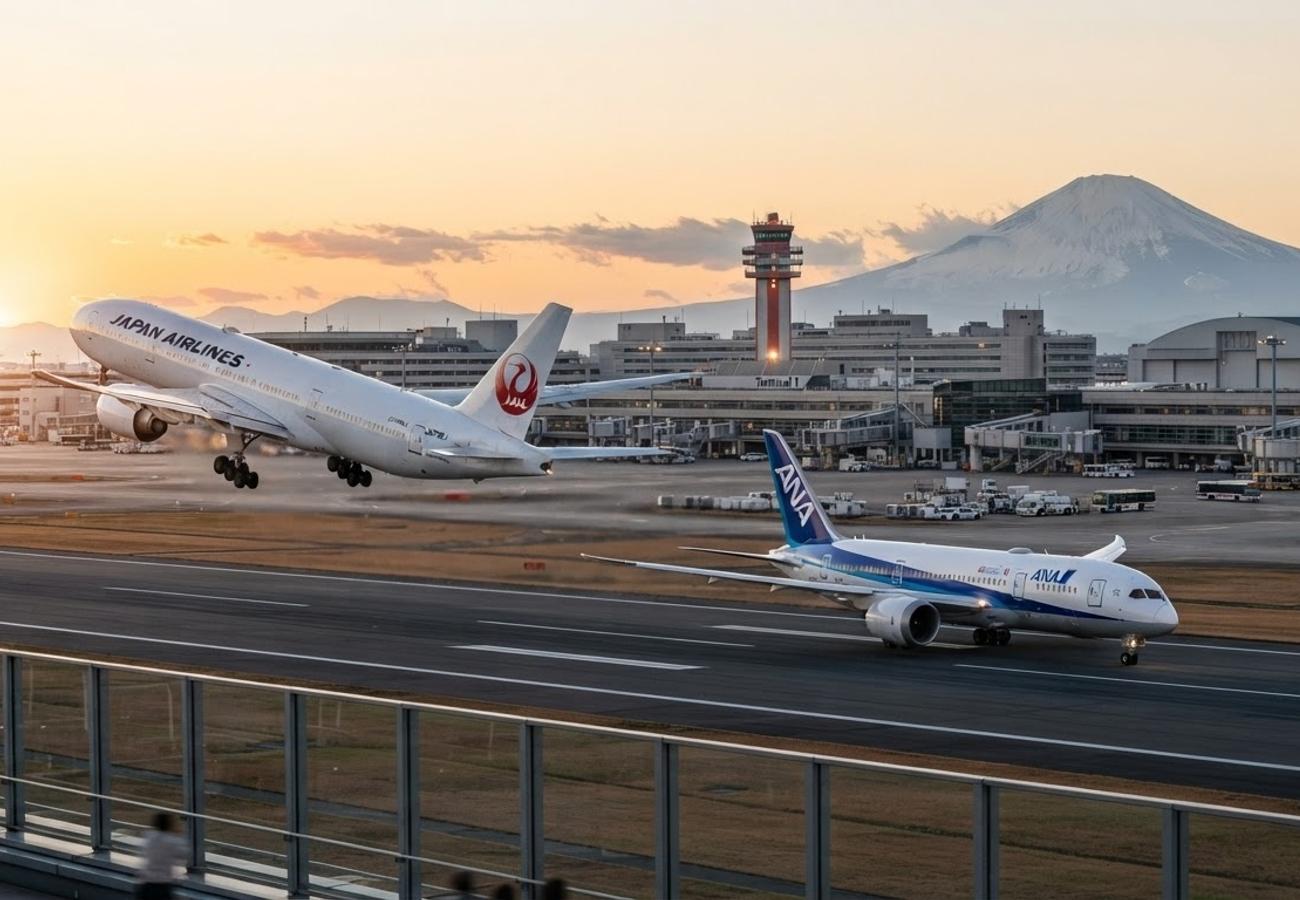
Image generated by AI
Japan Airlines (JAL) and All Nippon Airways (ANA) are preparing to align domestic timetables for the first time in history. This strategic shift aims to eliminate redundant departures and mitigate peak-hour crowding at Japan's primary aviation hubs.
Strategic Shift in Japanese Aviation
For decades, the domestic aviation market in Japan has been defined by aggressive, head-to-head competition between Japan Airlines and All Nippon Airways. The two carriers traditionally maintained parallel networks, often scheduling near-duplicate departures on high-traffic trunk routes. However, emerging industry briefings and business reports indicate a transition toward limited coordination of schedules on select domestic routes.
This collaboration is not focused on joint pricing, but rather on operational efficiency. By staggering departure times, the carriers intend to smooth out demand and reduce the clustering of flights in narrow time bands. This move is a direct response to shifting travel patterns, an aging population, and a documented decline in traditional business travel.
Route Alignment and Operational Focus
The coordination effort primarily targets "trunk routes"—the high-volume corridors linking Tokyo with major regional centers. The objective is to move away from a model of frequency battles toward a model of coordinated coverage.
Primary Impact Zones and Route Specifications
| Route Category | Primary City Pairs | Coordination Objective | Expected Outcome |
|---|---|---|---|
| Major Trunk Routes | Tokyo $\leftrightarrow$ Osaka, Fukuoka, Sapporo | Staggered departure windows | Reduced security and runway queuing |
| Regional Feeders | Tokyo $\leftrightarrow$ Small Regional Airports | Aligned arrival/departure gaps | Better utilization of terminal facilities |
| Tourism Corridors | Tokyo $\leftrightarrow$ Island/Countryside Hubs | Sequenced connectivity | Improved multi-destination itineraries |
Traveler Logistics Guide: Navigating the New System
From a ground-level perspective, the best way to navigate these changes is to move away from the assumption that "there is always another flight in 15 minutes" on major routes. While overall capacity remains stable, the timing of that capacity is shifting.
Booking Connections and Layovers If you are connecting from a regional flight to a long-haul international service at Tokyo Haneda, the coordinated schedules should theoretically improve minimum connection times (MCT). However, because these changes are being rolled out gradually, travelers should verify their specific connection windows during the seasonal timetable load.
Navigating Airport Congestion The primary benefit for the passenger is the reduction of "peak-hour spikes." By alternating departures between JAL and ANA, the carriers aim to distribute passenger flow more evenly across security checkpoints and boarding gates. Travelers can expect a more consistent experience throughout the day rather than extreme crowding during traditional business rush hours.
Digital Transit Integration For those utilizing digital transit tools like Digi Yatra or similar biometric boarding systems in Japan, these schedule shifts will likely result in smoother throughput at automated gates, as the volume of passengers arriving at the terminal will be more evenly spread.
Infrastructure and Regional Impact Assessment
The ripple effects of this coordination extend beyond the aircraft. Regional airports, which often suffer from "dead periods" where terminals are empty for hours followed by a sudden rush of simultaneous JAL and ANA arrivals, will see a more balanced operational flow. This is particularly beneficial for tourism-focused regions promoting island-hopping or combined city-and-countryside trips, as connections become more predictable.
However, this move invites scrutiny from competition authorities. Because JAL and ANA hold a dominant share of the domestic market, regulators are monitoring the alignment to ensure it does not lead to market partitioning or a reduction in consumer choice. The presence of low-cost carriers (LCCs) provides a necessary competitive buffer, ensuring that trunk lines remain accessible.
Future Outlook for Japan's Air Network
This initial wave of coordination is a litmus test. If the operational benefits—such as improved aircraft utilization and reduced airport congestion—are realized without regulatory pushback, the two carriers may explore deeper integration. Potential future alignments could include synchronized schedules during major national holidays or tighter integration between domestic feeder flights and international long-haul departures.
The era of redundant frequency is ending, replaced by a calculated approach to national connectivity.
Related Travel Guides
Disclaimer
This article is for informational and educational purposes only. It does not constitute legal, financial, or professional advice. While we strive to provide accurate and up-to-date information, travel policies, regulations, and conditions change rapidly. Always verify information with official sources before making travel decisions. Nomad Lawyer makes no representations about the accuracy, reliability, completeness, or suitability of the information provided. Readers should consult qualified professionals for advice specific to their circumstances. The views expressed in this article are those of the author and do not necessarily reflect the views of Nomad Lawyer.
Raushan Kumar
Founder & Lead Developer
Full-stack developer with 11+ years of experience and a passionate traveller. Raushan built Nomad Lawyer from the ground up with a vision to create the best travel and law experience on the web.
Learn more about our team →