
Italy, Greece and the UK Are Winning the American Tourist Surge — And Why That Won't Stop
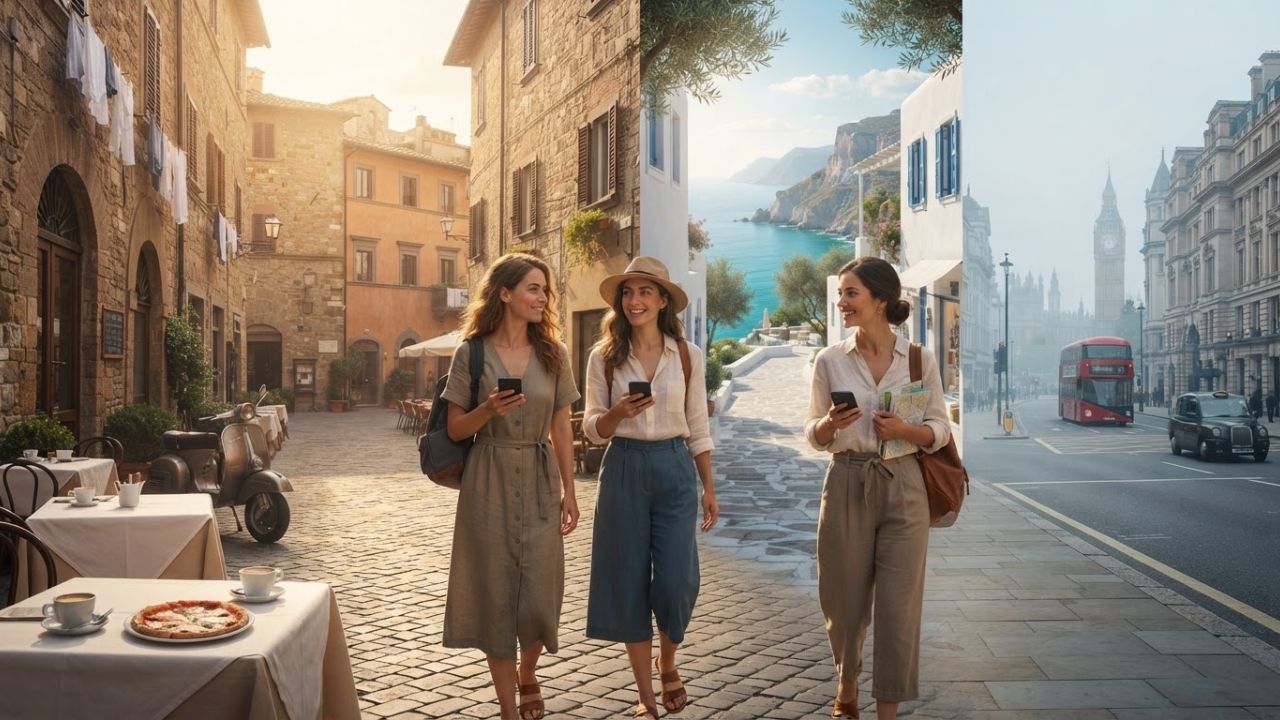
Image generated by AI
American travellers are choosing Europe in growing numbers, and industry data confirms that Italy and the United Kingdom are recording significant growth in US arrivals while Greece has become one of the fastest-growing Mediterranean destinations for American visitors — driven not by landmark tourism alone, but by food, luxury, and the search for experiences that cannot be replicated at home.
The Shift That Is Driving the Transatlantic Travel Boom
The American travelling public has changed how it thinks about European holidays. The classic two-week itinerary — a day in Paris, a day in Rome, a day in London — has been displaced by something slower, more specific, and significantly more expensive per head.
Modern US visitors are booking longer stays, concentrating on fewer destinations, and prioritising spending on experiences — private food tours, cooking classes in Tuscany, yacht charters in the Greek islands, countryside hotel stays — over the traditional museum-and-landmark circuit. That shift benefits Italy, Greece, and the United Kingdom disproportionately, because those three countries have the depth of regional culture, food heritage, and rural infrastructure to sustain the kind of immersive visit that American travellers are now specifically seeking.
The economic consequences of this are significant for European destination economies. American visitors consistently rank among the highest-spending international tourist segments — they tend to stay longer, book more expensive accommodation, and direct more spending toward premium dining and private experiences than most European domestic or regional visitor markets.
Italy: The Complete European Experience in One Country
Italy occupies a unique position in the American imagination: it is simultaneously familiar through cultural exports — film, food, fashion, art — and inexhaustibly varied in what it actually offers on the ground. That combination drives a repeat-visitor dynamic that few destinations can match.
Rome anchors most first-time American itineraries. The Colosseum, Vatican City, the Trevi Fountain, and the surrounding ancient Roman ruins operate as a concentrated encounter with two millennia of Western civilisation's physical history in a walkable city core. For American visitors from countries without pre-colonial built heritage of comparable age, the density of Rome's historical layering is genuinely without domestic parallel.
Florence serves the art-focused segment. The Uffizi Gallery, the Accademia (home of Michelangelo's David), the Duomo, and the Oltrarno neighbourhood — where working artisans still occupy traditional workshops on the south bank of the Arno — together make Florence the strongest single city for cultural tourism in Europe by many rankings.
Venice and Milan occupy different market positions: Venice for the experiential uniqueness of its geography and architecture, Milan for fashion and luxury retail. The Amalfi Coast, Sicily, and Sardinia draw the coastal and island-seeking segment.
The strongest growth in American tourism to Italy is now coming from regional and rural destinations. The Langhe wine region in Piedmont, the Matera cave city in Basilicata, and the hilltowns of Umbria are attracting US visitors on return trips who have exhausted the major cities and are going deeper into what Italy's regional culture — particularly its food, wine, and agricultural heritage — actually contains.
The Italian National Tourist Board (ENIT) and the regional tourism authorities across Tuscany, Sicily, and Campania have all invested significantly in English-language content and US market programming, reflecting the recognition that American visitors represent premium economic value per arrival.
Greece: Islands as Luxury Products, Athens as Cultural Anchor
Greece has been the fastest-growing Mediterranean destination for American travellers over the past three to four years, and the growth pattern differs meaningfully from the earlier wave of European heritage tourism.
Athens provides the cultural foundation. The Acropolis, the ancient temples, the National Archaeological Museum, and the historic neighbourhood of Plaka give the city more historical weight than most European capitals outside Rome. The renovated Athens Riviera coastal strip south of the city has added a luxury resort dimension that was previously missing from the mainland offer.
The Greek islands — particularly Santorini, Mykonos, Crete, Rhodes, and Corfu — are the primary driver of US visitor growth. Santorini's sunset views from Oia, whitewashed villages, and caldera-edge accommodation have become globally recognisable symbols of aspirational travel. Mykonos operates at the premium end of Mediterranean beach tourism. Crete provides the combination of serious archaeological sites (Knossos, the Palace of Phaistos), long beaches, and regional Cretan cuisine that rewards longer stays than the smaller islands can.
The economic profile of the American visitor in Greece is distinct from the European tourist norm. US visitors stay longer, book higher accommodation categories, spend more on private yacht charters, island-hopping experiences, and exclusive dining, and generate higher per-head revenue than most inbound European visitor segments. The Visit Greece national tourism organisation has structured its US marketing around this spending profile — targeting the premium experiential traveller rather than the budget backpacker segment.
The challenge Greece manages alongside this growth is the carrying capacity of its most popular islands. Santorini and Mykonos in particular have introduced or are discussing visitor management measures including cruise passenger limits and accommodation growth restrictions. The Greek Ministry of Tourism has been explicit that the long-term strategy prioritises high-spend, lower-volume visitors over high-arrival, low-spend tourism — a positioning that directly aligns with the American market profile.
The United Kingdom: Heritage, Language, and the Gateway Effect
The United Kingdom operates differently in the American tourism market than Italy or Greece. Its draw is partly the one factor that no other European destination can replicate for US visitors: no language barrier.
For first-time European travellers, the ability to navigate, ask questions, and read signage in English removes an anxiety that meaningfully affects destination choice. The UK consistently benefits from being the first European destination for many American travellers — and then becomes a gateway to broader European travel on subsequent trips.
London remains the anchor. Buckingham Palace, the Tower of London, Westminster Abbey, the British Museum, and the West End theatre district together form a heritage-and-entertainment combination that holds consistent appeal across American visitor demographics from family groups to solo cultural travellers to luxury tourists. The city's world-class restaurant scene — which has diversified dramatically over the past two decades into serious international and regional British cooking — has added a food tourism dimension that previously was not central to London's American market positioning.
Beyond London, American tourism to the UK is expanding into Scotland (castles, Highland scenery, whisky distillery experiences), Wales (coastal national parks, medieval fortresses), Northern Ireland (the Causeway Coast, the connection to Game of Thrones filming locations), and England's countryside — the Cotswolds, the Lake District, and Yorkshire most prominently.
The VisitBritain tourism authority has invested specifically in regional diversification campaigns in the American market, recognising that the concentration of US visitors in London alone limits the economic benefit to the rest of the country and creates pressure on the capital's tourism infrastructure.
Visitor Insider Tips: Getting More From Italy, Greece, and the UK in 2026
Italy — arrive in Rome, leave through Milan (or vice versa): Open-jaw routing — flying into Rome and out of Milan, or the reverse — eliminates backtracking and allows you to cover the country's geography efficiently without returning to the same airport. Both cities are served by multiple direct transatlantic routes from major US hubs.
Florence — book Uffizi and Accademia months in advance: These museums do not operate meaningful walk-up queuing systems during peak season. Both sell timed entry tickets online. Arriving without a booking in June–September means missing both. Book through the official Uffizi Galleries website.
Greece — fly into Athens and island-hop south: The efficient approach to the Greek islands is to fly into Athens International Airport (ATH), take a day or two in Athens, then use the domestic ferry system (from Piraeus port) or domestic flights to reach the islands. Return through Athens rather than attempting to fly out of smaller island airports directly to the US.
Santorini — stay in Imerovigli, not Oia: Oia has become so photographed and visited that the experience is largely a queue management exercise during peak season. Imerovigli, just north of Fira, offers the same caldera views, comparable sunset sightlines, and significantly fewer people. A legitimate insider choice rather than a compromise.
London — use the Oyster card, not contactless internationally: While London's transport system accepts contactless payments directly, international bank cards frequently trigger foreign transaction fees on every individual journey. A pre-loaded Oyster card caps your daily travel spending on the Underground and bus network and is more economical for anyone making multiple journeys per day.
Scotland — drive the NC500: The North Coast 500 route around Scotland's northern Highlands is the most efficiently structured self-drive touring route in the UK — 516 miles of coastal and Highland road connecting Inverness, Ullapool, Cape Wrath, Thurso, and John O'Groats. Petrol is significantly more expensive than in the US; budget accordingly.
Italy — avoid peak August: August is when Italians themselves holiday. City centres in Rome and Florence thin out while coastal resorts fill completely. Many of the best local restaurants close for all or part of August. September is the correct month for the combination of good weather, full restaurant operations, and reduced tourist pressure.
Tourism Outlook: What the American Surge Means for Each Destination Long-Term
The structural advantages that Italy, Greece, and the UK hold in the American market are durable. They rest on factors that cannot be manufactured quickly by competing destinations: centuries of documented cultural history, established cuisine traditions, mature luxury tourism infrastructure, and for the UK specifically, the English-language advantage.
The challenge each country faces is managing the concentration of American demand in a small number of over-pressured nodes — Rome, Florence, Santorini, London — while distributing economic benefit to the wider regional tourism economy. Italy's push toward Matera and Basilicata, Greece's development of the Athens Riviera, and the UK's regional campaigns into Scotland and Wales are all responses to this same structural problem.
For American travellers, the practical implication is that the most rewarding version of a European trip to any of these three countries is increasingly found away from the headline destinations — in the Langhe rather than the Amalfi Coast, in Crete rather than Santorini, in Edinburgh or the Cotswolds rather than central London. The infrastructure to support high-quality travel in those regional destinations has improved significantly over the past decade, and the price difference versus the iconic spots remains substantial.
FAQ: American Tourists in Europe 2026
Why are Italy, Greece, and the UK the top European destinations for American travellers? All three offer what American visitors most consistently seek: documented cultural and historical depth, world-class food and wine tourism, strong direct transatlantic air connectivity, and the kind of immersive regional travel that justifies longer stays. The UK additionally benefits from the English-language advantage for first-time European travellers.
Which Greek islands are most popular with American tourists? Santorini, Mykonos, Crete, Rhodes, and Corfu attract the highest volumes of American visitors. Among these, Santorini and Mykonos operate primarily at the luxury end of the market, while Crete, Rhodes, and Corfu offer more accessible price points alongside significant archaeological and natural heritage.
What is the best time for Americans to visit Europe to avoid peak-season crowds? May, June, and September offer the most favourable balance of weather, operational tourism services, and reduced visitor pressure across Italy, Greece, and the UK. Late August and the first two weeks of September are particularly strong for Greece, when sea temperatures remain warm and Athenian domestic tourism has subsided.
Related Travel Guides
Greece Cyclades Islands Summer Tourism Growth: Mykonos and Santorini 2026
Thassos, Greece: The Budget-Friendly Green Island That Overdelivers on Beaches, Forest and History
Disclaimer
This article is for informational and educational purposes only. It does not constitute legal, financial, or professional advice. While we strive to provide accurate and up-to-date information, travel policies, regulations, and conditions change rapidly. Always verify information with official sources before making travel decisions. Nomad Lawyer makes no representations about the accuracy, reliability, completeness, or suitability of the information provided. Readers should consult qualified professionals for advice specific to their circumstances. The views expressed in this article are those of the author and do not necessarily reflect the views of Nomad Lawyer.