
Bypassing Travel Chaos: Massive Middle East Airspace Lockout Triggers 3,400 Flight Cancellations as Israel and Global Carriers Face 500% Insurance Surge: Airline News
As severe travel chaos paralyzes Middle Eastern corridors, airlines suffer massive flight cancellations and skyrocketing war-risk premiums amid a total airspace lockout.

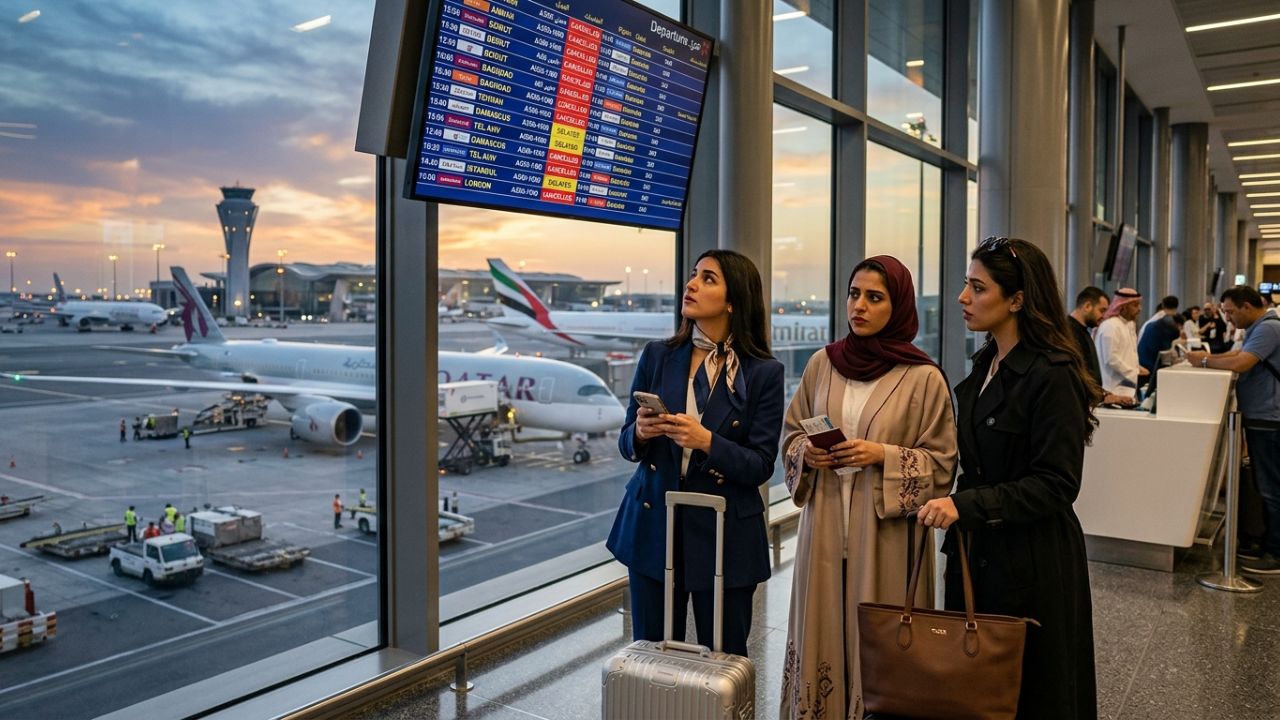
Image generated by AI
In an unprecedented regulatory and logistical collapse that is generating catastrophic travel chaos across the globe's most critical transit corridors, a massive airspace lockout has effectively paralyzed civil aviation across the Middle East. Reported on June 20, 2026, as panicked passengers frantically monitor the latest airline news for an escape from rolling flight cancellations and agonizing terminal gridlock, Israel has officially joined Iran, Iraq, Syria, and Lebanon in a regional aviation blackout. Driven by severe electronic warfare, direct military strikes, and a terrifying 500% surge in commercial war-risk insurance premiums, legacy carriers have entirely abandoned Gulf routes. This massive logistical meltdown has severed the primary Europe-to-Asia flight paths, triggering extreme airport disruptions and stranding hundreds of thousands of travelers, cementing this intercontinental transit collapse as today's most crucial headline in breaking aviation updates.
By introducing direct passenger coordination and dynamic scheduling backups, the regional aviation hubs target growing passenger demand across vital commerce sectors. The choice to coordinate flight departures in phases helps to manage gate capacity, supporting the country's broader regional transportation network.
Context: The Collapse of the Middle East Corridor
For the global aviation industry, attempting to operate commercial flights through the Middle Eastern Flight Information Regions (FIR) has become the absolute ultimate exposure to structural failure.
Unlike standard airspace restrictions based on systemic safety oversight (such as the FAA’s Category 1 and 2 ratings), the 2026 crisis is a rapid, threat-driven operational downgrade. Despite the scheduled signing of a formal bilateral peace agreement in Switzerland on June 20, 2026, the European Union Aviation Safety Agency (EASA) aggressively extended its Middle East Conflict Zone Information Bulletin (2026-03 R12) through June 24, 2026. This mandate completely prohibits commercial flights across Iranian, Iraqi, and Lebanese airspace at any altitude due to the extreme risk of civilian aircraft misidentification by hyper-alert air defense batteries. When major regional strikes completely shuttered Middle Eastern air corridors on February 28, 2026, the result was instantaneous, global travel chaos. By March 1, 2026, tracking databases logged the catastrophic cancellation of over 3,400 flights across seven primary regional hubs. To survive this total infrastructure failure, airlines are being forced to aggressively bypass the Gulf, funneling traffic through heavily congested northern detour corridors or pivoting entirely to ultra-long-haul polar routes.
To view live flight schedules, verify the active severity of these airspace lockouts, or to track potential route restorations prior to heading to the airport, travelers must consult official aviation directories. For direct updates regarding how this massive airspace crisis might trigger flight cancellations for your specific airline, travelers should aggressively utilize the official digital portals of their respective carriers. To explore live flight tracking and monitor the exact severity of the cascading bottlenecks paralyzing alternative Eurasian airspace, passengers can consult the official FlightAware tracking service.
Section-Wise Breakdown: The Geography of Gridlock
Dubai and the Gulf: The Hub Meltdown
The closure of Middle Eastern airspace triggered the most severe single-day aviation disruption in history. Within 72 hours of the late-February strikes, Dubai International Airport—the world's premier international hub—saw an unbelievable 85% of its scheduled flights canceled. By March 6, 2026, over 4,000 cancellations had stranded tens of thousands of passengers inside transit terminals. This collapse forced the UK Foreign, Commonwealth & Development Office (FCDO) into an unprecedented evacuation operation to rescue roughly 200,000 stranded British nationals. With UAE airspace completely suspended, desperate travelers were forced into overland car transit across the desert to Oman, with regional taxi fares from Dubai to Muscat escalating to £1,000 per passenger.
Israel: The $8 Billion Insurance Defense
The escalation of hostilities—from the October 2023 Israel-Hamas war, to the direct missile exchanges of October 2024 and June 2025, to the shuttering of Israeli civil airspace on June 13, 2025—triggered a total contraction of the global aviation insurance market. As war-risk underwriters invoked 48-hour cancellation clauses, foreign carriers suspended all services to Tel Aviv. To prevent a total commercial blockade, the Knesset Finance Committee approved a massive $8 billion state-backed insurance guarantee administered by Inbal Insurance Company Ltd. (a massive expansion from the previous $5-$6 billion emergency guarantees that only protected domestic carriers like El Al, Arkia, and Israir). This radical pivot to state-guaranteed indemnity was designed to incentivize foreign airlines to return to Ben Gurion Airport and safeguard the imports of essential goods.
The Rerouting Bottleneck: Turkey and the South
Because the primary airspaces of Iran, Iraq, and Syria are locked down, international flights have been forced into a highly congested northern corridor running over Azerbaijan, Georgia, and Turkey. This 150-kilometer-wide bottleneck rapidly absorbed 23% of total global air traffic demand, resulting in severe air traffic control saturation. Rerouting adds between two to five hours to total flight durations. Compounding this logistical nightmare, the Argus U.S. Jet Fuel Index confirmed that jet fuel prices surged 110% from $2.17 to $4.56 per gallon by mid-March 2026, devastating airline balance sheets.
Technical Roster: Official Regional Disruption and Insurance Matrix
To ensure absolute factual accuracy regarding the exact operational delays, specific financial impacts, and precise passenger stranding metrics defining this massive infrastructure failure, the following matrix details the strictly verified aviation data:
Official Regional Disruption and Insurance Metric Matrix
| Operational / Financial Metric | Verified Aviation Crisis Data |
|---|---|
| Massive Flight Cancellations | Over 3,400 flights canceled across 7 primary regional hubs on March 1, 2026 |
| Dubai International Collapse | 85% of scheduled flights canceled; 4,000+ total cancellations by March 6, 2026 |
| Aviation Insurance Surge | Commercial war-risk premiums for Gulf transits surged 50% to 500% |
| Maritime Cargo War-Risk | Strait of Hormuz premiums escalated 200% to 300% (3-5% of total vessel value) |
| Israeli State Insurance Guarantee | $8 Billion state-backed fund approved June 23, 2025 (Inbal Insurance Co.) |
| Jet Fuel Price Escalation | Surged 110% from $2.17 to $4.56 per gallon (mid-March 2026 Argus Index) |
| UK Consular Evacuation | ~100,000 British citizens repatriated by March 18, 2026 (out of ~200k stranded) |
| Rerouting Operational Penalty | Avoidance corridors add 2 to 5 hours to total flight durations |
Data accurately reflects the verified cancellation metrics, extreme insurance premium surges, and strategic financial guarantees tracking the Middle Eastern aviation crisis as of June 2026.
Industry Analysis: Sweeping Liquidations and Electronic Warfare
Aviation analysts monitoring the intensely volatile Europe-Asia transit market note that this airspace lockout is forcing major Western carriers to permanently liquidate regional networks.
Analysts emphasize that the financial pressure of doubled fuel costs and 500% insurance hikes is unsustainable. The Lufthansa Group has permanently liquidated its regional subsidiary Lufthansa CityLine and suspended over 20,000 European flights—including routes to Amman, Beirut, Erbil, Tehran, Riyadh, Dammam, Abu Dhabi, and Tel Aviv through October 24, 2026. KLM similarly suspended Dubai operations through August 2, 2026, alongside Riyadh and Dammam. Furthermore, the physical operating environment is heavily compromised by massive surges in GPS jamming and spoofing at airports in Bahrain, Doha, Sharjah, Abu Dhabi, and Dammam. This severe electronic warfare acts as a powerful non-tariff barrier, forcing cockpit crews to abandon automated procedures and definitively convincing Western commercial carriers to abandon the Middle East entirely in favor of ultra-long-haul polar routes.
Actionable Advice for Intercontinental Travelers
Because this massive transit collapse fundamentally alters the reliability of international travel, passengers currently navigating this crisis must execute this strategic survival checklist immediately:
- Refuse Gulf Layovers: If you are traveling between Europe and Asia, absolutely refuse to book itineraries that layover in Dubai, Doha, or Abu Dhabi. The combination of GPS spoofing, airspace closures, and massive flight cancellations makes transit through the Gulf a highly volatile gamble. Actively bypass the Middle East by booking direct, ultra-long-haul flights on Western carriers utilizing polar or Pacific routes.
- Prepare for Severe Rerouting Delays: Because airlines are forced into narrow, 150-km-wide northern corridors over Turkey and Georgia, you must integrate massive 2-to-5 hour time buffers into your travel plans. Do not book tight connections on the receiving end of these long-haul flights, as air traffic control saturation guarantees cascading delays upon arrival.
- Demand Consular and Financial Protection: As demonstrated by the chaotic UK FCDO evacuation—where a family spent nearly £4,000 on ground transit after being stranded in Muscat—travelers cannot rely solely on government rescue operations during a rapid airspace lockout. You must secure premium, "cancel-for-any-reason" travel insurance that explicitly covers war-risk evacuation and extended hotel accommodations.
FAQ: Middle East Airspace Lockout
Why are thousands of flights being canceled across the Middle East?
Flights are being canceled due to the massive closure of primary regional airspaces, driven by active military hostilities, GPS spoofing, and EASA conflict zone bulletins.
How much have aviation insurance premiums increased?
Due to extreme asset risk, global commercial war-risk premiums for aircraft transiting Gulf and West Asian airspaces have surged by an incredible 50% to 500%.
How are airlines avoiding the Middle Eastern airspace closures?
To bypass the locked-out airspace, carriers are rerouting flights through narrow northern corridors over Turkey and Georgia, adding 2 to 5 hours to total flight durations.
The Reality of Sovereign Defense
The catastrophic airspace lockout across the Middle East proves definitively that relying on highly volatile geopolitical transit corridors is the ultimate risk in modern aviation. By funneling millions of passengers through fragile regional chokepoints, the airline industry successfully guaranteed that a localized conflict would trigger global travel chaos. Yet, as the Israeli government authorizes an $8 billion sovereign insurance shield to keep Ben Gurion Airport operational, global passengers must accept a critical new reality: surviving the massive disruptions of modern global commerce demands extreme tactical planning. Navigating the hostile 2026 airspace requires a complete refusal to book vulnerable multi-stop itineraries through the Gulf, and the tactical discipline to pivot immediately to carriers utilizing secure, ultra-long-haul bypass routes that operate far outside the blast radius of electronic warfare.
Key Takeaways
- Massive Regional Lockout: Israel, Iran, Iraq, Syria, and Lebanon face severe airspace restrictions, triggering global travel chaos and severing the Europe-Asia flight corridor.
- Catastrophic Cancellations: The crisis triggered over 3,400 regional flight cancellations on March 1, 2026, effectively paralyzing major hubs like Dubai International.
- Insurance Premiums Skyrocket: Commercial war-risk aviation premiums surged 50% to 500%, forcing airlines to abandon routes due to unsustainable operating costs.
- $8 Billion Sovereign Shield: Israel deployed a massive $8 billion state-backed insurance guarantee via Inbal Insurance to keep international trade routes open.
- Sweeping Route Liquidations: Massive fuel spikes (110%) and 2-5 hour rerouting delays forced Lufthansa and KLM to aggressively suspend tens of thousands of Middle Eastern flights.
Related Travel Guides
Massive Travel Chaos Paralyzes Chicago O'Hare with 1,425 Disruptions
Disclaimer
This article is for informational and educational purposes only. It does not constitute legal, financial, or professional advice. While we strive to provide accurate and up-to-date information, travel policies, regulations, and conditions change rapidly. Always verify information with official sources before making travel decisions. Nomad Lawyer makes no representations about the accuracy, reliability, completeness, or suitability of the information provided. Readers should consult qualified professionals for advice specific to their circumstances. The views expressed in this article are those of the author and do not necessarily reflect the views of Nomad Lawyer.
Kunal K Choudhary
Co-Founder & Contributor
A passionate traveller and tech enthusiast. Kunal contributes to the vision and growth of Nomad Lawyer, bringing fresh perspectives and driving the community forward.
Learn more about our team →