
Ireland Tourism Paradox: Visitor Volume Rises to 789,000 as August Revenue Drops to €729 Million

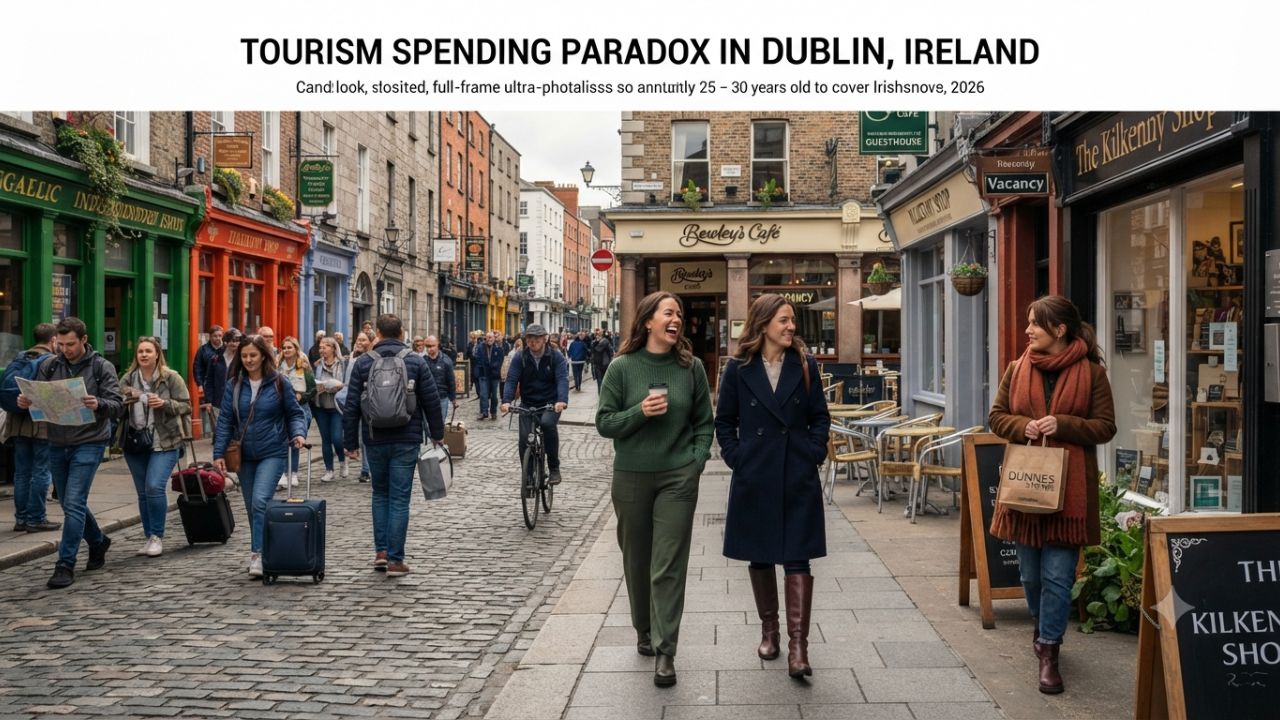
Ireland experiences a tourism revenue paradox in August 2026 as total expenditure falls to €729 million despite receiving nearly 789,000 foreign arrivals.
Ireland welcomed nearly 789,000 foreign visitors in August 2026, registering a 2% volume increase year-over-year. However, total overseas tourist expenditure dropped by €15 million to €729 million as the average length of stay compressed to 8.3 nights and mean trip spending fell by 4%. Official Central Statistics Office (CSO) data reveals an economic contraction affecting major urban centers, including Dublin, Cork, Galway, Limerick, and Waterford.
[DUBLIN, Ireland, October 5, 2026] — Ireland's tourism economy experienced a pronounced revenue paradox during the peak summer month of August 2026. Official monthly Inbound Tourism releases from the Central Statistics Office (CSO) confirm that foreign visitor arrivals reached almost 789,000, representing a 2% increase compared to August 2025. Cumulatively, overseas visits for the first eight months of 2026 expanded by 11% to reach an estimated 4.7 million.
Despite higher physical headcounts across major airports and urban streets, total foreign visitor expenditure in August contracted to €729 million. This figure represents a 2% decline from €744 million in August 2025 and an 11% drop compared to the €820 million recorded in August 2024. The revenue shortfall highlights how compressed visitor stays and tighter personal travel budgets are reducing economic yield for Irish hospitality businesses.
| Ireland Inbound Tourism Performance Metric | August 2025 Baseline | August 2026 Official Figure | Percentage Year-Over-Year Change |
|---|---|---|---|
| Foreign Resident Arrivals | ~773,500 visitors | Almost 789,000 visitors | +2.0% increase |
| Total Foreign Visitor Expenditure | €744 million | €729 million | -2.0% (€15M contraction) |
| Cumulative Foreign Visitor Nights | 6.7 million nights | 6.6 million nights | -2.0% (Loss of 107,300 nights) |
| Average Length of Stay | 8.6 nights | 8.3 nights | -3.5% stay compression |
| Mean Spend per Trip (excl. fares) | €962 | €924 | -4.0% spending drop |
| Year-to-Date Overseas Visits (Jan–Aug) | ~4.23 million | 4.7 million | +11.0% cumulative growth |
| International Transit Departures | 2,408,000 passengers | 2,432,100 passengers | +1.0% transit volume |
Compressed Length of Stay Reduces Regional Overnight Nights by 107,300
Foreign tourists spent a cumulative 6.6 million nights in Ireland during August 2026, marking a 2% drop that resulted in 107,300 fewer overnight stays compared to the previous year. The average length of stay shortened to 8.3 nights, down from 8.6 nights in August 2025.
Concurrently, average spending per trip (excluding international airfares and ferry costs) fell 4% from €962 to €924. This compression in overnight stays directly reduced the financial multiplier effect across regional accommodation providers, creating shorter booking windows and lower per-guest revenue from Dublin to Waterford.
| Source Market Category | Proportion of August 2026 Visitor Volume | Volume YoY Change | Generated Tourist Expenditure | Share of Total Spend |
|---|---|---|---|---|
| Great Britain | 36% of foreign arrivals | +1% increase | €148 million | 20% expenditure share |
| Continental Europe | ~31% of foreign arrivals | +9% surge | €262 million | 36% expenditure share |
| North America | 25% of foreign arrivals | -3% decline | €262 million | 36% expenditure share |
| Rest of the World | ~8% of foreign arrivals | -6% drop | Remaining total | 8% expenditure share |
Source Market Divergence: North American Spending Outpaces Volume
A detailed breakdown of origin markets demonstrates why urban centers reliant on transatlantic travel experienced sharper yield contractions. Great Britain remained Ireland's largest source market by volume, generating 36% of August arrivals (+1% YoY) but contributing €148 million in total spending.
Conversely, North American arrivals declined by 3% in August 2026. However, despite representing 25% of foreign headcounts, North American tourists generated €262 million—accounting for 36% of total national visitor expenditure and matching the total generated by Continental Europe (+9% volume growth). The dip in high-spending transatlantic travelers disproportionately impacted luxury hotels and fine-dining venues in major municipal hubs.
Leisure Travel Rises to 51% Amid Shorter Itineraries and Tight Budgets
Trip motivation data shows that holiday, leisure, and recreation trips accounted for 51% of all overnight foreign arrivals in August 2026, up from 48% in August 2025. Visiting friends and relatives (VFR) accounted for 33% of trips, while formal corporate business travel comprised 8%.
Although pure leisure travel expanded, holidaymakers executed tighter daily budgets to offset broader European consumer inflation. Urban hoteliers noted that leisure tourists exhibited higher price sensitivity than corporate travelers, resulting in lower food, beverage, and secondary attraction spending.
August 2026 Accommodation Selection Breakdown:
1. Traditional Hotels: 39% of overnight visitors
2. Own Property / Family & Friends: 37% of overnight visitors
3. Rented / Self-Catering Accommodation: 8% of overnight visitors
4. Other Lodging / Guesthouses / Hostels: 16% of overnight visitors
Urban Breakdown: How Ireland's Top Destinations Navigated Yield Softening
Regional destination reports outline how compressed stays affected urban and regional hospitality operators:
- Dublin: Serving as the primary gateway, Dublin Airport registered high passenger transit volume. However, capital hoteliers reported a softening in mid-tier hotel occupancy and weaker average daily rates (ADR). High room pricing prompted international tourists to shorten their capital stays before moving into rural counties.
- Cork: The south-west gateway experienced steady regional airport and maritime arrivals. Dips in multi-night bookings from traditional UK and North American markets offset early-summer gains across County Cork.
- Limerick: Positioned near Shannon Airport and the Wild Atlantic Way, Limerick recorded a plateau in regional transit dwell times. Day-tripping visitors significantly outnumbered overnight hotel guests, placing downward pressure on municipal lodging revenue.
- Galway: While peak domestic visitor numbers filled city streets, international arrivals saw a localized leveling off. Tourists opted for compressed single-night stopovers rather than multi-day western loops, impacting rural bed-and-breakfast operators.
- Waterford: Anchoring Ireland’s Ancient East, Waterford maintained weekend domestic family bookings. However, international arrivals faced competition from western coastal routes, alongside tighter discretionary spending from continental European travelers.
Airport Departures Hit 2.43 Million as Dwell Times Shorten
Infrastructure data shows that 2,432,100 passengers departed Ireland on international routes during August 2026, representing a 1% year-over-year increase across airports and seaports.
While transit facilities operated near capacity, the conversion rate from airport throughput to multi-night hotel stays weakened. Regional tourism boards note that efficient ground transit connections enabled travelers to pass through major cities without making overnight lodging commitments.
Industry Impact Analysis: Re-Evaluating Volume-Driven Tourism Models
The August 2026 CSO results challenge the assumption that rising visitor volumes guarantee sector profitability. While year-to-date arrivals grew 11% to 4.7 million, single-month spending fell 2% to €729 million.
Hospitality operators facing elevated energy, labor, and food overheads are confronting shrinking per-trip outlays (€924 vs. €962 in 2025). Industry analysts emphasize that destination marketing organizations must pivot toward attracting long-stay, high-yield travelers rather than relying solely on high transit volumes.
Why This Matters: Practical Travel & Budgeting Takeaways
For international travelers, Ireland's current market dynamics mean that mid-tier hotel rates in Dublin and regional hubs are becoming more flexible as hoteliers adjust pricing to capture shorter stays. Travelers planning trips along the Wild Atlantic Way or Ireland's Ancient East can find competitive shoulder-season offers by booking mid-week stays.
From a trip-planning perspective, visitors can maximize value by extending their dwell times in secondary cities like Cork, Limerick, or Waterford. Combining urban walking tours with longer regional stays helps support local independent guesthouses while avoiding peak weekend rate spikes in major gateways.
Related Travel Guides
Spain Family Travel Expands Through Geoparks and Rural Escapes as US Arrivals Reach 3.9 Million
Africa Tourism Growth Surges 4% in H1 2026 as South Africa and Rwanda Lead Coastal and Safari Demand
Zambia Rail Revival Boosts Regional Travel Across Zimbabwe, Tanzania, Malawi, and South Africa
Disclaimer
This article is for informational and educational purposes only. It does not constitute legal, financial, or professional advice. While we strive to provide accurate and up-to-date information, travel policies, regulations, and conditions change rapidly. Always verify information with official sources before making travel decisions. Nomad Lawyer makes no representations about the accuracy, reliability, completeness, or suitability of the information provided. Readers should consult qualified professionals for advice specific to their circumstances. The views expressed in this article are those of the author and do not necessarily reflect the views of Nomad Lawyer.
Raushan Kumar
Founder & Lead Developer
Full-stack developer with 11+ years of experience and a passionate traveller. Raushan built Nomad Lawyer from the ground up with a vision to create the best travel and law experience on the web.
Learn more about our team →