
IndiGo Doha-Bengaluru Flight Diverts to Muscat After Pilot Medical Emergency Triggers Mid-Air Mayday Call
IndiGo flight 6E 1302 from Doha to Bengaluru diverted safely to Muscat after a pilot medical emergency triggered a Mayday call aboard the Airbus A320neo.

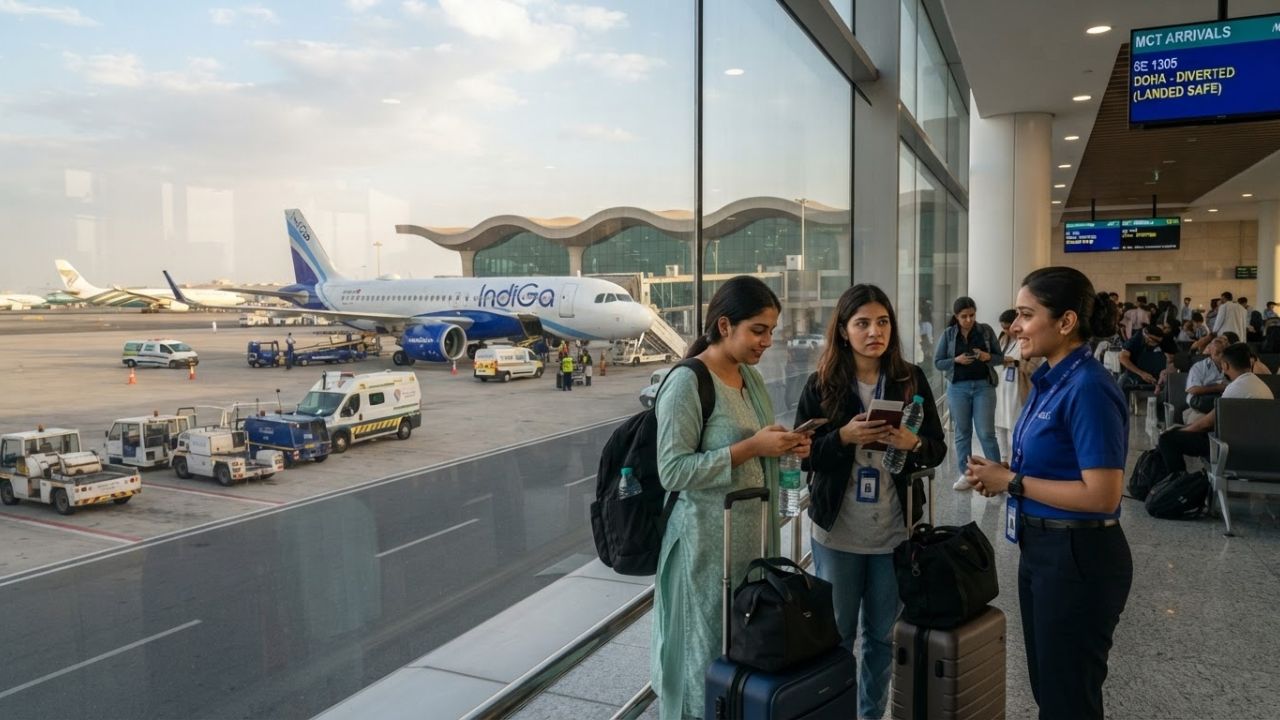
Image generated by AI
An IndiGo Airbus A320neo operating flight 6E 1302 from Doha to Bengaluru executed an emergency diversion to Muscat International Airport on Thursday after an operating flight crew member suffered a mid-air medical emergency, prompting the cockpit to declare a Mayday call.
In-Flight Emergency Over the Gulf of Oman
IndiGo flight 6E 1302 departed Hamad International Airport in Doha, Qatar, bound for Kempegowda International Airport in Bengaluru, India. The flight was operated by an Airbus A320neo, taking off on Thursday at approximately 3:00 AM, roughly one hour behind its scheduled departure timetable.
Less than two hours into the journey, as the twin-engine jet was tracking southeast across the Gulf of Oman toward the Arabian Sea, an operating pilot became medically incapacitated and unable to perform regular flight deck duties. Recognizing the severe operational demands of single-pilot flight over an extended oceanic sector, the remaining pilot initiated international emergency procedures, broadcasting a Mayday call to regional air traffic control to secure immediate priority clearance, altitude descent, and direct vectors toward Muscat International Airport in Oman.
[IndiGo Flight 6E 1302 Emergency Diversion Profile]
• Flight Number:         IndiGo 6E 1302
• Aircraft Model:        Airbus A320neo
• Origin:                Hamad International Airport, Doha (DOH)
• Scheduled Destination: Kempegowda International Airport, Bengaluru (BLR)
• Diversion Point:       Muscat International Airport, Oman (MCT)
• Takeoff Time:          Thursday ~3:00 AM (approx. 1 hour behind schedule)
• Incident Onset:        Under 2 hours into flight
• Emergency Status:      Mayday declared; successful priority landing at MCT
| Operational Parameter | Flight Record Detail | Safety Management Action |
|---|---|---|
| Airline & Flight | IndiGo 6E 1302 | Scheduled international red-eye service |
| Aircraft Registration/Type | Airbus A320neo | Twin-engine narrow-body passenger jet |
| Origin Gateway | Doha (DOH), Qatar | Departed Thursday around 3:00 AM |
| Diversion Hub | Muscat (MCT), Oman | Closest major airport with full trauma medical infrastructure |
| Emergency Code | Mayday Call | Priority approach and runway reservation granted by Muscat ATC |
| Pilot Medical Status | Incapacitated in flight | Received immediate tarmac medical intervention; reported improving |
| Passenger Recovery | Alternate aircraft & crew | Sustained with meals, terminal care, and relief crew to Bengaluru |
The aircraft made a safe, controlled touchdown on Muscat's primary runway, where emergency medical response teams, ramp ambulances, and airport operations units were stationed on standby.
Two-Pilot Redundancy and Cockpit Workload Distribution
Modern commercial passenger airliners, including the Airbus A320neo family, are designed with extensive fail-safe systems and require a two-pilot operating philosophy. On standard flights, responsibilities are systematically divided between the Pilot Flying (PF) and the Pilot Monitoring (PM):
- Aircraft Trajectory and Flight Controls: Hand-flying or directing the autopilot flight director system along authorized airway coordinates.
- Radio Telephony and Navigation: Maintaining continuous voice communication with air traffic control sectors and managing navigation waypoints.
- Systems Oversight: Verifying fuel burn rates, hydraulic pressures, cabin pressurization, and electrical power buses.
- Checklist Execution: Reading and confirming standard and abnormal operational checklists.
When a pilot suffers acute medical incapacitation, the remaining aviator must immediately absorb all flight deck functions simultaneously. While commercial pilots undergo rigorous biannual simulator testing for single-pilot abnormal operations, continuing a four-hour trans-oceanic crossing to southern India with a single active pilot increases operational risk. Entering the Arabian Sea offers few diversion alternates with specialized medical facilities. Diverting into Muscat provided an immediate, fully equipped runway, optimal weather, and access to emergency medical teams.
Ground Response and Relief Aircraft Logistics in Muscat
Upon arrival at Muscat International Airport, medical professionals boarded the aircraft to administer emergency treatment to the affected crew member. IndiGo confirmed that the pilot received comprehensive medical care at a local hospital and was subsequently reported to be feeling better and resting in stable condition.
Managing an unexpected international diversion requires rapid ground coordination between the carrier, civil aviation regulators, and ground handlers:
- Passenger Welfare in Terminal: Passengers on flight 6E 1302 were escorted into the Muscat terminal transit concourse, where ground agents provided meal vouchers, refreshments, and periodic operational briefings.
- Flight Duty Time Limitations (FDTL): Strict civil aviation safety regulations prohibit flight crew members from exceeding maximum legal duty hours. Because the original crew could no longer operate the remaining sector, IndiGo mobilized a replacement operating crew alongside an alternate aircraft.
- Ferry Flight Mobilization: The airline dispatched a relief aircraft and fresh flight crew to Muscat to embark the passengers and complete the scheduled journey to Bengaluru safely.
Safety Infrastructure in Gulf-to-India Flight Corridors
The air corridor linking the Arabian Peninsula and the Indian subcontinent represents one of the world's most heavily traveled international travel networks. Hundreds of daily passenger flights connect Doha, Dubai, Abu Dhabi, and Muscat with Indian metropolitan centers including Bengaluru, Mumbai, Delhi, and Chennai.
Muscat International Airport serves as a designated, high-readiness diversion sanctuary along this route network:
- Extended Dual Runways: Muscat features dual parallel runways capable of handling all commercial aircraft sizes, equipped with Category IIIB Instrument Landing Systems (ILS) for precision approaches in low visibility.
- On-Field Emergency Medical Centers: The airport maintains specialized 24-hour paramedic squads equipped with advanced trauma and cardiac life-support apparatus.
- Regulatory Alignment: Seamless bilateral coordination between India's Directorate General of Civil Aviation (DGCA) and Oman's Civil Aviation Authority (CAA) enables rapid regulatory clearance for relief aircraft and replacement crews without bureaucratic delays.
Local Insider Tips for Travelers on Gulf-India Red-Eye Routes
- Protect Connecting Bookings on Separate PNRs: If traveling on late-night Gulf-India red-eye flights with an onward domestic connection booked on a separate airline or ticket, unexpected diversions can lead to missed connections. Always maintain a minimum transit cushion of four to six hours at Indian gateways like Bengaluru (BLR) or Mumbai (BOM), or book your entire domestic and international itinerary under a single booking reference (PNR) to ensure complimentary rebooking protection.
- Secure an Official Delay and Diversion Certificate: If your flight is diverted or delayed by more than three hours due to an operational or medical emergency, visit the airline's airport duty manager or customer support desk to request a stamped Flight Delay/Diversion Certificate. This document is essential for filing travel insurance claims covering missed tours, non-refundable hotel nights, or incidental transit meals.
- Navigating Muscat International (MCT) During an Unplanned Layover: Muscat International features one of the modern transit terminals in the Middle East. Travelers with extended layovers can utilize:
- Quiet Rest Areas: Complimentary reclining rest loungers located near departure gates on the upper concourse.
- Free Unlimited Wi-Fi: Easily accessible throughout the terminal by entering your mobile number or flight boarding pass details.
- Primeclass Lounge Pay-Per-Use Access: If airline meal vouchers only cover basic fast food, you can purchase entry to the Primeclass Lounge, which provides private shower suites, hot buffet dining, and comfortable work booths.
- Keep Essential Prescription Medications in Carry-On Baggage: During unplanned medical diversions, checked luggage remains sealed inside the cargo hold. Always carry essential prescription medications, contact lens supplies, and portable electronic chargers inside your personal carry-on bag.
Aviation Industry Outlook: Prioritizing Safety Over Schedule
The swift handling of IndiGo flight 6E 1302 illustrates why modern commercial aviation maintains an extraordinary safety record. Declaring a Mayday call during an in-flight crew emergency is a deliberate, highly trained protocol designed to clear conflicting airspace, secure immediate descent priority, and protect lives.
While unexpected diversions inevitably create travel delays, passenger safety protocols mandate that health emergencies receive immediate intervention. The coordinated response between the flight deck, Muscat air traffic controllers, emergency medical personnel, and IndiGo’s flight dispatch team demonstrates how robust safety margins safeguard passengers across international airspace.
Frequently Asked Questions
Why was IndiGo flight 6E 1302 diverted to Muscat International Airport?
The flight was diverted after an operating flight crew member suffered an acute mid-air medical emergency, prompting the cockpit to declare a Mayday call and land at the nearest major international airport.
What aircraft type was operating flight 6E 1302?
The flight was operated by a twin-engine Airbus A320neo narrow-body passenger aircraft.
What time did the flight depart Doha?
The flight took off from Hamad International Airport in Doha on Thursday at around 3:00 AM, approximately one hour behind its scheduled departure time.
How did the airline support passengers during the Muscat diversion?
IndiGo provided waiting passengers with refreshments, meal support, and continuous flight updates while coordinating an alternate aircraft and a replacement crew to fly them onward to Bengaluru.
What was the condition of the affected pilot following landing?
The crew member received immediate medical attention from emergency medical services on the tarmac at Muscat and was subsequently reported to be in stable, improving condition.
Related Travel Guides
Disclaimer
This article is for informational and educational purposes only. It does not constitute legal, financial, or professional advice. While we strive to provide accurate and up-to-date information, travel policies, regulations, and conditions change rapidly. Always verify information with official sources before making travel decisions. Nomad Lawyer makes no representations about the accuracy, reliability, completeness, or suitability of the information provided. Readers should consult qualified professionals for advice specific to their circumstances. The views expressed in this article are those of the author and do not necessarily reflect the views of Nomad Lawyer.
Raushan Kumar
Founder & Lead Developer
Full-stack developer with 11+ years of experience and a passionate traveller. Raushan built Nomad Lawyer from the ground up with a vision to create the best travel and law experience on the web.
Learn more about our team →