
Indiana Tourism Tax Strategy: How Lodging Levies Fund Regional Infrastructure in 2026
Indiana utilizes a strategic dual-level taxation system on lodging and rentals to fund major civic projects, saving local households an average of $583 annually.

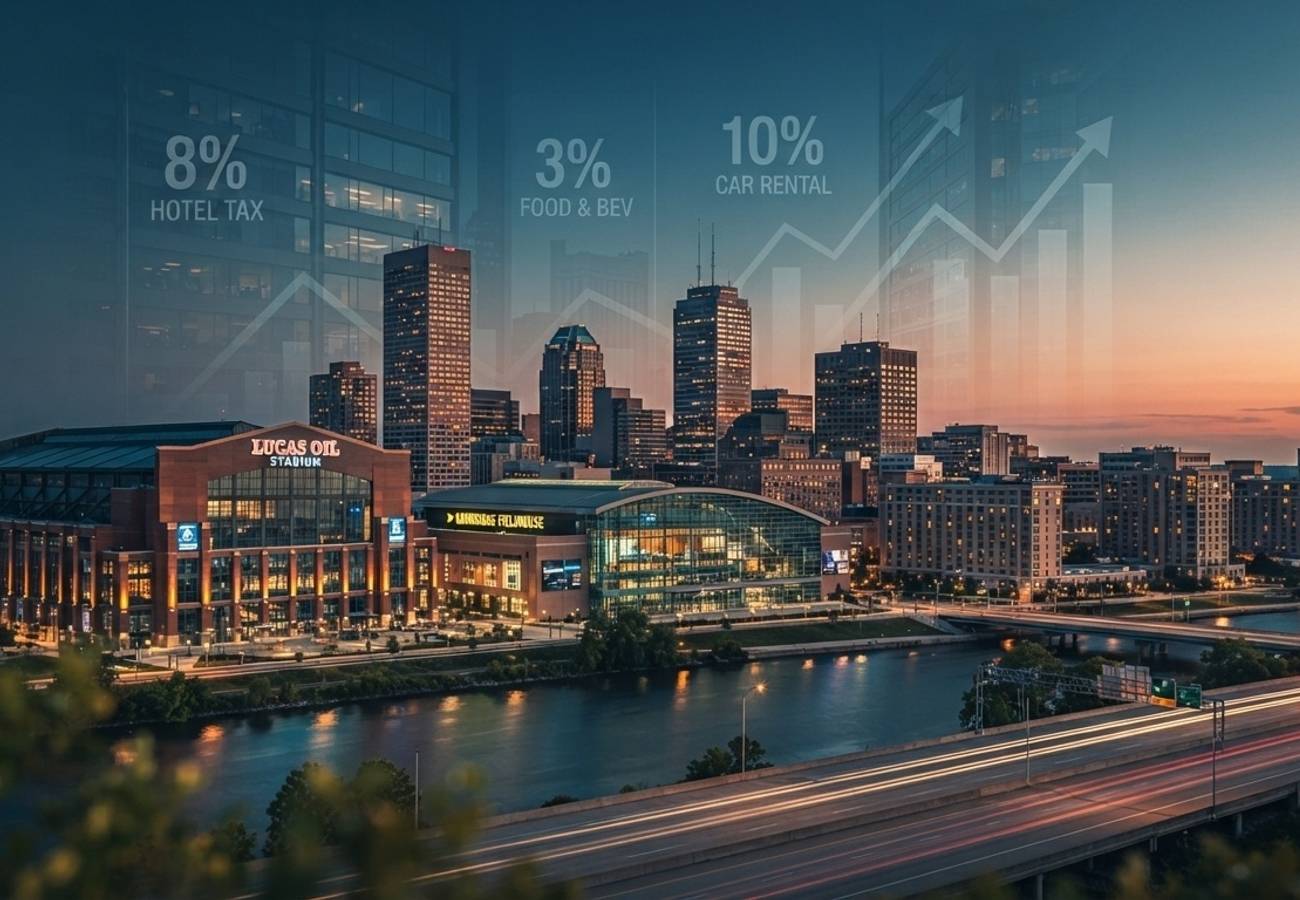
Image generated by AI
Indiana leverages a sophisticated hospitality tax framework to shift the financial burden of civic infrastructure from residents to out-of-state visitors. This strategic allocation allows the state to modernize stadiums and convention centers while providing a direct tax subsidy to local households.
The state of Indiana operates a precise hospitality tax system designed to capture spending from short-term guests without impacting the resident tax base. Governed by Indiana Code Title 6, Article 9 (IC 6-9), local governments possess the authority to levy taxes on food, entertainment, and lodging.
While the State Gross Retail (Sales) Tax remains uniform at 7.0% across all 92 counties, county councils have the autonomy to implement the County Innkeeper’s Tax (CIT). These local rates fluctuate significantly, ranging from a minimum of 3.5% in Cass County to a maximum of 10.0% in Marion County.
Funding Regional Growth Through Dual-Level Taxation
The synergy between state and local taxes ensures that non-resident travelers directly subsidize regional development and convention expansions. In Indianapolis, visitors face a cumulative lodging tax of 17.0%, a combination of the state sales tax and the Marion County Innkeeper’s Tax.
Other regional hubs, including Monroe County (Bloomington), Brown County, and Allen County (Fort Wayne), maintain total lodging tax rates of 15.0%. This revenue stream is specifically earmarked for world-class venues, including:
- Lucas Oil Stadium
- Gainbridge Fieldhouse
- The Indiana Convention Center
Under IC 6-9-18-4, these funds are restricted to Destination Marketing Organizations (DMOs) and local Convention and Visitors Bureaus (CVBs). By isolating hospitality revenues from general municipal budgets, Indiana creates a self-sustaining economic cycle that attracts further sporting events and leisure travelers to areas such as Tippecanoe, LaPorte, and Lake Counties.
Specialized Levies for Capital Infrastructure
Beyond standard lodging, Indiana utilizes targeted excise levies to manage municipal bond debt and maintain high-volume visitor services.
Event and Admissions Taxes
The Marion County Admissions Tax, regulated by Indiana Code § 6-9-13, imposes a 10.0% tax on paid tickets for professional sporting events, athletic contests, and entertainment shows. These funds are remitted to the Marion County Capital Improvement Board (CIB) to cover long-term debt for landmark facilities like Gainbridge Fieldhouse.
Vehicle Rental Excise
Transportation infrastructure is similarly funded through Indiana Code § 6-6-9 and § 6-6-9.7. Short-term passenger vehicle rentals are subject to a 4.0% State Auto Rental Excise Tax, with additional local county options adding up to 6.0%.
Travelers utilizing rentals at Indianapolis International Airport (IND) pay a combined rental tax of 10.0% plus the 7.0% state sales tax. This 17.0% effective rate ensures that visitors using local roads contribute to the upkeep of transportation networks in Hamilton, Boone, and Hendricks Counties.
Compliance and Digital Marketplace Regulations
The proliferation of peer-to-peer lodging platforms has led to the establishment of strict legal frameworks under Indiana Code § 6-2.5-1-21.9. According to Sales Tax Information Bulletin #89, online rental platforms are classified as Marketplace Facilitators.
These facilitators are legally mandated to collect and remit both state sales taxes and county innkeeper’s taxes via the Indiana Department of Revenue (DOR) online portal, known as INTIME.
Strict Filing Requirements:
- Deadline: Electronic filings must be submitted by the 20th day of the following month.
- Late Penalties: Failure to meet deadlines results in an immediate 10% penalty on the total tax liability.
- Format Penalties: An additional 10% penalty is applied if filings are not submitted electronically.
- Exemptions: Stays exceeding 30 consecutive days may qualify for exemptions, provided Form ST-105 records are maintained. This applies across various regions, including Howard, LaGrange, Knox, Jefferson, and Daviess Counties.
Economic Impact on Indiana Households
The financial architecture of Indiana's tourism sector serves as a massive economic engine. Data from the Indiana State Budget Agency and the Indiana Destination Development Corporation (IDDC) indicates that visitor spending generates over $1.7 billion annually in state and local tax collections.
This influx of external capital provides a tangible benefit to local residents by reducing the reliance on property taxes. It is estimated that these tourism revenues save the average Indiana household approximately $583 per year in local state tax obligations.
Furthermore, the hospitality and travel sector is a primary employer, supporting roughly 3.8% of all non-farm jobs statewide. This employment spans transportation networks, hotels, and cultural attractions, from the scenic Indiana Dunes to the historic Visit Madison area in Jefferson County.
Lodging Tax Rate Comparison
| Location | State Sales Tax | Local Innkeeper's Tax | Total Lodging Tax Rate |
|---|---|---|---|
| Marion County (Indianapolis) | 7.0% | 10.0% | 17.0% |
| Allen County (Fort Wayne) | 7.0% | 8.0% | 15.0% |
| Monroe County (Bloomington) | 7.0% | 8.0% | 15.0% |
| Brown County | 7.0% | 8.0% | 15.0% |
| Cass County (Low End) | 7.0% | 3.5% | 10.5% |
Key Takeaways
- Resident Savings: Tourism taxes save Indiana households an estimated $583 annually.
- Infrastructure Funding: Revenue specifically funds major venues like Lucas Oil Stadium and the Indiana Convention Center.
- Strict Compliance: Marketplace facilitators (Airbnb/VRBO) must use the INTIME portal or face 10-20% penalties.
- Job Creation: The sector supports 3.8% of all non-farm employment in the state.
FAQ
What is the typical range for the County Innkeeper’s Tax (CIT)? The CIT varies by county ordinance, typically ranging from 3.5% to 10.0%. For example, Marion County is at the ceiling (10.0%), while Allen and Hamilton Counties are at 8.0%.
Are taxes automatically handled for short-term rentals like VRBO? Yes. Under Indiana Code § 6-2.5-1-21.9, these platforms act as Marketplace Facilitators and must collect both the 7.0% state tax and the applicable local innkeeper's tax at checkout.
How do these taxes actually lower costs for residents? By generating over $1.7 billion in annual revenue from non-residents, the state can fund public services and infrastructure projects without increasing property taxes for local homeowners.
A strategic shift in tax burden that transforms visitor spending into permanent civic assets.
Related Travel Guides
Disclaimer
This article is for informational and educational purposes only. It does not constitute legal, financial, or professional advice. While we strive to provide accurate and up-to-date information, travel policies, regulations, and conditions change rapidly. Always verify information with official sources before making travel decisions. Nomad Lawyer makes no representations about the accuracy, reliability, completeness, or suitability of the information provided. Readers should consult qualified professionals for advice specific to their circumstances. The views expressed in this article are those of the author and do not necessarily reflect the views of Nomad Lawyer.
Kunal K Choudhary
Co-Founder & Contributor
A passionate traveller and tech enthusiast. Kunal contributes to the vision and growth of Nomad Lawyer, bringing fresh perspectives and driving the community forward.
Learn more about our team →