
Hundreds Stranded Heathrow: 319 Delayed Flights Trigger European Aviation Crisis
Hundreds of passengers face disruption as London Heathrow Airport experiences major operational strain with 319 delayed and 15 cancelled flights in April 2026, impacting transatlantic and European routes.

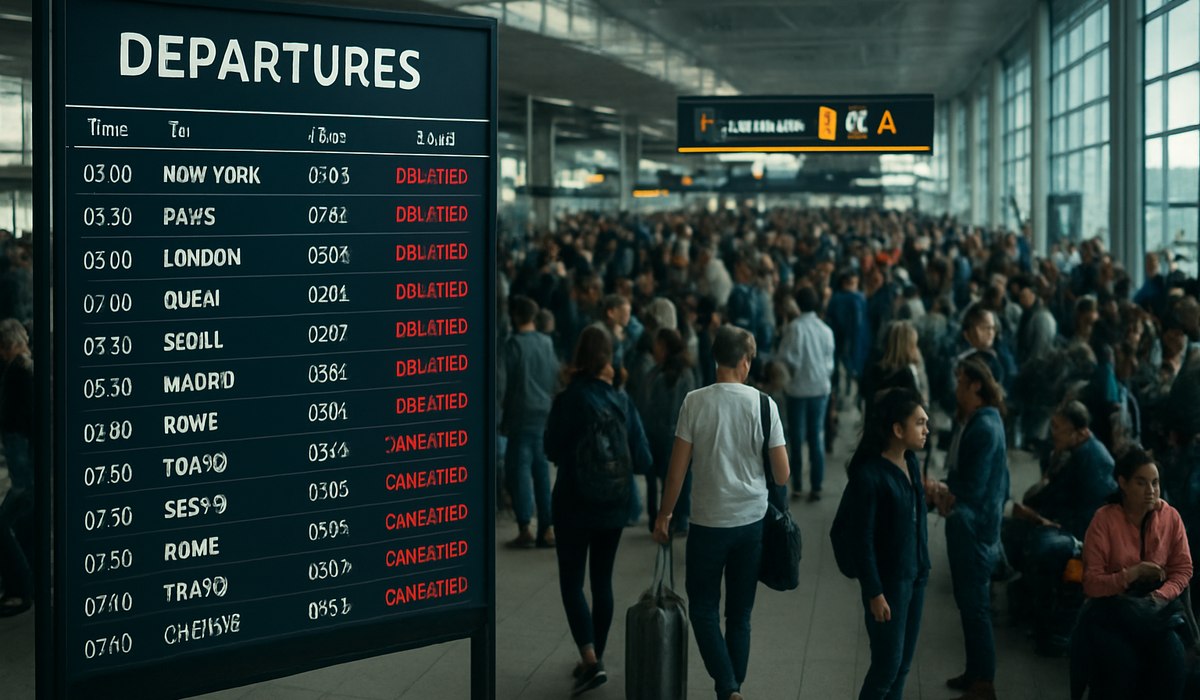
Image generated by AI
Heathrow's April 2026 Operational Crisis Leaves Hundreds Stranded
London Heathrow Airport has become the epicenter of European aviation disruption, with 319 delayed flights and 15 cancellations cascading through one of the world's busiest travel hubs. The operational disruption, concentrated on April 9, 2026, has stranded hundreds of passengers on critical transatlantic and regional routes operated by British Airways, American Airlines, Lufthansa, and multiple other carriers. Major destinations including New York, Dubai, Paris, and Frankfurt have all felt the immediate ripple effects of Heathrow's scheduling strain.
This fresh wave of delays signals deeper systemic challenges facing European aviation as spring travel demand collides with capacity constraints and infrastructure limitations at the continent's primary gateways.
Scale of Disruption at Europe's Busiest Hub
Heathrow's operational data from April 2026 underscores mounting pressure on an airport already operating near maximum capacity during peak travel seasons. The 319 delayed flights represent a significant operational challenge when combined with 15 outright cancellations—a ratio that suggests systemic rather than isolated problems. Airlines operating under these constraints cannot absorb delays through spare aircraft or crew repositioning, forcing them into successive cancellations that compound passenger frustration.
The knock-on effect extends far beyond the immediate day. When a morning flight from London to New York arrives four hours late, the aircraft scheduled for an evening return service cannot depart on time, automatically delaying dozens of subsequent legs across multiple airlines' networks. This cascading failure pattern is particularly acute at Heathrow, where shared runway infrastructure and limited slot availability leave no margin for recovery. Passengers attempting connections through the airport face multiplied cancellation risks, while transit traffic between Europe and long-haul markets experiences amplified uncertainty.
Recent analyses of operational performance across major European hubs reveal that coordinated disruption at London, Frankfurt, and Madrid simultaneously creates what aviation professionals term a "network shock"—a moment when system-wide redundancy disappears and individual delays trigger wholesale schedule collapses.
Global Impact: How Heathrow Delays Ripple Worldwide
Hundreds stranded Heathrow disruptions carry outsized consequences because the airport functions as a global aviation hub connecting North America, the Middle East, Asia, and Africa through a single bottleneck. When British Airways and partner airlines encounter scheduling problems at London, the impact reverberates across 24-hour flying windows spanning multiple continents.
Transatlantic services to New York's JFK and Newark airports experienced extended departure holds and selective cancellations as carriers attempted aircraft repositioning. A morning departure delay automatically pushes back an evening return flight by identical duration, effectively canceling profitable nighttime slots when demand is highest. American Airlines and British Airways joint-venture operations, which depend on precision timing across their transatlantic network, absorbed particular strain as crew scheduling conflicts multiplied.
Gulf region services to Dubai and Doha also faced disruption, intersecting with existing Middle Eastern airspace constraints and schedule adjustments affecting connecting passengers. Passengers booked on morning departures to the Middle East who experienced Heathrow delays often missed their onward Asia-Pacific connections, requiring multi-day rebookings through alternative routing. The knock-on effect transformed local airport disruption into transcontinental itinerary failures.
Contributing Factors and Regional Aviation Instability
April 2026 disruption at Heathrow reflects converging operational pressures rather than a single failure point. European aviation has experienced elevated instability throughout early April, with severe weather systems, saturated schedules, and technical constraints in shared airport systems all contributing to heightened delays across the continent.
Heathrow operates with minimal scheduling buffer—nearly all landing and departure slots are occupied during daytime hours, meaning any delay immediately cascades into subsequent services. When weather, maintenance issues, or air traffic control constraints add even 30 minutes of ground time per flight, the compounding effect across 319 delayed services creates immense passenger disruption.
Contributing factors include crew duty-time regulations that prevent extended flight operations without mandatory rest periods. When inbound services arrive significantly late, airlines cannot simply extend crew shifts to compensate—regulations force schedule adjustments that cascade across the entire network. Airlines operating at Heathrow found themselves unable to recover from initial delays without strategic cancellations, a choice that frustrated hundreds of passengers.
Regional instability across Frankfurt, Munich, Madrid, and other major European hubs simultaneously creates a situation where spare aircraft cannot be positioned to cover Heathrow disruptions. Airlines like Lufthansa managing their own network disruptions cannot spare aircraft for emergency rerouting through London, leaving carriers without recovery options.
Affected Routes and Passenger Impact Details
| Route | Carrier(s) | Status Impact | Typical Frequency |
|---|---|---|---|
| London-New York JFK | British Airways, American Airlines | 4+ hour delays, selective cancellations | 15+ daily |
| London-Newark | United Airlines, United Airlines partners | Extended departure holds | 8+ daily |
| London-Dubai | Emirates, British Airways | Disrupted connections to Asia | 12+ daily |
| London-Paris | British Airways, Air France | Cascading delays on feeder routes | 20+ daily |
| London-Frankfurt | Lufthansa, British Airways | Connection failures to Asian hubs | 18+ daily |
| London-Manchester | British Airways, Ryanair | Domestic rotation compression delays | 25+ daily |
| London-Edinburgh | British Airways, Scottish carriers | Aircraft rotation delays from long-haul | 12+ daily |
| London-Glasgow | Ryanair, British Airways | Compressed turnaround times | 8+ daily |
What Passengers Need to Know
Travelers affected by Heathrow's April 2026 operational disruption should understand their rights and take immediate protective action. The European Union's passenger rights legislation entitles delayed and cancelled flight passengers to compensation ranging from €250 to €600 depending on flight distance, provided airlines cannot prove "extraordinary circumstances" caused the disruption.
Traveler Action Checklist
-
Document your disruption immediately: Photograph booking confirmations, delay notices, and airline communication. Request written delay confirmation from the airline before leaving the airport.
-
Request rebooking on alternate flights: Airlines must rebook you on the next available service at no additional cost. Request preference for competing carriers if original airline cannot accommodate within 24 hours.
-
Collect expenses for care and assistance: Retain all receipts for meals, hotel accommodations, and ground transportation if delayed overnight. Airlines must reimburse these costs up to €30 per meal and €120 per hotel night.
-
File compensation claims immediately: Contact your airline's customer relations department with documentation. Set a 30-day deadline to receive initial response or escalate to national enforcement bodies.
-
Check flight tracking platforms: Use FlightAware and airline apps to monitor rebooked flights in real-time. Expect continued delays on subsequently booked services during this disruption period.
-
Verify your passenger rights coverage: Confirm your ticket type and route eligibility for EU261 compensation. Connecting passengers have different rights than point-to-point passengers.
-
Contact your travel insurance provider: If you purchased travel insurance, notify them immediately and file claims for non-reimbursable expenses airline won't cover.
FAQ
Q: What compensation am I entitled to if my Heathrow flight was delayed or cancelled? Under EU Regulation 261/2004, passengers delayed over 3 hours receive €250-€600 compensation based on flight distance, unless the airline proves extraordinary circumstances. Cancellations prompt identical compensation. However, technical defects rarely qualify as extraordinary circumstances.
Q: How do I track my reboooked flight to ensure it departs on time? Use FlightAware's real
Disclaimer
This article is for informational and educational purposes only. It does not constitute legal, financial, or professional advice. While we strive to provide accurate and up-to-date information, travel policies, regulations, and conditions change rapidly. Always verify information with official sources before making travel decisions. Nomad Lawyer makes no representations about the accuracy, reliability, completeness, or suitability of the information provided. Readers should consult qualified professionals for advice specific to their circumstances. The views expressed in this article are those of the author and do not necessarily reflect the views of Nomad Lawyer.
Raushan Kumar
Founder & Lead Developer
Full-stack developer with 11+ years of experience and a passionate traveller. Raushan built Nomad Lawyer from the ground up with a vision to create the best travel and law experience on the web.
Learn more about our team →