
Airbus A350's Revolutionary Wing Design Slashes Fuel Consumption by 25%, Signaling Major Shift in Aircraft Economics
Breaking airline news and aviation industry updates for 2026.

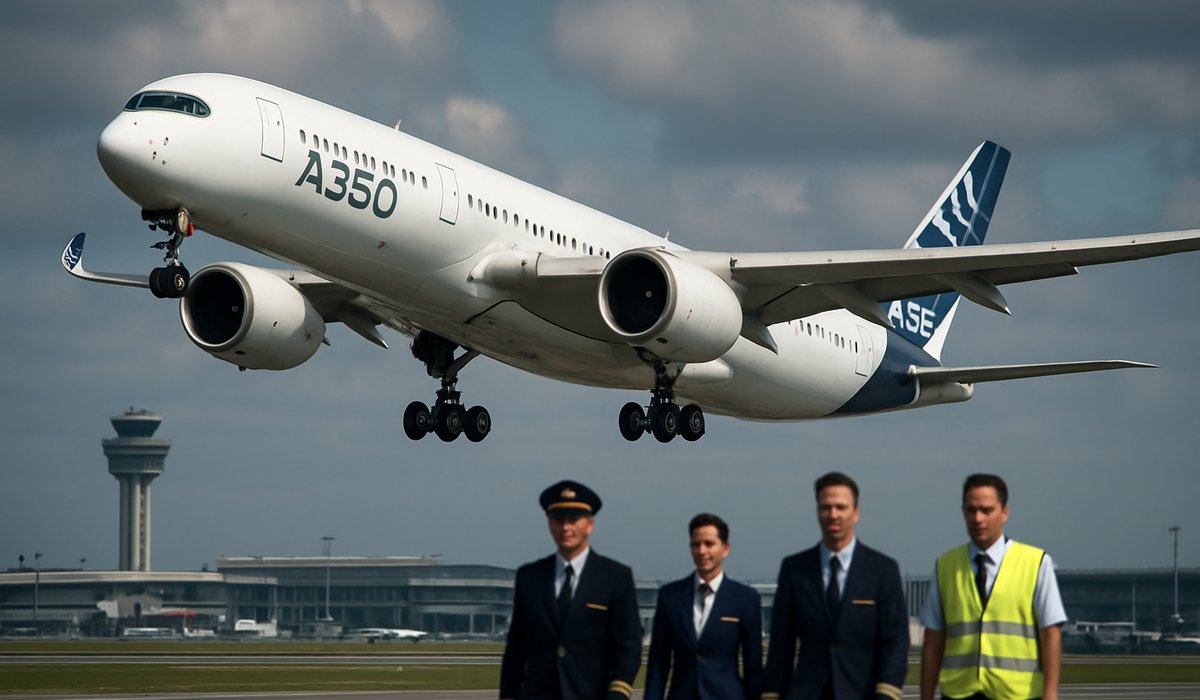
Image generated by AI
Airbus A350's Revolutionary Wing Design Slashes Fuel Consumption by 25%, Signaling Major Shift in Aircraft Economics
Bio-inspired technology transforms wide-body jet efficiency, reshaping airline operating costs and environmental impact
A Comeback Born from Crisis
When Boeing's 787 Dreamliner captured the market imagination in the 2000s, Airbus faced an existential challenge. Distracted by its costly A380 superjumbo program—a project that would ultimately consume over $25 billion in development—the European manufacturer scrambled to respond to Boeing's game-changing composite aircraft. Initial attempts to retrofit the aging A330 with new engines and cockpit systems failed to impress prospective customers, leaving Airbus vulnerable to Boeing's relentless competition across the critical long-range segment where the 777 dominated.
Cornered by market forces and mounting pressure from airlines seeking fuel-efficient alternatives, Airbus made a critical decision: complete reimagination rather than incremental improvement. The result is the A350, an aircraft featuring breakthrough aerodynamic innovations that fundamentally reshape how modern commercial aviation consumes fuel.
The Wing That Adapts in Real Time
The A350's defining technological achievement lies in its sophisticated wing architecture, engineered to morph dynamically during flight operations. Drawing inspiration from avian wing mechanics—the way birds instinctively adjust feather configurations for optimal efficiency—Airbus's design enables the aircraft's wing surfaces to continuously reconfigure based on flight conditions, altitude, and speed parameters.
This adaptive capability delivers extraordinary operational results: a 25-percent reduction in fuel consumption compared to earlier wide-body competitors. For global airlines already grappling with volatile jet fuel prices and mounting pressure to reduce aviation emissions, this efficiency gain translates directly to improved bottom-line economics.
Industry-Wide Implications for Airline Economics
The fuel-efficiency breakthrough holds profound implications for the aviation sector's operational framework. Airlines operating the A350 can reduce their exposure to jet fuel price volatility—a persistent headwind that has driven sustained increases in baggage charges, seat selection fees, and ancillary revenue streams across the industry. Enhanced fuel economics enable carriers to moderate or stabilize these passenger-facing fees while maintaining profitability margins.
The development represents a watershed moment in aircraft engineering, validating Airbus's decision to pursue radical innovation over cosmetic modification. Where Boeing's 787 emphasized advanced materials, Airbus's A350 demonstrates that aerodynamic transformation—grounded in biological principles—can deliver equivalent or superior performance gains.
Looking Forward
As airlines worldwide confront dual pressures from environmental regulations and fuel-cost inflation, the A350's efficiency credentials position it as a market accelerant. The aircraft effectively rebalances Airbus's competitive position against Boeing while offering carriers a tangible path toward more sustainable long-haul operations.
FAQ: Understanding the A350's Impact on Aviation
How much fuel does the A350 actually save compared to older aircraft? The A350 achieves approximately 25-percent fuel consumption reduction versus earlier wide-body jets, directly impacting airline operating costs and baggage fee structures.
What is "wing morphing" and how does it work? Bio-inspired wing technology allows the aircraft's wing surfaces to continuously reshape during flight, automatically optimizing aerodynamic efficiency based on speed, altitude, and atmospheric conditions—similar to how birds adjust their wings.
Will the A350's efficiency lead to lower airfare prices? Improved fuel economics reduce airline operating costs, potentially moderating ancillary fees like baggage charges, though ticket pricing remains dependent on market competition and demand dynamics.
Why did Airbus initially fail to attract customers with early A350 versions? The original A350 concept—essentially an upgraded A330—lacked meaningful differentiation from competitor offerings. Complete redesign with breakthrough wing technology proved necessary to win market acceptance.
How does jet fuel price volatility affect airline profitability and passenger fees? When fuel costs spike, airlines increase ancillary charges to maintain margins. Aircraft with superior fuel efficiency, like the A350, reduce exposure to fuel-price swings and may stabilize fee structures.
Related Travel Guides
External Resources
Disclaimer
This article is for informational and educational purposes only. It does not constitute legal, financial, or professional advice. While we strive to provide accurate and up-to-date information, travel policies, regulations, and conditions change rapidly. Always verify information with official sources before making travel decisions. Nomad Lawyer makes no representations about the accuracy, reliability, completeness, or suitability of the information provided. Readers should consult qualified professionals for advice specific to their circumstances. The views expressed in this article are those of the author and do not necessarily reflect the views of Nomad Lawyer.
Kunal K Choudhary
Co-Founder & Contributor
A passionate traveller and tech enthusiast. Kunal contributes to the vision and growth of Nomad Lawyer, bringing fresh perspectives and driving the community forward.
Learn more about our team →