
Severe Travel Chaos Paralyzes Harbin Taiping Airport as Massive 65-Flight Disruption Wave Strands Air China and Hainan Airlines Passengers: Latest Airline News
Northeast China's critical winter aviation gateway has buckled under extreme operational pressure, with Harbin Airport suffering 56 delays and 9 cancellations that are severing massive domestic business and tourism routes.

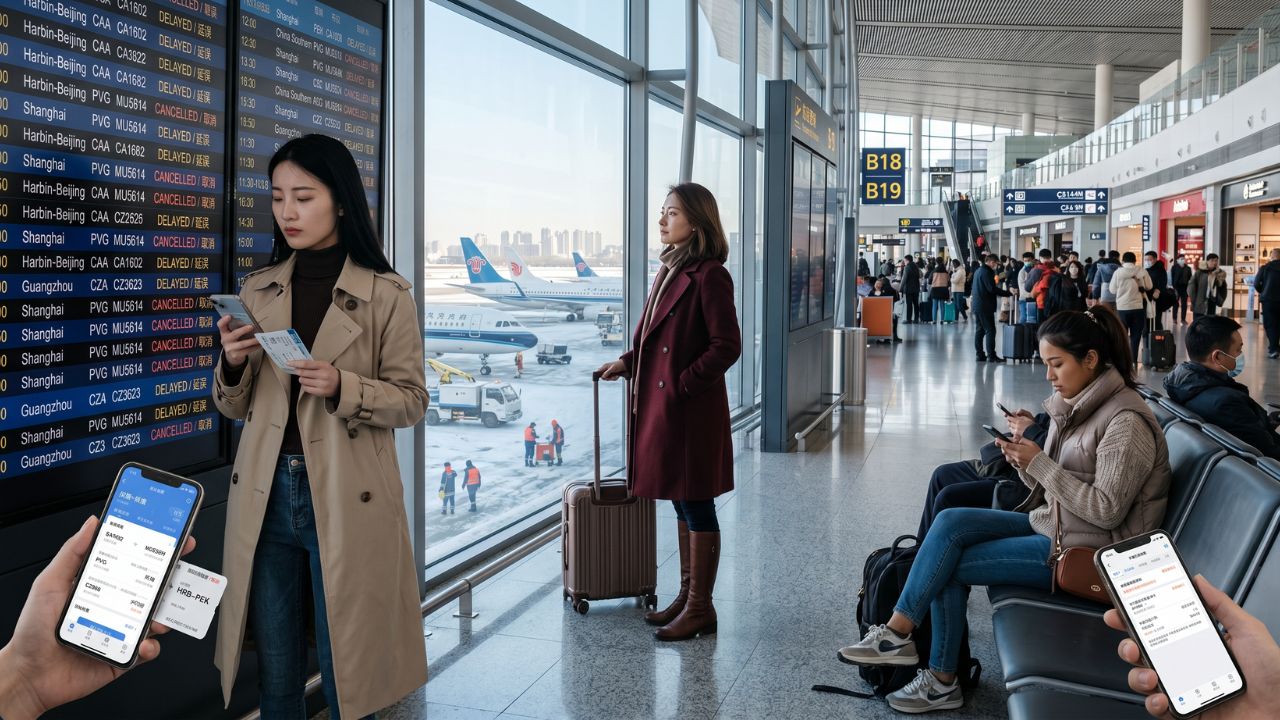
Image generated by AI
In a highly destructive operational breakdown that is currently tearing through the absolute core of Northeast China's aviation infrastructure, thousands of domestic business and leisure passengers have been completely stranded following a catastrophic wave of airport disruptions at Harbin Taiping International Airport. According to official flight data for the current reporting period, this premier winter transit gateway has buckled under extreme logistical pressure, officially recording a staggering 56 flight delays and 9 outright cancellations. As major legacy and regional airlines desperately scramble to reset their interconnected networks, severe travel chaos is ravaging the schedules of Hainan Airlines, China Eastern Airlines, Air China, and Spring Airlines. With critical routes bound for Beijing, Shanghai, Guangzhou, and Chengdu suffering massive cascading interruptions, this systemic capacity failure represents the premier headline in today's breaking airline news and critical global aviation updates.
By introducing direct passenger coordination and dynamic scheduling backups, the regional aviation hubs target growing passenger demand across vital commerce sectors. The choice to coordinate flight departures in phases helps to manage gate capacity, supporting the country's broader regional transportation network.
Context: The Collapse of the Northeast Gateway
For the thousands of passengers relying on Harbin Taiping International Airport to seamlessly connect them to China's massive urban megacities and critical winter tourism zones, the current operational reality has degenerated into an absolute logistical nightmare.
The latest data from the Heilongjiang aviation network highlights precisely how rapidly a structural bottleneck can destabilize a national transit grid. The concentration of 65 total disruptions (56 delays, 9 cancellations) has placed insurmountable pressure on ground handling, gate allocation, and aircraft rotation schedules. Because multiple carriers operate overlapping departure windows out of Harbin, even minor ground delays have instantly escalated into a cascading network failure. This breakdown has devastated the tightly scheduled winter route structures typical of Northeast China hubs. Passengers traveling for critical business, education, and seasonal winter tourism are currently experiencing severe knock-on effects, completely missing onward connections to secondary cities and provincial airports as the entire regional aviation flow grinds to a halt.
To view live flight schedules, real-time terminal maps, or specific delay protocols for the Northeast China network, travelers must consult the official Harbin (HRB) airport directories. For direct booking access, specific baggage rules, and rebooking options, passengers should check the official Air China portal or their respective operating carrier. To explore live flight tracking and monitor the exact severity of the domestic airspace closures, passengers can consult the official FlightAware tracking service.
Section-Wise Breakdown of the Harbin Meltdown
Hainan Airlines and China Eastern: The Cancellation Epicenter
The sheer volume of the disruption has fallen heavily on major legacy carriers. Hainan Airlines recorded the highest cancellation impact among individual operators, executing significant, sudden schedule adjustments on its domestic sectors linked to Harbin. Simultaneously, China Eastern Airlines reported a highly volatile mix of delays and hard cancellations, indicating severe rotational disruptions across its network flow connecting to major eastern hubs like Shanghai.
Air China and Secondary Carrier Gridlock
The disruption immediately spread to the national flag carrier. Air China faced massive operational strain, with multiple delayed services crippling onward domestic connections to Beijing. Secondary and regional legacy carriers, including Shandong Airlines and XiamenAir, significantly contributed to the broader delay statistics, highlighting a system-wide scheduling pressure that spared virtually no operator on the tarmac.
Low-Cost and Cargo Logistics Failure
The breakdown spared neither budget travel nor critical logistics. Low-cost operators like Spring Airlines, 9 Air, and Juneyao Airlines experienced massive rolling delays. Furthermore, cargo and express operations, specifically SF Airlines, suffered intense scheduling pressure. The disruption of these freight operations highlights how passenger gate bottlenecks can instantly suffocate broader aviation logistics and regional supply chains.
Technical Roster: Harbin Disruption Matrix
To ensure absolute factual accuracy regarding the specific airlines driving this massive Chinese aviation failure, the following table details the core operational metrics generated by the Harbin Airport breakdown:
| Airline / Operating Carrier | Operational Disruption Metric | Regional Travel Market Impact |
|---|---|---|
| Harbin Taiping Intl. | 56 Delays & 9 Cancellations | Northeast China's premier gateway suffers a massive operational collapse |
| Hainan Airlines | Highest Cancellation Ratio | Severe schedule adjustments destroy domestic point-to-point itineraries |
| China Eastern & Air China | Massive Rolling Delays | High-frequency legacy routes to Beijing and Shanghai suffer severe gridlock |
| Spring Airlines & 9 Air | System-Wide Delays | Low-cost leisure travelers face massive waiting times in the terminal |
| SF Airlines (Cargo) | Express Logistics Delayed | Passenger gate bottlenecks instantly suffocate regional freight operations |
Passenger Impact: Stranded in Heilongjiang
For the everyday passengers currently trapped inside Harbin Taiping International Airport, the logistical reality is rapidly deteriorating.
The immediate impact is felt most severely by passengers holding complex, multi-leg domestic itineraries connecting through Beijing, Shanghai, Guangzhou, or Chengdu. Because Chinese domestic connections operate on exceedingly tight windows, a mere 45-minute delay on an inbound regional flight frequently results in a passenger missing a highly lucrative onward connection. For the inbound demographic, Harbin’s massive seasonal winter tourism economy depends heavily on punctual air connectivity; delays risk completely ruining same-day travel flows for tourists visiting Heilongjiang’s famous ice and snow destinations. The emotional stress of ruined vacations is compounded by the intense customer service load, as airline rescheduling has led to total congestion in digital rebooking systems, leaving travelers facing extended layovers due to limited seat availability during peak reallocation periods.
Industry Analysis: The Vulnerability of Tightly Scheduled Hubs
Aviation industry analysts view the 65-flight disruption wave at Harbin as a textbook symptom of the extreme structural vulnerability inherent in modern, tightly scheduled winter operations.
While no specific external weather event was cited as the singular trigger, analysts note that the disruption pattern heavily suggests an intense failure in air traffic flow management compounded by overlapping departure banks. When an airport operates at maximum capacity during the busy winter season, airlines have virtually zero buffer to absorb a minor delay. A single late aircraft rotation immediately occupies a gate needed by an arriving flight, creating a network-wide imbalance where aircraft, crew, and gate resources require immediate reallocation. This cascading failure directly implicates operators like China Southern Airlines and Shenzhen Airlines, who suffer downstream repositioning delays even when they are not physically grounded in Harbin.
Actionable Advice for Surviving Harbin Disruptions
If you are a traveler relying on Air China, Hainan Airlines, or regional operators through Harbin during this massive disruption wave, execute this extreme survival checklist immediately:
- Pad Domestic Connections: If you are flying inbound to Harbin to catch an onward flight to Beijing or Shanghai, always assume standard HRB peak-hour friction. Build a minimum 3-hour buffer into your layover to absorb inevitable ground handling delays.
- Aggressive Pre-Emptive Rebooking: If your Hainan Airlines flight is officially listed among the cancellations, do not stand in the physical customer service line. Immediately contact your airline via the official mobile app to secure alternative travel arrangements before the remaining commercial inventory vanishes.
- Monitor Freight Corridors: If you are an enterprise reliant on SF Airlines or commercial cargo out of Harbin, assume that passenger re-accommodation will take absolute priority over freight departures. Adjust your supply chain logistics accordingly for the next 48 hours.
- Secure Local Lodging Quickly: Because Harbin is a major winter tourism destination, local hotel capacity is often near 100%. If your evening flight is cancelled, secure a hotel room immediately via your phone before the hundreds of other stranded passengers flood the local inventory.
FAQ: Harbin Airport Flight Disruptions 2026
How severe is the current operational breakdown at Harbin Taiping International Airport?
Harbin is buckling under significant operational strain, officially recording a highly disruptive 56 flight delays and 9 outright cancellations across major legacy and low-cost carriers.
Which specific airlines are most affected by this travel chaos?
The disruption wave heavily impacted Hainan Airlines (highest cancellations), China Eastern, Air China, Spring Airlines, Shandong Airlines, XiamenAir, and major cargo operators like SF Airlines.
What domestic routes are suffering from these Harbin delays?
The massive delay wave has completely destabilized the regional network, severing or severely delaying flights connecting Harbin to major economic hubs like Beijing, Shanghai, Guangzhou, and Chengdu.
The Breaking Point of the Winter Gateway
The catastrophic wave of 65 flight disruptions ravaging Harbin Taiping International Airport proves definitively that the Northeast Chinese aviation infrastructure is currently operating on a razor's edge in 2026. By entirely devastating the highly scheduled, interconnected operations of Hainan Airlines, Air China, and China Eastern, this operational meltdown has ruthlessly exposed the deep logistical fragility of Heilongjiang's premier tourism and business gateway. As airlines desperately attempt to prioritize high-demand routes to Beijing and clear the massive backlog of stranded passengers, travelers and policymakers must accept a brutal reality: navigating Harbin during peak periods requires extreme flexibility, aggressive contingency planning, and the absolute understanding that a minor ground delay can instantly paralyze a national itinerary.
Key Takeaways
- Massive 65-Flight Breakdown: Harbin Taiping International Airport has been paralyzed by a severe operational collapse, recording 56 rolling flight delays and 9 outright cancellations.
- Hainan and China Eastern Crippled: Major legacy carriers absorbed the brunt of the cancellations and severe rotational delays, destroying point-to-point domestic connectivity.
- National Hubs Severed: Critical routes connecting Harbin to massive economic centers like Beijing, Shanghai, Guangzhou, and Chengdu suffered devastating logistical friction.
- Ground Handling Failure: The primary driver of the chaos was intense pressure on gate allocation and overlapping departure windows, creating a massive cascading delay effect.
- Tourism and Cargo Disrupted: The breakdown severely impacted inbound winter tourism to Heilongjiang and suffocated regional express logistics operators like SF Airlines.
Related Travel Guides
Severe Travel Chaos Paralyzes San Francisco Across Major Airlines
Severe Travel Chaos Paralyzes Tampa Airport Across Major Airlines
Harbin Airport Disruption and Rebooking Strategies Discussion on Reddit
Disclaimer
This article is for informational and educational purposes only. It does not constitute legal, financial, or professional advice. While we strive to provide accurate and up-to-date information, travel policies, regulations, and conditions change rapidly. Always verify information with official sources before making travel decisions. Nomad Lawyer makes no representations about the accuracy, reliability, completeness, or suitability of the information provided. Readers should consult qualified professionals for advice specific to their circumstances. The views expressed in this article are those of the author and do not necessarily reflect the views of Nomad Lawyer.
Kunal K Choudhary
Co-Founder & Contributor
A passionate traveller and tech enthusiast. Kunal contributes to the vision and growth of Nomad Lawyer, bringing fresh perspectives and driving the community forward.
Learn more about our team →