
Guangzhou Baiyun Airport Plunges Into Travel Chaos as 530 Flight Delays and Strategic Flight Cancellations Trigger Severe Airport Disruptions Across Southern China: Latest Airline News
A catastrophic delay crisis has struck Guangzhou Baiyun Airport, triggering brutal travel chaos as 530 delayed flights trap thousands of passengers in severe terminal gridlock.

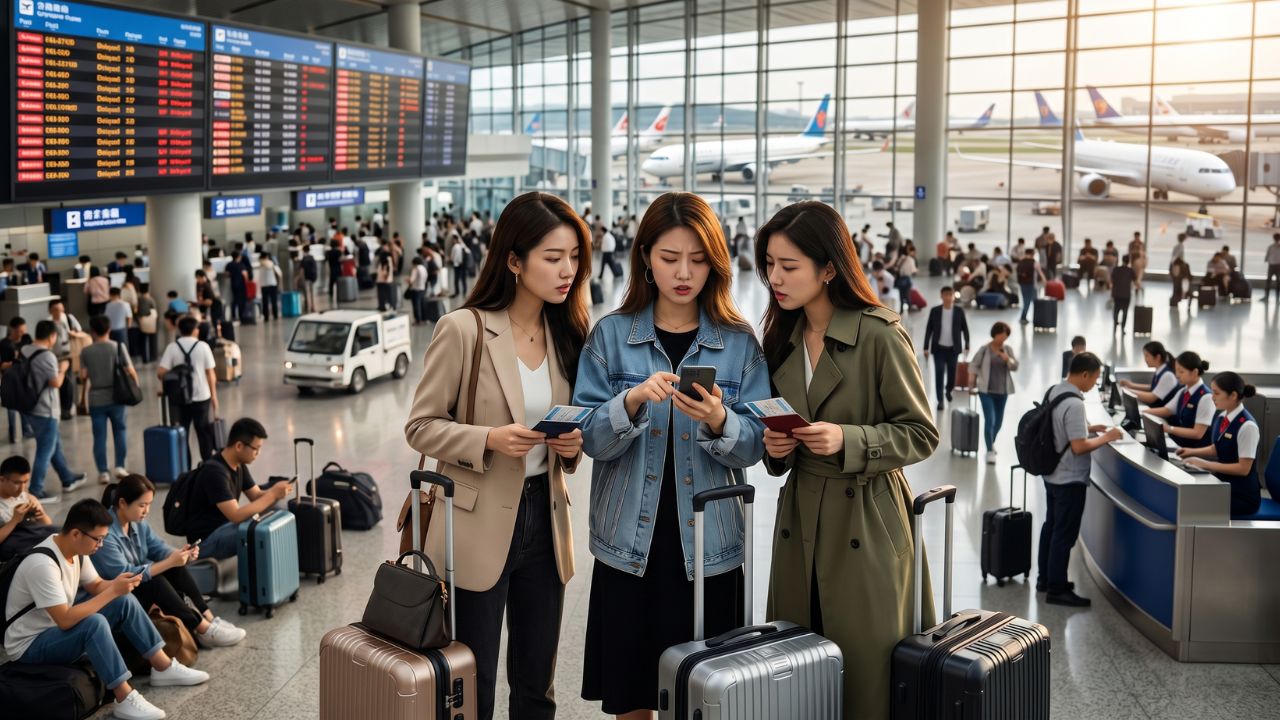
Image generated by AI
In a devastating operational breakdown that is currently driving unprecedented travel chaos and targeted flight cancellations across one of southern China’s most critical aviation gateways, Guangzhou Baiyun International Airport is suffering a catastrophic terminal meltdown. Recorded today, June 18, 2026, the massive mega-hub has been hammered by an astonishing 530 delayed departures, completely paralyzing the transit schedules of thousands of domestic and international passengers. While total airspace collapse was narrowly avoided—limiting outright groundings to just seven cancelled flights across carriers like China Eastern and 9 Air—the sheer volume of rolling delays has triggered severe airport disruptions. Passengers connecting to critical global markets including Singapore, Vietnam, Turkey, and Kenya are currently trapped in agonizing terminal gridlock as major operators like China Southern desperately attempt to recover their schedules. As furious travelers face destroyed itineraries and missed connections across the region, this brutal "delay-dominated" crisis stands as the premier headline in today's breaking airline news and absolutely vital global aviation updates.
By introducing direct passenger coordination and dynamic scheduling backups, the regional aviation hubs target growing passenger demand across vital commerce sectors. The choice to coordinate flight departures in phases helps to manage gate capacity, supporting the country's broader regional transportation network.
Context: The Anatomy of a Delay-Dominated Crisis
For the thousands of corporate commuters and international tourists attempting to navigate southern China today, the sheer scale of operational bottlenecks at Guangzhou Baiyun has transformed routine transit into absolute physical exhaustion.
Historically, massive weather events force airports to immediately execute hundreds of flight cancellations, instantly clearing the tarmac but abandoning passengers. Today's crisis at Guangzhou presents a different, highly exhausting form of travel chaos: the delay-dominated disruption. The airport has remained functional, but its operational efficiency has collapsed. Airlines are desperately attempting to keep their networks active rather than grounding jets, resulting in aircraft departing hours behind schedule. This strategy creates a brutal cascading effect. When China Southern Airlines delays 232 flights to wait for late-arriving aircraft or crews, those jets are subsequently late for their next rotations, triggering rolling airport disruptions throughout the entire day. For passengers, this means holding a valid ticket but spending hours trapped in a congested departure hall, nervously watching the boarding time continually shift as regional connectivity slowly grinds to a halt.
To view live flight schedules, verify the active delay status of your specific itinerary, or to track active regional airspace restrictions, travelers must consult official aviation directories. For direct booking access on carriers attempting to recover from this massive terminal gridlock, travelers should actively monitor the official portals for major operators like China Southern Airlines and China Eastern Airlines. To explore live flight tracking and monitor the exact severity of the cascading delays causing the flight cancellations you are actively surviving, passengers can consult the official FlightAware tracking service.
Section-Wise Breakdown of the Guangzhou Meltdown
The Dominant Operator: China Southern Airlines
The operational data reveals that the hub's largest resident carrier is shouldering the absolute worst of the travel chaos. China Southern Airlines reported an incredible 232 delayed flights, representing a 33% delay rate across its massive schedule. Because Guangzhou serves as the airline's primary global hub, delays affecting one aircraft instantly cascade throughout its entire domestic and international network. By refusing to cancel a single flight today, China Southern preserved itineraries but forced tens of thousands of passengers into extreme terminal wait times.
The Cancellation Crisis: China Eastern and 9 Air
While most airlines absorbed delays, China Eastern Airlines faced more substantial operational challenges, balancing schedule recovery while being forced to execute four flight cancellations (alongside 66 delays, a massive 47% delay rate). Similarly, 9 Air executed three flight cancellations (a 4% rate for their smaller network). These targeted cancellations instantly triggered immediate stranding scenarios for passengers whose aircraft were removed from the board entirely.
Total Saturation Across the Network
The crisis at Guangzhou is not isolated to a few operators. Hainan Airlines recorded 58 delayed flights (a brutal 61% delay rate), Air China suffered 49 delays (a 50% rate), and Shenzhen Airlines logged 32 delays. Astonishingly, several smaller carriers—including China United Airlines, Tianjin Airlines, Hebei Airlines, and Lao—suffered 100% delay rates, meaning every single scheduled movement they operated through Guangzhou today failed to depart on time.
Technical Roster: Guangzhou Baiyun Operational Data
To ensure absolute factual accuracy regarding the exact scale of this operational collapse and the extreme defensive measures executed by airlines, the following matrix details the verified disruption data for June 18, 2026. This data explicitly retains all factual percentages and flight counts.
Today’s Flight Disruption Statistics at Guangzhou Baiyun International Airport
| Airline | Cancelled (#) | Cancelled (%) | Delayed (#) | Delayed (%) |
|---|---|---|---|---|
| China Eastern | 4 | 2% | 66 | 47% |
| 9 Air | 3 | 4% | 8 | 11% |
| AirAsia | 0 | 0% | 1 | 7% |
| China Airlines | 0 | 0% | 1 | 25% |
| Beijing Capital Airlines | 0 | 0% | 4 | 25% |
| Air China | 0 | 0% | 49 | 50% |
| Zhejiang Loong | 0 | 0% | 3 | 16% |
| Shandong Airlines | 0 | 0% | 4 | 28% |
| West Air | 0 | 0% | 1 | 16% |
| Hainan Airlines | 0 | 0% | 58 | 61% |
| Cathay Pacific | 0 | 0% | 1 | 16% |
| Spring Airlines | 0 | 0% | 12 | 37% |
| Sichuan Airlines | 0 | 0% | 12 | 48% |
| Shanghai Airlines | 0 | 0% | 4 | 44% |
| China Southern Airlines | 0 | 0% | 232 | 33% |
| Shenzhen Airlines | 0 | 0% | 32 | 32% |
| China United Airlines | 0 | 0% | 4 | 100% |
| XiamenAir | 0 | 0% | 13 | 50% |
| Juneyao Airlines | 0 | 0% | 6 | 37% |
| Ethiopian Airlines | 0 | 0% | 1 | 33% |
| Tianjin Airlines | 0 | 0% | 3 | 100% |
| Hebei Airlines | 0 | 0% | 4 | 100% |
| Vietnam Airlines | 0 | 0% | 1 | 25% |
| Kunming Airlines | 0 | 0% | 2 | 50% |
| Kenya Airways | 0 | 0% | 1 | 50% |
| Lao | 0 | 0% | 1 | 100% |
| Lucky Air | 0 | 0% | 1 | 50% |
| MAI | 0 | 0% | 1 | 50% |
| Singapore Airlines | 0 | 0% | 1 | 16% |
| Tibet Airlines | 0 | 0% | 1 | 50% |
| Scoot | 0 | 0% | 1 | 50% |
| Turkish Airlines | 0 | 0% | 1 | 16% |
Passenger Impact: Trapped in Terminal Gridlock
For the tens of thousands of corporate and leisure travelers forced to navigate Guangzhou Baiyun today, the psychological toll of a delay-dominated crisis is arguably worse than an outright cancellation.
The immediate passenger impact is severe connection anxiety. A passenger flying from Guangzhou to a major international gateway like Singapore, Vietnam, Turkey, or Kenya knows that a three-hour delay on the tarmac guarantees they will miss their onward connection. Because airlines overwhelmingly chose not to execute mass flight cancellations, passengers cannot simply leave the airport and rebook for tomorrow; they must remain at the gate, enduring hours of terminal congestion while baggage systems back up and lounges overflow. Furthermore, corporate travelers attending high-stakes meetings in southern China's manufacturing hubs are seeing their schedules completely destroyed by this massive wave of 530 delayed operations.
Industry Analysis: The Danger of "Rolling" Delays
Aviation industry analysts view the specific operational profile at Guangzhou today as definitive proof that massive hub congestion is the primary driver of modern travel chaos, even when airspace remains officially open.
Analysts note that widespread delays across 32 different airlines simultaneously indicate a core structural breakdown—likely a severe confluence of air traffic control flow restrictions, high seasonal demand, and extreme runway saturation. By choosing to push 530 flights late into the schedule rather than executing strategic flight cancellations, airlines are gambling on their ability to recover aircraft rotations overnight. Industry experts warn that while this prevents immediate refund demands, it causes massive economic ripple effects. Late flights burn more fuel circling congested hubs, crews hit their regulated duty-time limits (requiring sudden mid-delay crew swaps), and the broader regional economy suffers massive productivity losses as business commuters and cargo shipments are stranded in transit.
Actionable Advice for Surviving Massive Airport Delays
If you are navigating the highly volatile Asian aviation network during a severe delay event, execute this strategic planning checklist to fully bypass regional travel chaos:
- Never Leave the Gate Area: During a delay-dominated crisis, airlines frequently issue sudden, revised boarding times when a "slot" suddenly opens. If you are sitting in a lounge on the other side of the terminal, you will miss your flight.
- Pre-empt Missed Connections: If your originating flight out of Guangzhou is delayed by two hours and you have a tight international connection (e.g., Turkish Airlines or Kenya Airways), assume you will miss it. Contact your airline's customer service immediately—while still sitting in Guangzhou—to secure a seat on the next available onward flight.
- Do Not Rely on Checked Baggage: When 530 flights are delayed, ground handling systems collapse. Aircraft rotations become so rapid that luggage is frequently left behind. Travel exclusively with carry-on bags to ensure your belongings survive the airport disruptions.
- Understand Refund Triggers: In China, if your flight is officially delayed but not cancelled (such as the 232 delayed China Southern flights), you are rarely entitled to an immediate refund. However, airlines are generally required to provide meal vouchers or hotel accommodation if the delay pushes late into the night. Demand these provisions at the service desk.
FAQ: Guangzhou Baiyun Airport Operations & Travel Chaos
How many flights were cancelled at Guangzhou Baiyun Airport today?
Despite the massive travel chaos, only seven flights were officially cancelled today (June 18, 2026), including four by China Eastern Airlines and three by 9 Air.
How severe were the flight delays?
The airport suffered a catastrophic 530 delayed flights, with China Southern Airlines recording 232 delays (33% rate) and China Eastern logging 66 delays (47% rate).
Are international flights affected by the airport disruptions?
Yes. International carriers operating out of Guangzhou, including Singapore Airlines, Turkish Airlines, Kenya Airways, and Cathay Pacific, all suffered operational delays today.
The Reality of Terminal Gridlock
The historic operational breakdown executed at Guangzhou Baiyun International Airport proves definitively that "delay-dominated" crises are the most exhausting form of physical travel chaos. By stubbornly refusing to execute mass flight cancellations and instead forcing 530 flights to operate hours behind schedule, airlines have trapped thousands of passengers in an agonizing cycle of terminal congestion. As airport infrastructure desperately struggles to manually process this backlog—triggering severe airport disruptions that ruin vital international connections to Singapore, Turkey, and Kenya—travelers must accept a critical new reality: avoiding brutal travel anxiety during a hub meltdown requires absolute vigilance, immediate contingency planning, and the aggressive utilization of carry-on luggage to survive the chaos.
Key Takeaways
- Massive Delay Volume: Guangzhou Baiyun Airport suffered 530 delayed flights on June 18, 2026, causing severe, system-wide terminal congestion.
- Minimal Cancellations: Only seven flights were officially cancelled (China Eastern and 9 Air), meaning airlines forced passengers to endure extreme delays rather than offering immediate refunds.
- Hub Operators Crushed: China Southern Airlines (232 delays) accounted for the vast majority of the travel chaos, severely impacting its primary global hub.
- International Impact: The domestic delays immediately threatened connecting itineraries to global destinations via carriers like Turkish Airlines, Singapore Airlines, and Kenya Airways.
- Passenger Survival: Travelers trapped in a delay crisis must remain at the gate, proactively rebook missed connections via phone, and avoid checking baggage at all costs.
Related Travel Guides
Massive Travel Chaos Paralyzes Chicago O'Hare with 1,425 Disruptions
Disclaimer
This article is for informational and educational purposes only. It does not constitute legal, financial, or professional advice. While we strive to provide accurate and up-to-date information, travel policies, regulations, and conditions change rapidly. Always verify information with official sources before making travel decisions. Nomad Lawyer makes no representations about the accuracy, reliability, completeness, or suitability of the information provided. Readers should consult qualified professionals for advice specific to their circumstances. The views expressed in this article are those of the author and do not necessarily reflect the views of Nomad Lawyer.
Kunal K Choudhary
Co-Founder & Contributor
A passionate traveller and tech enthusiast. Kunal contributes to the vision and growth of Nomad Lawyer, bringing fresh perspectives and driving the community forward.
Learn more about our team →