
Global Flight Disruptions Expose Deepening Strain in Aviation Networks
Cascading flight disruptions sweep across Europe, Asia Pacific, and North America in April 2026 as weather shocks, staffing shortages, and thin operational buffers reveal critical vulnerabilities in interconnected global aviation networks.

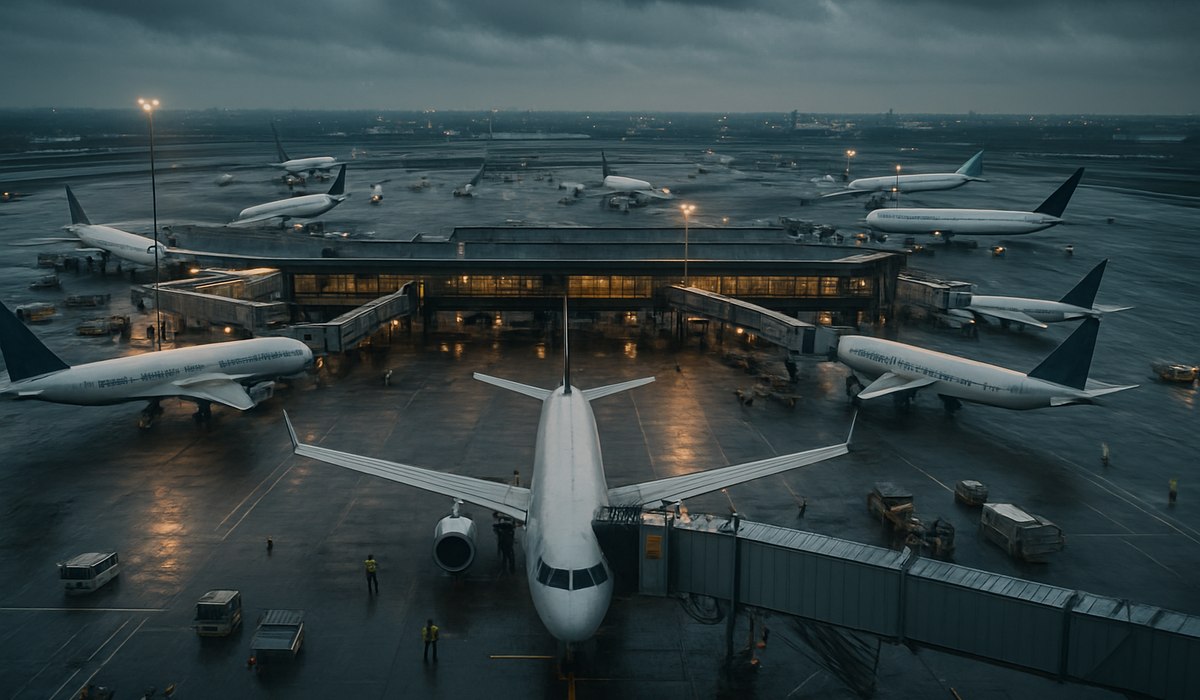
Image generated by AI
Europe's Aviation Networks Buckle Under Rolling Disruption
Europe's tightly linked hub networks are buckling under unprecedented cascading delays in April 2026, revealing dangerous fragility in a system designed with minimal operational buffers. On April 9 alone, tracking data documented over 1,600 delayed flights and dozens of cancellations across six European countries. London Heathrow and Gatwick emerged as the hardest-hit hubs, with disruptions spreading rapidly through interconnected networks.
A single late departure from a southern European airport triggered crew connection failures in Amsterdam, forcing aircraft swaps at Heathrow and cascading cancellations to Frankfurt and Zurich. These aren't isolated incidents—they exemplify how modern aviation networks amplify minor delays into continental-scale disruptions. During the Easter period, some days saw 1,400+ delays and 170+ cancellations, affecting passengers simultaneously across multiple countries rather than isolated airports. Seasonal storms combined with air traffic control constraints mean weather hundreds of kilometers away now triggers disruptions in calm skies elsewhere, as aircraft rotations and crew scheduling ripple across entire regions.
Cascading Effects Expose Systemic Vulnerabilities in Global Flight Networks
The architecture of global aviation reveals critical weak points. Global flight disruptions stem from how airlines operate with razor-thin buffers and maximized aircraft utilization, leaving zero margin for error. When one hub experiences delays, the effect propagates like dominoes across interconnected networks within hours.
A maintenance delay at a major Chinese airport in March multiplied into dozens of downstream disruptions, eventually affecting travelers in Delhi, Manila, and European cities relying on tight transfer windows. This single-aircraft issue exposed how dependence on precision scheduling creates systemic fragility. Athens and Mediterranean airports registered high disruption levels on days when severe weather occurred hundreds of kilometers northward—pure evidence that modern hub-and-spoke networks create vulnerability zones far from actual weather events.
Asia Pacific recorded 770+ cancellations and 2,000+ delays in a single day mid-March, compounded by monsoon rains, early typhoon activity, and geopolitical tensions forcing airspace rerouting. Longer, more complex flight paths increase duty times, strain crew scheduling, and trigger cascading cancellations where aircraft cannot be positioned for onward legs.
Staffing Gaps and Operating Costs Compound the Crisis
Global flight disruptions worsen as staffing levels remain below pre-pandemic capacity despite demand recovery. Asia Pacific particularly struggles with fleet and staffing constraints—demand has rebounded strongly, yet ground crews, pilots, and maintenance personnel haven't kept pace. Airlines operate with reduced resilience, meaning routine operational challenges escalate rapidly into large-scale disruptions.
In North America, severe spring storms combined with structural staffing gaps created disruption hotspots from April 2–6. Major hubs like Atlanta, Chicago O'Hare, Dallas Fort Worth, and Houston experienced hundreds of daily cancellations. A single delay at these mega-hubs reverberates across transborder networks, pushing aircraft and crews out of position and triggering rolling delays even after local weather improves.
Rising operational costs force carriers to maximize aircraft utilization and minimize crew reserve pools—strategic choices that eliminate the buffers needed to absorb weather shocks or geopolitical disruptions. The cost structure of modern aviation now creates the very fragility that disrupts millions of travelers annually.
What This Means for Business and Leisure Travelers
The April 2026 global flight disruptions demonstrate that booking with major hubs no longer guarantees reliability—instead, it increases exposure to cascading delays. Passengers experienced multi-day disruptions not from local weather but from interconnected network failures hundreds of kilometers away.
Business travelers face unpredictability on key routes like London-Frankfurt and London-Zurich. Leisure travelers during peak Easter periods encountered massive delays affecting entire regions simultaneously. The disruption pattern reveals that operational fragility now affects millions across multiple countries within hours.
Airlines cannot easily solve this without structural changes: reducing aircraft utilization, expanding crew reserves, and building schedule slack. These moves would raise ticket prices meaningfully, creating a choice between affordability and reliability that airlines have historically resolved by choosing affordability.
Key Disruption Data: April 2026 Global Flight Crisis
| Region | Date Range | Delayed Flights | Cancellations | Primary Causes |
|---|---|---|---|---|
| Europe (6 countries) | April 9, 2026 | 1,600+ | 40–50 | Weather, staffing, hub strain |
| Europe (Easter period) | April 1–7, 2026 | 1,400/day avg | 170+/day | Seasonal storms, ATC constraints |
| Asia Pacific | March 15, 2026 | 2,000+ | 770+ | Monsoons, typhoons, geopolitics |
| North America | April 2–6, 2026 | 800+/day | 50–100/day | Spring storms, staffing gaps |
| Mediterranean hubs | April 9, 2026 | 300+/day | 20–30 | Remote weather propagation |
Traveler Action Checklist: Managing Global Flight Disruption Risks
-
Book direct flights or avoid tight connections at major hub airports (Heathrow, Amsterdam, Frankfurt, Atlanta, O'Hare, Dubai). Hub transits now guarantee exposure to cascading delays from distant weather.
-
Check real-time tracking on FlightAware before departing for the airport. Monitor your aircraft's entire rotation history—delays often originate from overnight position flights.
-
Contact your airline 48 hours before departure to confirm crew scheduling and aircraft assignment. Ask specifically if your aircraft experienced disruptions or maintenance in prior rotations.
-
Verify EU261 compensation eligibility through US DOT guidelines (3-hour+ delays = compensation rights). Document all delays with photos and boarding passes.
-
Purchase comprehensive travel insurance covering airline disruptions, not just cancellations. Coverage should include rebooking costs if airlines deny rerouting to competitors.
-
Consider flying non-peak days (Tuesday–Thursday outside holiday periods) when network utilization is lower and buffers slightly wider.
-
Request written delay confirmation from airlines immediately, as compensation deadlines apply within 6 months. Many carriers deliberately withhold formal documentation.
-
Explore alternative routing yourself before contacting airline customer service—alternatives are available faster when passengers identify them.
FAQ: Global Flight Disruptions and Traveler Rights
What causes cascading flight delays across continents when local weather appears calm?
Modern aviation networks operate with precision scheduling that eliminates buffers. When weather or delays occur anywhere in an aircraft's daily rotation, the aircraft arrives late to subsequent airports, cascading across time zones. A morning delay in London propagates through afternoon services in Frankfurt and evening flights to Amsterdam—all driven by a single aircraft's late arrival chain.
How long do cascading disruptions typically last once they begin?
Cascading delays persist 24–72 hours depending on network complexity and disruption severity. Major hub delays require 12–18 hours to clear backlogs once weather/technical issues resolve. During April 2026, some routes experienced rolling delays for 5+ days as aircraft remained positioned incorrectly across networks.
Are passengers entitled to compensation for cascading delays not caused by their airline?
Yes. EU261 regulations provide €250–€600 compensation for 3+ hour delays regardless of cause except extraordinary circumstances. "Extraordinary circumstances" typically means severe weather or security incidents, not operational failures. Airlines must prove extraordinary circumstances—burden rests on carriers, not passengers.
What routes or airports should travelers avoid during disruption periods?
Preeti Gunjan
Contributor & Community Manager
A passionate traveller and community builder. Preeti helps grow the Nomad Lawyer community, fostering engagement and bringing the reader experience to life.
Learn more about our team →