
Nuremberg Airport Reopens After False Hijacking Signal and Bundeswehr Fighter Jet Interception

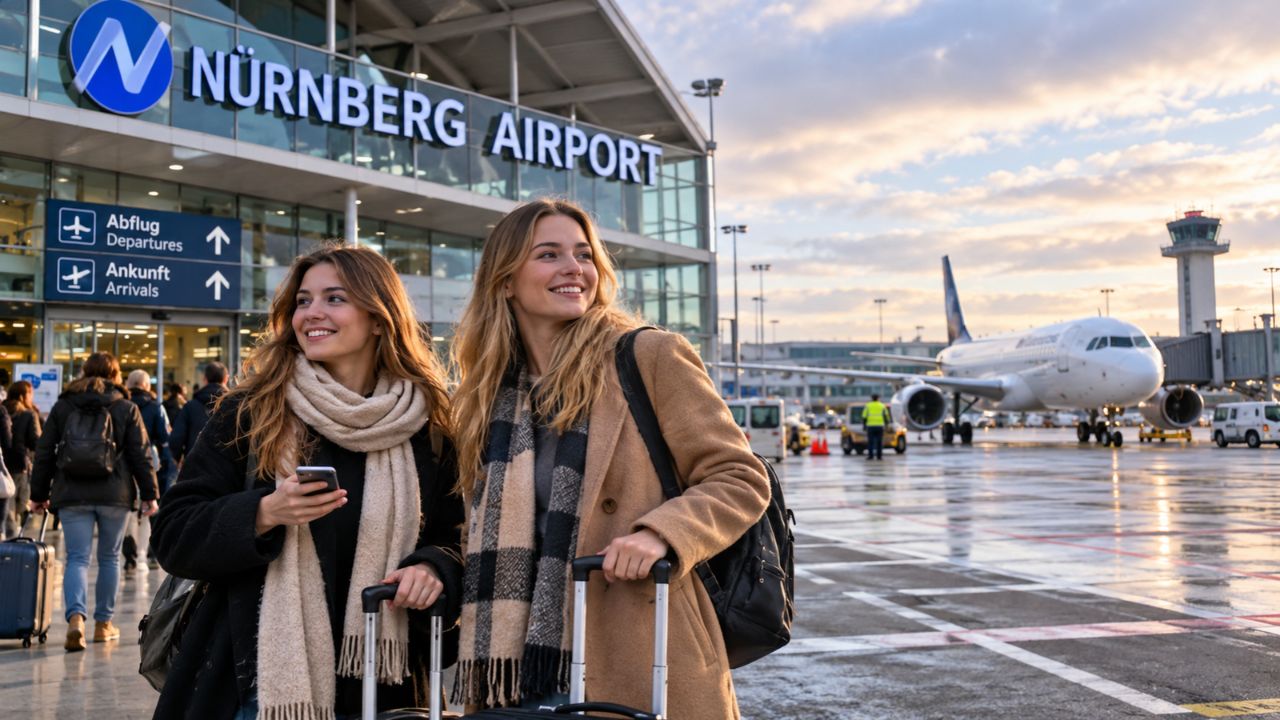
A 70-minute aerodrome shutdown and the deployment of two armed Bundeswehr fighter jets unfolded at Nuremberg Airport on 13 October 2026 after an incoming passenger airliner inadvertently squawked an emergency hijacking code. Inbound from the Greek holiday island of Corfu, the commercial aircraft transmitted a transponder code signaling unlawful interference while simultaneously becoming unreachable by air traffic controllers over German airspace. The resulting emergency protocol triggered an immediate military interception, ground containment by Mittelfranken Police, and a total suspension of take-offs and landings that grounded regional flight traffic until comprehensive cabin checks confirmed zero hostile threat.
The aircraft touched down safely under armed escort at approximately 12:15 PM local time, with regular flight operations and passenger disembarkation formally restored by 1:25 PM. Compounding the afternoon security emergency was a separate, unconfirmed drone sighting earlier that morning that diverted two flights to Cologne and Prague while delaying six departures and arrivals. Occurring at a regional aviation facility that processed a record 4,508,765 passengers in 2025, the double disruption demonstrates how automated air defense safeguards and strict aerodrome security standards operate when technical anomalies strike high-density holiday flight corridors.
Tactical Response: The Interception and Ground Containment Sequence
The incident began when the arriving Corfu service transmitted a transponder emergency code—designated internationally as Squawk 7500—indicating that the flight deck was under unlawful coercion. Coupled with an acute loss of voice radio communications, known in aviation terminology as a NORDO (No Radio) event, European air defense coordination centers instantly treated the situation as an active airborne crisis.
Under established NATO and German national security protocols supervised by the European Union Aviation Safety Agency (EASA), the German Air Force (Luftwaffe) scrambled two Quick Reaction Alert (QRA) fighter jets from their alert station. The supersonic jets intercepted the passenger aircraft, visually verified cockpit integrity, and escorted the jet to Runway 28/10 at Flughafen Nürnberg.
Upon landing at 12:15 PM, local police forces under the Polizeipräsidium Mittelfranken deployed an emergency security perimeter. Inbound commercial flights were directed into holding patterns or rerouted to alternate regional fields, while airport landside access roads were sealed at approximately 12:30 PM. Tactical units surrounded the aircraft on an isolated taxiway, conducted systematic inspections of the cabin and hold, and established emergency passenger assistance posts in the terminal. Once investigators verified that the hijack squawk resulted from an inadvertent equipment error and that no threat existed, passengers were permitted to disembark at 1:25 PM, coinciding with the lifting of the flight freeze and the reopening of perimeter roadways at 1:30 PM.
Dissecting the Disruptions: False Hijacking Alert Versus Morning Drone Sighting
To assess operational performance accurately, aviation authorities emphasize the necessity of separating the afternoon transponder incident from a completely unrelated morning airspace closure.
Earlier on the morning of 13 October, airport security detected a suspected drone in proximity to Nuremberg's approach paths. Because unverified unmanned aerial vehicles present severe ingestion hazards for jet engines, air traffic control halted movements, causing two inbound flights to divert to Cologne Bonn Airport and Prague Václav Havel Airport before returning later in the day. The morning drone scare generated delays across six scheduled services (two arrivals and four departures) before being classified as unconfirmed.
| Event & Operational Metric | Morning Airspace Incident | Afternoon False Hijack Response | Combined Passenger & System Impact |
|---|---|---|---|
| Primary Trigger | Suspected drone near airfield | Inadvertent transponder hijack squawk + NORDO | Two distinct emergencies on 13 October 2026 |
| Response Agency | Air traffic control / Local police | Bundeswehr Luftwaffe jets & Mittelfranken Police | Military scramble paired with landside cordons |
| Reported Timing | Early morning 13 October | 12:15 PM landing to 1:25 PM clearance | 70-minute total afternoon runway suspension |
| Flight Diversions | 2 flights (diverted to CGN and PRG) | Multiple inbound services rerouted or held | Diverted morning aircraft returned to NUE later |
| Flight Delays | 6 flights (2 arrivals, 4 departures) | Afternoon schedule cascades across network | Delays compounded by subsequent aircraft rotations |
| Roadside Access Status | Unaffected during morning | Access roads closed until 1:30 PM | Perimeter cordons prevented terminal vehicle pick-ups |
| Verified Security Threat | Unconfirmed drone sighting | Confirmed technical / human transponder error | Zero hostile intention established in either event |
The disruption unfolded against an operational backdrop of historic capacity expansion for Nuremberg. Official traffic data published by the airport authority on 16 January 2026 confirmed that Nuremberg achieved an all-time record of 4,508,765 passengers in 2025, marking an 11.9% increase over 2024.
Leisure travel to Mediterranean destinations like Greece, Spain, and Turkey represented the fastest-growing segment, expanding by 13.2% to roughly 1.631 million passengers, while scheduled and low-cost flights climbed 10.8% to 2.812 million travelers across 52,918 flight movements, operating at an average seat occupancy rate of 83%.
Expert Analysis: The High Cost of Uncompromised Air Defense Protocols
The immediate scrambling of armed fighter jets to intercept a commercial airliner highlights the absolute zero-tolerance doctrine governing European airspace security. Ever since post-9/11 security frameworks were codified into German federal aviation law, any commercial airliner combining radio silence with an emergency transponder code triggers an automatic military response.
For travelers booking this route, the direct consequence is severe schedule chaos without standard passenger compensation rights. Under European Union Regulation EC 261/2004, airlines are legally required to pay cash compensation ranging from €250 to €600 for flights delayed by more than three hours upon arrival. However, military airspace interventions, mandatory police lockdowns, and suspected drone incursions are classified under European law as "extraordinary circumstances" entirely outside an operating carrier's control. Passengers stranded on the tarmac or delayed by afternoon network cascades are entitled to duty-of-care provisions—such as meals, refreshments, and hotel accommodations for overnight delays—yet they possess no legal right to statutory monetary compensation.
The pricing pressure this creates means that regional airports and operating airlines must absorb significant unrecoverable operating expenses. Scrambling high-readiness Eurofighter intercepts, diverting fuel-heavy airliners to alternate airports like Prague or Cologne, and parking aircraft on remote stands burns substantial capital that neither airlines nor airport authorities can recoup from passengers.
Furthermore, civil aviation oversight administered by the Luftfahrt-Bundesamt (LBA) will subject the operating flight crew to an exhaustive technical investigation. Avionics recording boxes and communication transcripts will be audited to determine whether the false Squawk 7500 resulted from manual pilot input error, cockpit control panel malfunction, or transponder code corruption during communication handoffs between Greek and German air traffic sectors.
Key Takeaways
- Armed Military Escort: Two Bundeswehr fighter jets intercepted and escorted a Corfu-to-Nuremberg flight on 13 October 2026 after a false hijack squawk and radio failure.
- 70-Minute Airfield Freeze: Flight operations were suspended from the aircraft's 12:15 PM landing until police gave the all-clear at 1:25 PM.
- Two Separate Events: The afternoon false alarm was preceded by a separate, unconfirmed morning drone scare that diverted two flights to Cologne and Prague.
- No Passenger Compensation: Because military intercepts and police actions constitute extraordinary circumstances under EU261, travelers cannot claim cash delay compensation.
- Record Regional Hub: The incident occurred at an airport that handled a record 4,508,765 passengers and 52,918 flights in 2025 with an 83% seat load factor.
FAQ: Nuremberg Airport Security Incident 2026
Was the flight to Nuremberg actually hijacked?
No. Mittelfranken Police confirmed that the aircraft inadvertently transmitted an emergency hijacking transponder code (Squawk 7500) and that thorough security sweeps found zero evidence of any threat.
When did Nuremberg Airport resume normal operations?
Regular take-offs, landings, and passenger disembarkation resumed at approximately 1:25 PM on 13 October 2026, with airport access roads reopening five minutes later at 1:30 PM.
Can passengers claim EU261 cash compensation for delays caused by this incident?
No. Military interceptions and official police interventions qualify as extraordinary circumstances under EU law, exempting airlines from statutory cash payouts while preserving basic duty-of-care obligations.
Were the morning flight diversions to Cologne and Prague caused by the hijack signal?
No. Those two diversions and six flight delays were caused by a separate, unconfirmed drone sighting earlier that morning, completely unrelated to the afternoon transponder incident.
[While the sudden deployment of fighter jets can unnerve passengers, the rapid resolution at Nuremberg demonstrates that automated European air defense protocols operate precisely as designed.]
Related Travel Guides
Disclaimer
This article is for informational and educational purposes only. It does not constitute legal, financial, or professional advice. While we strive to provide accurate and up-to-date information, travel policies, regulations, and conditions change rapidly. Always verify information with official sources before making travel decisions. Nomad Lawyer makes no representations about the accuracy, reliability, completeness, or suitability of the information provided. Readers should consult qualified professionals for advice specific to their circumstances. The views expressed in this article are those of the author and do not necessarily reflect the views of Nomad Lawyer.
Preeti Gunjan
Contributor & Community Manager
A passionate traveller and community builder. Preeti helps grow the Nomad Lawyer community, fostering engagement and bringing the reader experience to life.
Learn more about our team →