
Germany Ends Swiss Border Checks — Europe Tourism Surges Now
Germany has lifted temporary border checks along the Swiss frontier as Schengen controls expire, restoring seamless cross-border travel and triggering tourism gains across Switzerland, France, Italy, Austria, the Netherlands, and Belgium.

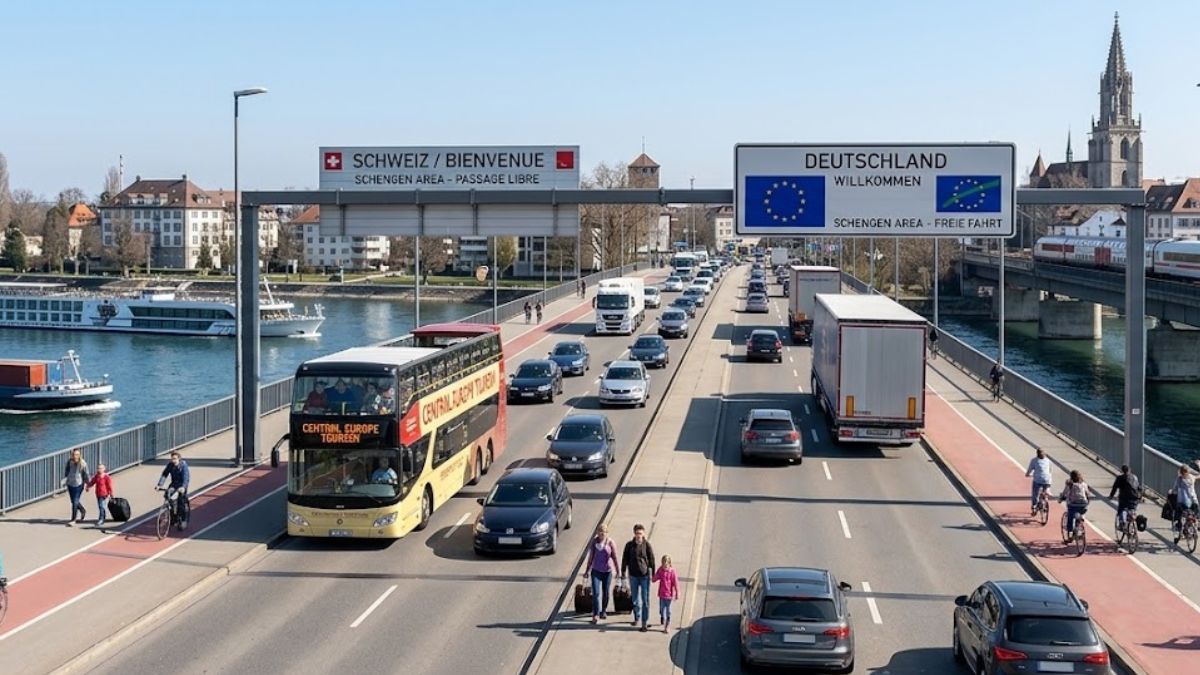
Image for illustrative purposes
Quick Summary
- Germany has ended temporary border checks along the Swiss frontier as Schengen controls expire, restoring smooth cross-border travel across Central Europe
- Checks were introduced on 16 September 2025 under Article 25 of the Schengen Borders Code, citing irregular migration and security concerns
- Switzerland, France, Italy, Austria, the Netherlands, and Belgium are all set to benefit from increased tourism flows as multi-destination travel becomes faster and easier
- Over 400,000 cross-border workers in Switzerland and daily freight corridors carrying pharmaceuticals and engineering goods will return to normal schedules
Germany has lifted its temporary border inspections along the 362-kilometre Swiss frontier, restoring one of Europe's most strategically important travel corridors. The controls — introduced on 16 September 2025 under Article 25 of the Schengen Borders Code — have now expired, ending months of delays for commuters, freight operators, and tourists moving between the two countries. Switzerland joins France, Italy, Austria, the Netherlands, and Belgium in expecting immediate tourism gains as seamless cross-border travel resumes across Central Europe.
Why Germany Introduced the Checks — and Why They Have Now Ended
Germany activated temporary controls on several internal Schengen borders in September 2025, citing rising irregular migration, increased activity by people-smuggling networks, and broader geopolitical security concerns. The measure was legal under Schengen rules, which allow member states to restore inspections temporarily when serious threats to public order or internal security emerge.
Switzerland was among nine neighbouring states affected. Although controls were limited and targeted, they added new layers of complexity for daily cross-border life.
Logistics companies running trucks between Zurich, Stuttgart, and Germany's Rhine-Ruhr industrial region reported delays of 15 to 45 minutes during peak hours. Courier services saw higher operational costs from documentation requirements and waiting times.
With those concerns now addressed and the controls' legal time limit reached, Germany has removed the systematic inspections. The frontier returns to its normal open-border status under the Schengen Agreement.
A Border Unlike Any Other in Europe
The Germany–Switzerland border runs largely along the High Rhine and Lake Constance. Cities such as Basel, Konstanz, Schaffhausen, and Waldshut sit directly on the frontier — communities often separated only by a bridge or a railway line.
Public transport, cycling routes, and major road corridors frequently cross the border multiple times within a single journey. For decades, the Schengen open-border arrangement has meant no systematic passport inspections for this daily back-and-forth.
At stake during the inspection period was not just tourism but the entire regional economy. More than 400,000 cross-border workers are employed in Switzerland in sectors including healthcare, engineering, logistics, hospitality, and finance — a significant share commuting daily from Germany. Predictable crossing times are essential for their employers and for Swiss hospitals, factories, and offices depending on that workforce.
Freight and Supply Chains Return to Normal
The Basel region functions as a strategic freight gateway connecting Germany, Switzerland, and France. Trucking corridors from the Rhine-Ruhr industrial heartland to Swiss pharmaceutical and engineering manufacturing centres all pass through this zone.
Just-in-time delivery systems were particularly vulnerable during the inspection period, forcing transport companies to add scheduling buffers and absorb additional costs. With systematic checks lifted, freight movement is expected to return to pre-September 2025 speeds, reducing supply chain uncertainty across the region.
Which Countries See the Biggest Tourism Gains
Switzerland
Switzerland benefits most immediately. Germany is one of its largest visitor markets, and with delays removed, German travellers can again reach Zurich, Lucerne, Interlaken, and the Swiss Alpine resorts without friction.
Short city breaks and weekend trips from southern Germany — already common before September 2025 — are expected to rebound quickly. Spontaneous leisure travel, shopping visits, and cultural weekends all increase when crossing times are predictable and fast.
Germany
Swiss residents regularly cross into Germany for shopping, restaurants, and leisure. Border regions including the Black Forest, the Lake Constance area, and the historic city of Freiburg are set to recapture day-trip tourism from Switzerland.
Local businesses in border towns depend significantly on this cross-border footfall. Its return benefits retail, hospitality, and cultural venues.
France
France gains through the Upper Rhine tourism zone, where three countries converge in a compact geographical area. Strasbourg, Colmar, and Mulhouse form a cross-border cultural landscape shared by Germany, France, and Switzerland.
Tourists exploring the region typically move between all three countries in a single trip. Removing travel barriers makes these multi-stop itineraries faster and more attractive, strengthening tourism businesses across the entire tri-national zone.
Italy
Northern Italy benefits from the restored transit corridor through Switzerland. Travellers heading from Germany toward Milan, Lake Como, and Lake Maggiore frequently route through the Swiss Alpine passes by train or car.
Combined Switzerland–Italy itineraries along scenic Alpine rail routes are popular with international visitors. Easier cross-border movement encourages these journeys, boosting arrivals at Italian lakeside resorts and mountain towns.
Austria
Austria's Alpine regions — Tyrol, Salzburg, and Vorarlberg — are frequently combined with visits to Germany and Switzerland on the same holiday. When internal European borders operate smoothly, travellers can move across these destinations without administrative complications.
The reopening of the Swiss frontier supports broader tourism momentum throughout the Alpine arc.
Netherlands and Belgium
Travellers from the Netherlands and Belgium often drive or take rail south through Germany on their way to Switzerland, the Alps, and the Mediterranean. Road trips and multi-country itineraries linking Dutch and Belgian cities to Alpine destinations are common in both summer and winter.
Faster, more predictable crossings encourage travellers to plan these longer journeys and to combine more destinations in a single trip — benefiting resorts and cultural cities across Central Europe.
Key Facts at a Glance
- Border length: approximately 362 km along the High Rhine and Lake Constance
- Controls introduced: 16 September 2025, under Article 25 of the Schengen Borders Code
- Reason: irregular migration, people-smuggling networks, geopolitical security concerns
- Cross-border workers: over 400,000 in Switzerland, many commuting daily from Germany
- Freight delay during inspections: 15–45 minutes for trucks at peak hours
- Countries gaining: Switzerland, Germany, France, Italy, Austria, Netherlands, Belgium
- Sample multi-country routes: Zurich → Strasbourg → Munich; Milan → Lucerne → Freiburg
- Next step: Europe is implementing new digital biometric systems to monitor external Schengen border entries — protecting internal freedom of movement while tightening outer-border security
What This Means for Travelers
If you are planning any trip involving Germany and Switzerland — or a multi-country itinerary through Central Europe — the removal of border checks is immediately good news. Crossing times are faster, rail and road journeys are more predictable, and tour operators can now build smoother multi-destination itineraries without building in buffer time for inspections.
Travellers combining Switzerland with France, Italy, or Austria in one holiday will find the overall journey experience significantly easier. Day trips between border cities are again practical without planning around potential queues.
For business travellers and freight-dependent sectors, the return to normal crossing speeds reduces costs and scheduling uncertainty on some of the continent's busiest commercial routes.
What Comes Next for Schengen Travel
Even as internal borders reopen, Europe continues to develop new digital tools to manage its external frontier. Upcoming systems will collect biometric data and track the entry and exit of non-European visitors entering the Schengen Area — strengthening outer-border security while preserving the freedom of movement inside the zone that makes European multi-country travel so appealing.
Germany's decision to lift Swiss border checks restores a vital link in the continent's travel network. With one key route open again, the benefits ripple outward — through the Alps, along the Rhine, and across the interconnected geography of Central Europe.
Frequently Asked Questions
Why did Germany introduce border checks with Switzerland in September 2025? Germany activated temporary controls under Article 25 of the Schengen Borders Code, citing rising irregular migration pressures, increased people-smuggling activity, and broader security concerns linked to geopolitical tensions.
Which countries benefit from the lifting of Germany–Switzerland border checks? Switzerland, Germany, France, Italy, Austria, the Netherlands, and Belgium all stand to gain through increased tourism flows, smoother multi-destination itineraries, and faster freight movement across the Central European travel network.
How many cross-border workers commute between Germany and Switzerland? Switzerland employs more than 400,000 cross-border workers across healthcare, engineering, logistics, and finance. A significant proportion commute daily from Germany.
Will there be new border checks in Europe in the future? Europe is introducing new digital biometric tracking systems for non-EU visitors at external Schengen borders. These are designed to strengthen external frontier management while preserving the internal open-border arrangement that enables free movement across the Schengen Area.
Related Travel Guides
Middle East Crisis: UAE, Saudi, Qatar & Gulf States Waive Visa Fines for Stranded Travelers
Washington Dulles Airport Chaos: Flights to Doha, Chicago & Orlando Cancelled
Massive Flight Chaos at U.S. Airports: Cancellations Hit Hawaii-Bound Travelers Hard
Disclaimer
This article is for informational and educational purposes only. It does not constitute legal, financial, or professional advice. While we strive to provide accurate and up-to-date information, travel policies, regulations, and conditions change rapidly. Always verify information with official sources before making travel decisions. Nomad Lawyer makes no representations about the accuracy, reliability, completeness, or suitability of the information provided. Readers should consult qualified professionals for advice specific to their circumstances. The views expressed in this article are those of the author and do not necessarily reflect the views of Nomad Lawyer.
Raushan Kumar
Founder & Lead Developer
Full-stack developer with 11+ years of experience and a passionate traveller. Raushan built Nomad Lawyer from the ground up with a vision to create the best travel and law experience on the web.
Learn more about our team →