
London Gatwick Runway Closure Triggers Widespread Chaos as 90% of Flights Face Delays Reaching 71 Minutes
A 50-minute runway shutdown at London Gatwick led to 90% of flights delayed, 8% cancelled, and average delays of 71 minutes, forcing diversions across the UK.

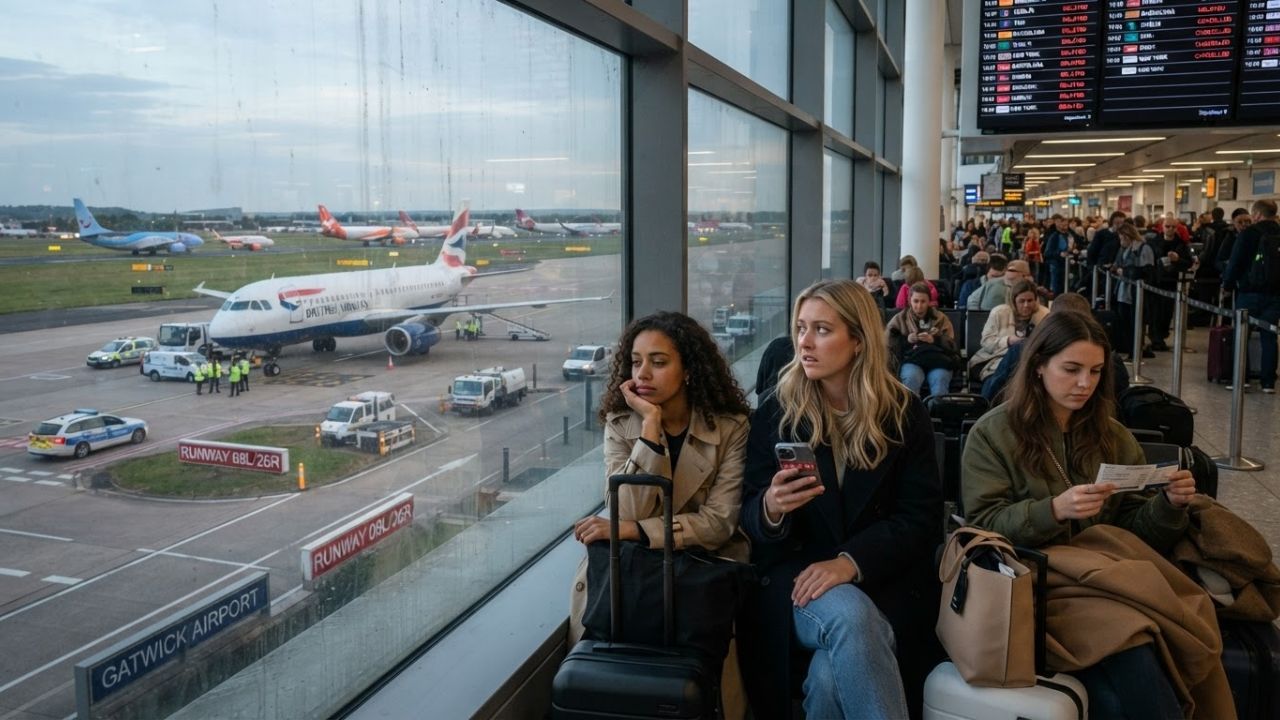
Image Credit: London Gatwick Airport
A 50-minute runway closure at London Gatwick triggered systemic travel disruptions across the United Kingdom, leaving 90% of flights delayed with average hold times reaching 71 minutes and forcing diversions to Stansted and Birmingham.
The incident demonstrates the acute operational sensitivity of high-throughput single-runway aerodromes. Following an emergency runway shutdown lasting approximately 50 minutes due to a departing aircraft experiencing technical difficulties, commercial flight operations ground to a complete halt. Although ground handling crews safely towed the disabled aircraft clear and airport safety personnel completed a full runway foreign object debris (FOD) inspection, the brief infrastructure freeze created a massive scheduling backlog that compounded throughout Friday evening, disrupting tens of thousands of international passengers.
The Local Trend Revealed: 50-Minute Closure Paralyzes Gatwick
The operational breakdown commenced on Friday afternoon when a departing aircraft reported a mechanical anomaly on the active strip, prompting airport air traffic control to suspend all takeoffs and landings as a safety precaution.
While the runway was closed for just 50 minutes, the resulting disruption multiplied rapidly across regional airspace:
- Severe Evening Delays: Flight-tracking data recorded shortly after 21:30 BST revealed that 90% of all Gatwick flights were delayed, with average departure delays climbing to 71 minutes.
- Flight Cancellations: Approximately 8% of scheduled flights were canceled outright, as operating airlines exhausted crew duty hours and encountered arrival curfews at European destination airfields.
- Regional Diversions: Arriving jetliners holding in holding stacks over Kent and Sussex exhausted reserve fuel margins, forcing aircraft to divert to London Stansted (STN), Birmingham Airport (BHX), and other regional airfields.
Gatwick Operational Impact Index
| Disruption Metric | Official Recorded Position | Operational Impact on Passengers |
|---|---|---|
| Runway Suspension Duration | 50 minutes | Complete ground halt for all departures and arrivals |
| Delayed Flights by Evening | 90% (as of 21:30 BST) | Widespread misconnections and rolling late departures |
| Cancelled Flights | 8% of daily schedule | Hundreds of passengers stranded overnight |
| Average Reported Delay | 71 minutes per affected flight | Significant schedule slippage on onward European rotations |
| Primary Diversion Gateways | London Stansted, Birmingham | Passengers displaced over 60 to 120 miles from Gatwick |
| Reported Incident Cause | Technical issue with departing aircraft | Towed clear to remote stand followed by FOD runway sweep |
The Single-Runway Bottleneck: Why Gatwick Is Vulnerable
The disruption brings renewed scrutiny to Gatwick’s unique infrastructure configuration. While the aerodrome features two parallel strips, the Civil Aviation Authority (CAA) categorizes Gatwick as operating in a single-runway configuration. The northern runway (08L/26R) functions primarily as a standby or taxiway facility and cannot currently operate simultaneously with the main southern runway (08R/26L) for routine commercial traffic.
This lack of operational redundancy makes Gatwick exceptionally vulnerable:
- High Scheduled Density: Gatwick’s maximum scheduled movements stand at 57 aircraft per hour in 2026 (up from 55 per hour in 2025), leaving virtually zero buffer to absorb unexpected ground halts.
- Massive Passenger Volume: Gatwick handled 42.8 million passengers across 259,000 aircraft movements in 2025, with an average passenger load factor of 84.5%. Low-cost titan easyJet carried 18.9 million passengers through the facility during the year.
- Long-Haul & Global Reach: Long-haul services account for 16% of Gatwick’s passenger traffic, with surging international traffic to Sub-Saharan Africa (+22%), the Far East and South Asia (+24%), and the Middle East and Central Asia (+17%). Consequently, an afternoon runway closure impacts intercontinental connecting banks spanning four continents.
- The Dual-Runway Proposal: Gatwick Airport Limited (GAL) is actively pursuing planning approval to bring its northern runway into routine operational use. Under CAA documentation, the proposed dual-runway model would route 50% to 70% of routine departures onto the northern runway, reserving the main strip for arrivals and providing vital operational resilience during mechanical emergencies.
Cultural & Environmental Value: Decarbonization and Transit Resilience
Managing major airport disruptions requires balancing operational recovery with environmental responsibility. Holding dozens of commercial airliners in low-altitude stacking loops burns thousands of tons of excess aviation kerosene.
Gatwick’s Decade of Change environmental framework emphasizes sustainable ground surface operations. When runway halts occur, Collaborative Decision Making (CDM) protocols keep departing aircraft parked at terminal stands with auxiliary engines powered down rather than queuing in long taxiway idling lines.
Simultaneously, travelers can leverage low-emission electric surface transit to mitigate travel delays:
- Direct Rail Connections: Gatwick's integrated South Terminal railway station provides direct electric rail connectivity via Thameslink and Southern Railway. Utilizing electric rail straight into central London hubs like London Bridge and St Pancras International reduces automotive congestion along the heavily traveled M23 and M25 motorways.
Visitor Insider Tips: Navigating Gatwick Flight Disruptions
If you are caught in flight disruptions or diversions at London Gatwick, apply these actionable passenger strategies:
- Handling Diversions to Stansted or Birmingham: If your flight diverted to Stansted or Birmingham, do not immediately hail a private taxi. Under consumer guidance from Which?, the operating airline is legally responsible for providing onward coach or rail transportation to Gatwick or your final destination. If you must self-fund transport due to absent airline personnel, keep all itemized VAT receipts to claim reimbursement under UK261.
- Thameslink Over Gatwick Express: If stranded at Gatwick and needing to reach central London, skip the premium-priced Gatwick Express. The Thameslink rail line departs every few minutes from the South Terminal station, reaching London Bridge, Farringdon, and St Pancras in 30 to 35 minutes for less than half the cost of express shuttles.
- Understand UK261 "Duty of Care" vs. "Compensation": If your flight is delayed over two hours for short-haul or three hours for long-haul, the airline must provide complimentary food and drink vouchers, alongside free hotel accommodations and transfers if delayed overnight. However, financial compensation (£220 to £520) may be denied if the airline proves the runway blockage constituted an "extraordinary circumstance." Regardless of compensation disputes, your right to care is absolute and legally mandatory.
- The 5-Hour Refund Rule: Under UK261, if your flight departure is delayed by more than five hours and you decide not to proceed with your trip because the vacation or business meeting is compromised, you have the statutory right to abandon your journey and receive a 100% cash refund within seven days.
- Terminal Navigation & Quiet Zones: Gatwick operates two terminals connected by a free two-minute monorail shuttle. If the North Terminal becomes crowded during irregular operations, head to the upper mezzanine near the entrance to the lounges. South Terminal passengers can find quieter seating and power outlets along the outer gates of Pier 1 (Gates 10–28).
Tourism Outlook: The Balancing Act Between Growth and Resilience
Friday’s disruption serves as a vivid case study in modern aviation vulnerability. London Gatwick remains one of the world's most efficiently run single-runway airports, demonstrating an 11-percentage-point improvement in on-time departures in 2025 compared to 2024. However, operating close to maximum capacity means that a minor 50-minute equipment failure can cascade into hours of delayed departures and dozens of diverted flights.
As the UK government advances its Civil Aviation Bill to expand CAA passenger protection enforcement powers, and Gatwick progresses toward its dual-runway expansion, travelers must recognize that infrastructure capacity and operational resilience are intrinsically linked. For passengers flying through London, monitoring live radar feeds, understanding UK261 rights, and building sensible layover cushions remain the best defenses against unexpected airport disruptions.
Related Travel Guides
- China Steps Up With Oman And More Nations To Offer Peace Efforts That Could Transform Middle East Tourism
- American Airlines Flight ENY4057 Diverted to Madison Dane County Airport
- Poland and Croatia Celebrate Resurgence of Adriatic Express Overnight Train as July 2026 Departures Sell Out Rapidly, Offering a Scenic 19-Hour Escape From Airport Chaos: New Travel Alert
Disclaimer
This article is for informational and educational purposes only. It does not constitute legal, financial, or professional advice. While we strive to provide accurate and up-to-date information, travel policies, regulations, and conditions change rapidly. Always verify information with official sources before making travel decisions. Nomad Lawyer makes no representations about the accuracy, reliability, completeness, or suitability of the information provided. Readers should consult qualified professionals for advice specific to their circumstances. The views expressed in this article are those of the author and do not necessarily reflect the views of Nomad Lawyer.
Raushan Kumar
Founder & Lead Developer
Full-stack developer with 11+ years of experience and a passionate traveller. Raushan built Nomad Lawyer from the ground up with a vision to create the best travel and law experience on the web.
Learn more about our team →