
Aviation Updates: Historic Fourth of July Travel Boom Triggers Nationwide Flight Cancellations as Alaska and Maine Surge
Record US flight demand for the Fourth of July holiday drives a 121% surge in flight cancellations as travelers flock to Alaska, Maine, and Montana.

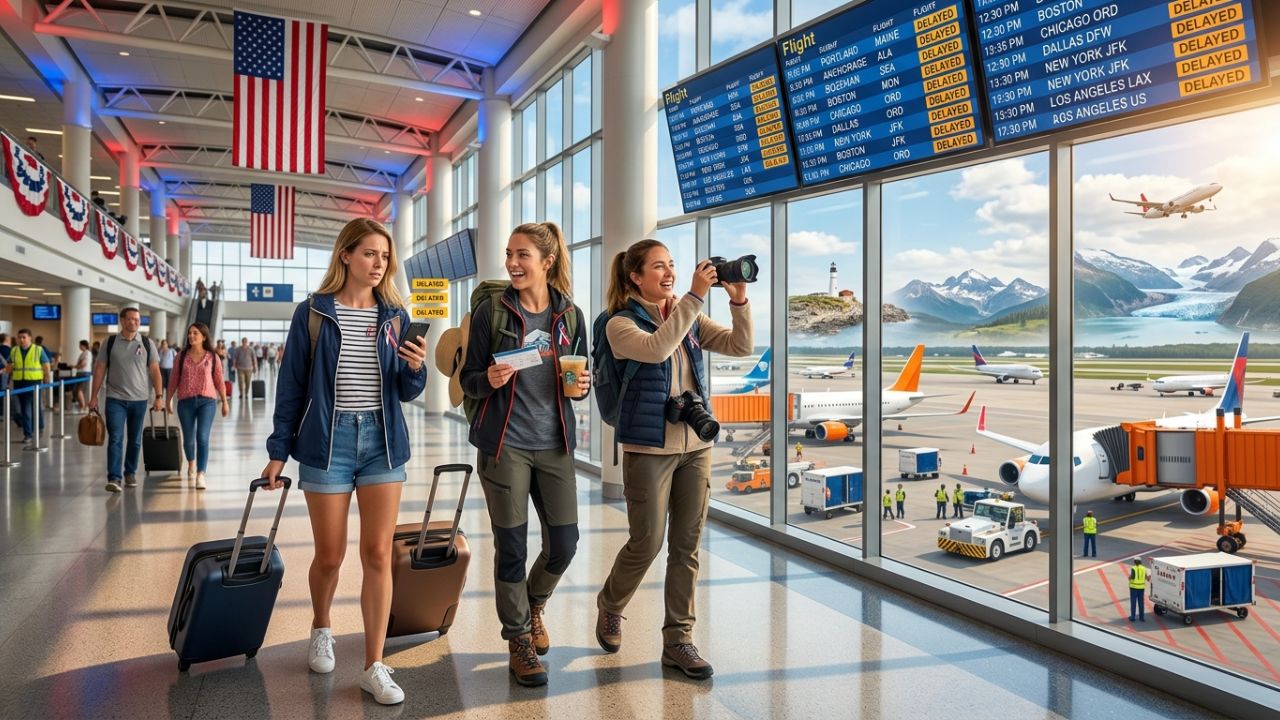
Image generated by AI
Aviation Updates: Historic Fourth of July Travel Boom Triggers Nationwide Flight Cancellations as Alaska and Maine Surge
An unprecedented surge in domestic holiday demand pushes the US aviation network to its absolute breaking point, severely degrading operational reliability across major national corridors.
Image generated by AI
The highly anticipated Fourth of July holiday has formally ignited a massive US aviation surge, unleashing widespread travel chaos as millions of passengers flood the national airspace. According to the latest airline news and verified traffic telemetry, record US flight demand has lifted scheduled airline operations by a staggering 16.3% during this peak holiday week. However, this historic spike in domestic traffic is entirely overwhelming the aviation network, triggering severe airport disruptions from coast to coast. As operational reliability collapses under the pressure, the industry is witnessing a terrifying 121.5% explosion in flight cancellations. While legacy metropolitan hubs struggle to clear massive congestion, domestic leisure travel has experienced a profound geographic shift. Remote, nature-based destinations are heavily outperforming traditional gateway cities, with Alaska, Maine, and Montana emerging as the fastest-rising domestic travel markets for the Independence Day period.
Expanded Overview: The Cost of Record Demand
The Fourth of July window remains one of the most operationally demanding weeks on the United States aviation calendar. A 16.3% expansion in scheduled flights may seem manageable in theory, but in practice, it places devastating strain on airline scheduling systems, constrained airport handling capacities, and complex air traffic flow management.
When demand pushes airlines to operate near maximum capacity, the operational buffer completely evaporates. The current data reveals that cancellations have surged by 121.5%, effectively more than doubling compared to standard non-holiday periods. Simultaneously, flights experiencing devastating delays of more than three hours have skyrocketed by 74.6%. This deeply concerning metric indicates that system-wide congestion extends far beyond minor scheduling friction; the network is suffering from extended, structural operational bottlenecks that heavily degrade the national travel experience.
Section-Wise Breakdown: The Collapse of Major Hubs
The surge in demand is aggressively exposing the capacity limitations of heavily congested national corridors, specifically along the East Coast and West Coast. At these major metropolitan hubs, airlines operate with virtually zero spare capacity.
When a single aircraft rotation is disrupted by summer weather volatility or air traffic control constraints, the lack of buffer space prevents the airport from absorbing the delay. A disruption at one major hub instantly cascades across multiple routes, trapping passengers in terminals and creating a knock-on effect that paralyses both departures and arrivals nationwide. This data proves that even modest increases in scheduled flights can amplify severe strain across interconnected, tightly optimized airline networks.
Section-Wise Breakdown: The Rush to Regional Nature Havens
While major hubs battle gridlock, the destination data reveals a massive behavioral shift in US travel patterns. Instead of concentrating in traditional city break destinations, passengers are fleeing toward open spaces, lower population densities, and experiential tourism.
Alaska has emerged as the absolute strongest growth market in the nation, recording an astonishing 51.7% surge in incoming flights driven entirely by seasonal adventure travel and national park demand. The East Coast equivalent, Maine, follows incredibly closely with a 50.9% rise in arrivals, cementing its status as the premier coastal summer retreat. Meanwhile, Montana continues to dominate the mountain tourism sector, posting a massive 49.9% increase in inbound arrivals. This targeted regional growth confirms that short-haul domestic leisure travel is aggressively outperforming traditional international movement during the holiday.
Flight Details: Fourth of July Aviation Surge Matrix
The specific operational telemetry detailing this massive holiday congestion event has been consolidated into the mandatory matrix below, reflecting the specific growth metrics and the corresponding operational decay.
Fourth of July Aviation Surge Data (2026)
| Operational Metric | Percentage Increase |
|---|---|
| Scheduled Flight Operations | +16.3% |
| Flight Cancellations | +121.5% |
| Long Delays (3+ hours) | +74.6% |
| Alaska Inbound Arrivals | +51.7% |
| Maine Inbound Arrivals | +50.9% |
| Montana Inbound Arrivals | +49.9% |
Passenger Impact: Trapped in Transit
For passengers attempting to navigate this holiday boom, the combination of increased demand and reduced operational flexibility guarantees a highly unpredictable travel experience. The staggering 74.6% rise in three-hour delays translates directly into agonizing wait times, severe gate congestion, and completely shattered itineraries.
Travelers flying multi-leg itineraries through major hubs face the absolute highest risk of cascading disruptions. Missing a connection during a holiday week often means waiting days for an available seat, completely destroying expensive accommodation bookings and scheduled holiday events. While airlines are actively attempting to deploy additional staffing and execute capacity adjustments, the sheer scale of the demand-driven strain frequently overwhelms these localized recovery efforts.
Industry Analysis: Why the System Fails at Peak
Aviation strategists monitoring these aviation updates emphasize that this dual reality—surging demand paired with collapsing reliability—is a structural failure, not a temporary glitch. The concentration of massive leisure demand into an incredibly narrow time window exposes the hard limits of US aviation infrastructure. Tightly optimized airline schedules rely entirely on rapid turnaround times. When load factors are effectively at 100% and backup aircraft are unavailable, operational recovery becomes mathematically impossible without executing mass cancellations. Until the industry expands its capacity buffers and improves scheduling elasticity, peak holidays will continue to generate extreme friction.
Conclusion: A Shift in Domestic Tourism
Ultimately, the Fourth of July travel data proves that the US domestic aviation sector is being radically reshaped by leisure demand. While airlines struggle to contain the massive spike in delays and cancellations, travelers are overwhelmingly rejecting crowded international gateways in favor of vast regional nature havens. As Alaska, Maine, and Montana absorb an unprecedented 50% surge in inbound traffic, the industry must rapidly adapt to these shifting regional flows. Passengers traveling during these peak seasonal periods must prepare for severe airport congestion, rely strictly on real-time application updates, and build substantial flexibility into their holiday itineraries.
Key Takeaways
- Network Expansion: Scheduled US flight operations increased by 16.3% for the Fourth of July holiday.
- Operational Collapse: The demand surge triggered a massive 121.5% increase in flight cancellations nationwide.
- Severe Delays: Flights experiencing delays longer than three hours surged by 74.6%.
- Alaska Leads: Alaska recorded the highest inbound growth in the country with a 51.7% surge in arrivals.
- Nature Havens Surge: Maine (+50.9%) and Montana (+49.9%) confirmed a massive shift toward domestic, outdoor-oriented tourism.
FAQ: Fourth of July Travel Disruptions 2026
Which US states saw the highest increase in flights for the Fourth of July? Alaska recorded the highest growth with a 51.7% surge in arriving flights, closely followed by Maine (50.9%) and Montana (49.9%), reflecting a massive shift toward nature-based tourism.
How much did flight cancellations increase during the holiday week? During the Fourth of July travel week, nationwide flight cancellations surged by an astonishing 121.5%, effectively more than doubling compared to non-holiday periods.
Why are there so many flight delays during the July 4th holiday? A 16.3% increase in scheduled flights eliminates all spare capacity in the aviation network. When airports operate near full capacity, minor issues like thunderstorms or air traffic control constraints instantly cascade into massive delays, leading to a 74.6% increase in delays lasting more than three hours.
Related Travel Guides
Helsinki-Vantaa Airport Delays Finnair CityJet Travel Chaos 2026
Seattle-Tacoma Airport Delays Alaska Delta Travel Chaos 2026
US Domestic Airport Travel Disruption Survival Guide 2026
Disclaimer: This article is strictly for informational purposes. Delay and cancellation statistics (+121.5% cancellations, +74.6% long delays) and state-level arrival growth data are based on industry aviation metrics at the time of publication. Flight schedules are highly dynamic and subject to continuous modification by the airlines. Passengers must verify their exact flight status directly with their airline before arriving at the airport.
Disclaimer
This article is for informational and educational purposes only. It does not constitute legal, financial, or professional advice. While we strive to provide accurate and up-to-date information, travel policies, regulations, and conditions change rapidly. Always verify information with official sources before making travel decisions. Nomad Lawyer makes no representations about the accuracy, reliability, completeness, or suitability of the information provided. Readers should consult qualified professionals for advice specific to their circumstances. The views expressed in this article are those of the author and do not necessarily reflect the views of Nomad Lawyer.
Kunal K Choudhary
Co-Founder & Contributor
A passionate traveller and tech enthusiast. Kunal contributes to the vision and growth of Nomad Lawyer, bringing fresh perspectives and driving the community forward.
Learn more about our team →