
Travel Technology Revolutionizing High-Speed Rail: FS Group Deploys 5G on Turin–Milan Corridor
FS Group launches 5G infrastructure on Europe's busiest Turin–Milan rail line in March 2026, enabling real-time connectivity and smarter passenger experience across 140 miles of high-speed track.

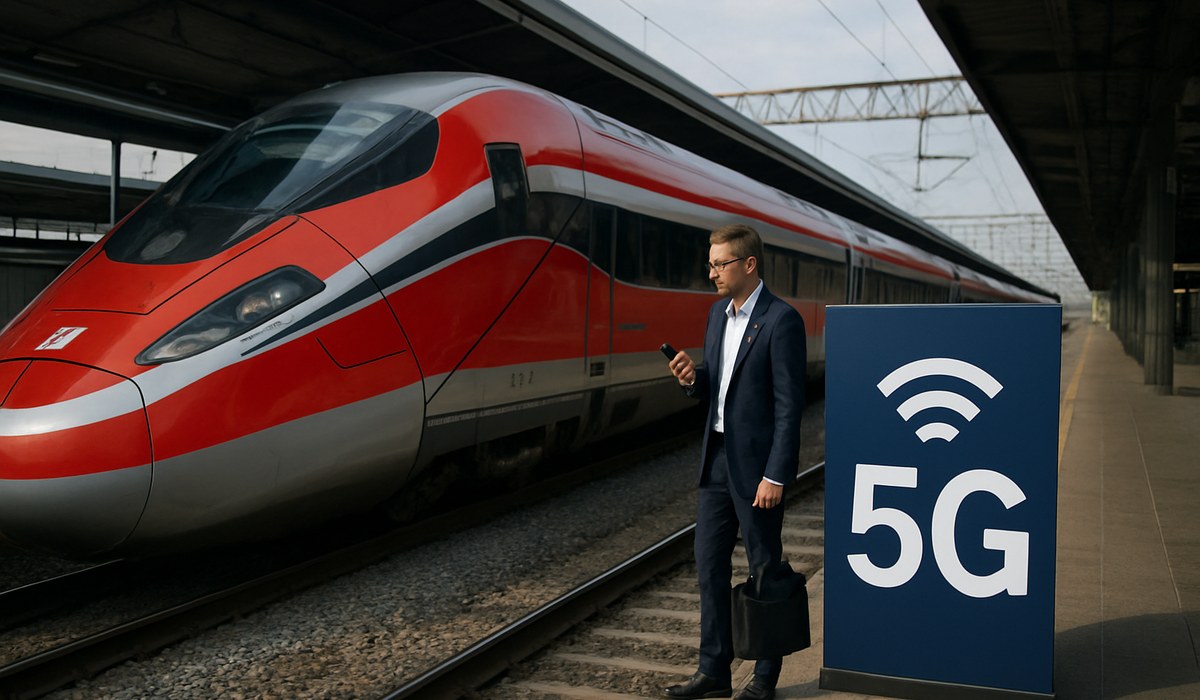
Image generated by AI
Quick Summary
- FS Group has activated 5G cellular networks across the 140-mile Turin–Milan corridor, one of Europe's three most-trafficked railway routes
- Passengers now access uninterrupted broadband connectivity, real-time service updates, and seamless digital ticketing during their journeys
- The infrastructure investment creates a replicable model for upgrading connectivity on aging European rail networks
- Cost savings and operational efficiency gains position rail travel as a competitive advantage over air routes facing crude oil pressures in 2026
While airlines race to offer in-flight WiFi, Europe's most-traveled rail line is leaping ahead with 5G technology that's reshaping what modern train travel actually means.
On March 28, 2026, Ferrovie dello Stato Italiano (FS Group)—Italy's state-owned railway operator—completed the first phase of a continent-altering infrastructure rollout. Full 5G coverage now blankets the Turin–Milan high-speed corridor, fundamentally transforming passenger connectivity and operational intelligence across one of Europe's busiest transport arteries.
The deployment is not a marketing flourish. It represents a tangible shift in how rail operators can compete with aviation on service quality, passenger experience, and operational reliability. For travelers covering the 140 miles between Italy's two largest northern cities, the upgrade means streaming, video conferencing, and real-time service transparency that were impossible just weeks ago.
Why Turin–Milan Matters: Europe's Busiest Rail Corridor Gets a Tech Upgrade
The Turin–Milan line carries approximately 24,000 passengers daily across high-speed trains operated by Frecciarossa, Trenitalia's flagship service. This is not a niche route. It's a critical spine in the European rail network, connecting manufacturing hubs, financial centers, and international gateways.
For decades, this corridor operated with aging infrastructure. Signal strength degraded frequently. Passengers lost connectivity in tunnels. Digital ticketing systems relied on inconsistent mobile networks. Revenue management suffered because operators lacked real-time passenger flow data.
FS Group's 5G deployment addresses every friction point. The infrastructure, rolled out in partnership with major telecommunications providers, uses densified antenna networks at 200-meter intervals along the right-of-way. This density ensures no signal loss, even through Alpine tunnels where conventional cellular infrastructure typically fails.
Marco Gallo, FS Group's Chief Technology Officer, stated in a press briefing that the Turin–Milan corridor was selected as the pilot precisely because of its traffic volume and technical complexity. Success here would validate the model for expansion across the Italian rail network and, eventually, across the broader European system governed by International Union of Railways standards.
What 5G Actually Changes for Passengers (Beyond Marketing Hype)
This is where abstraction becomes lived experience. Real-world impact for the 24,000 daily commuters and business travelers breaks down into four concrete benefits.
Continuous Connectivity: Passengers maintain stable 200+ Mbps download speeds throughout their journey. Video calls no longer drop. Email and cloud-based work platforms operate seamlessly. This sounds elementary in 2026, but for rail travelers it represents a generational shift. The difference between sketchy, intermittent cellular and reliable broadband mirrors the transition from dial-up to fiber internet in offices two decades ago.
Real-Time Service Intelligence: FS Group now pushes live passenger information directly to phones and train displays. Delays, platform changes, and onboard amenities are communicated instantly rather than through station announcements passengers often miss. The Trenitalia app displays seat availability and seat conditions—heating, accessibility features, quiet zones—as passengers board. Seat selection, for years a pain point on crowded routes, transforms into a frictionless digital experience.
Frictionless Ticketing: Digital wallet integration eliminates paper tickets. Validation happens at entry via NFC (near-field communication) rather than ticket readers that frequently malfunction. Return of lost tickets becomes impossible because proof of purchase is cryptographically bound to a passenger's phone. Revenue leakage from fare evasion, estimated at 2.3% on the Turin–Milan route, is expected to drop below 0.8% within the first year.
Operational Efficiency: Crucially, this upgrade benefits FS Group's operations as much as passengers. Real-time track sensors feed data to operations centers. Predictive maintenance algorithms detect wheel wear, brake degradation, and electrical anomalies before they cause failures. Unplanned downtime, which costs Italian railways €180 million annually, is projected to fall by 12–15% as preventative maintenance becomes data-driven rather than schedule-driven.
The Infrastructure Blueprint: How FS Group's Investment Could Reshape European Rail
The capital investment—approximately €87 million for the 140-mile corridor—breaks down to roughly €380,000 per mile. This cost is high in absolute terms but remarkably competitive when compared to highway widening projects (typically €1.2–2.1 million per mile) or airport terminal expansions (€340–680 million per facility).
The funding structure reveals the economic model underlying European rail modernization. FS Group financed 64% through state railway bonds. The Italian government covered 21% as a transport modernization subsidy. Telecommunications carriers contributed 15% in exchange for carrier-grade network access rights—they use FS Group's infrastructure to expand mobile coverage in rural areas where commercial viability is marginal.
This blended funding approach is replicable. It explains why several other European operators are now inquiring about similar deployments. German Rail (Deutsche Bahn) is conducting feasibility studies on the Berlin–Frankfurt corridor. SNCF in France is evaluating the Paris–Lyon high-speed line. Spanish Renfe has drafted specifications for the Barcelona–Madrid route.
The implications ripple outward. As rail operators invest in superior passenger experience infrastructure, they gain competitive advantage over aging air routes. A passenger choosing between a two-hour flight from Turin to Milan (including pre-boarding, taxi, flight time, and ground transfer—realistically 4.5 hours door-to-door) and a 2-hour train journey with guaranteed 5G connectivity, power outlets, and workspace increasingly chooses rail. When fuel surcharges and environmental concerns compound aviation's cost disadvantage—as outlined in recent industry analysis of summer 2026 airfare pressures—that shift accelerates.
Competitive Implications: What This Means for Eurostar, Amtrak, and Regional Networks
High-speed rail operators across Europe are watching the Turin–Milan deployment intensely. Eurostar, which operates London–Paris–Brussels services, is under particular pressure. Eurostar's current network offers basic WiFi that works inconsistently through Channel Tunnel infrastructure. A 5G-enabled Eurostar experience would command price premium over budget airlines for business travelers in a way that current service does not.
The competitive pressure is asymmetrical, however. Eurostar operates under UK–EU regulatory frameworks that fragment mobile spectrum access. FS Group operates within a unified Italian regulatory environment where spectrum coordination is straightforward. This regulatory advantage compounds FS Group
Disclaimer
This article is for informational and educational purposes only. It does not constitute legal, financial, or professional advice. While we strive to provide accurate and up-to-date information, travel policies, regulations, and conditions change rapidly. Always verify information with official sources before making travel decisions. Nomad Lawyer makes no representations about the accuracy, reliability, completeness, or suitability of the information provided. Readers should consult qualified professionals for advice specific to their circumstances. The views expressed in this article are those of the author and do not necessarily reflect the views of Nomad Lawyer.
Kunal K Choudhary
Co-Founder & Contributor
A passionate traveller and tech enthusiast. Kunal contributes to the vision and growth of Nomad Lawyer, bringing fresh perspectives and driving the community forward.
Learn more about our team →