
Severe Travel Chaos Paralyzes Europe as Frankfurt and Milan Suffer Massive 295-Flight Disruption Wave, Stranding Lufthansa, easyJet, and Ryanair Passengers: Latest Airline News
Europe's central aviation corridors are fracturing under severe operational pressure as a catastrophic wave of 295 delays and 25 cancellations paralyzes Frankfurt and Milan Malpensa airports.

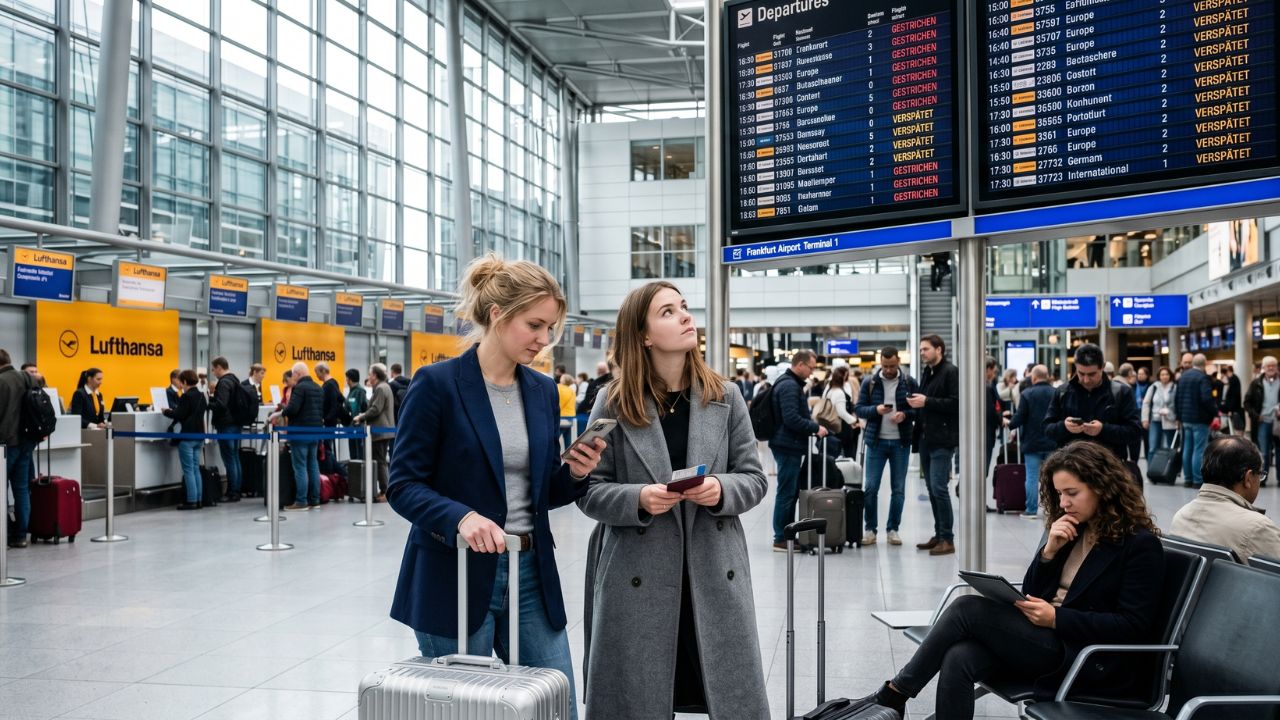
Image generated by AI
In a massive, highly destructive operational breakdown that is currently tearing through the absolute core of Europe's aviation infrastructure, thousands of global passengers have been completely stranded following a catastrophic wave of airport disruptions at Frankfurt Airport (FRA) and Milan Malpensa Airport (MXP). According to official FlightAware tracking data, the central European aviation corridor is buckling under unprecedented congestion, recording a staggering combined total of 295 flight delays and over 25 cancellations. As airlines desperately scramble to reset their routing, severe travel chaos is ravaging both legacy and low-cost networks. Passengers flying on Lufthansa, Condor, easyJet, Ryanair, and British Airways are currently trapped in overflowing terminals, facing missed connections bound for London, Paris, Rome, and intercontinental destinations. This systemic capacity failure represents the premier headline in today's breaking airline news and essential global aviation updates.
By introducing direct passenger coordination and dynamic scheduling backups, the regional aviation hubs target growing passenger demand across vital commerce sectors. The choice to coordinate flight departures in phases helps to manage gate capacity, supporting the country's broader regional transportation network.
Context: The Collapse of the Central European Corridor
The European aviation network operates on a highly fragile equilibrium, heavily dependent on the operational perfection of its primary transit hubs.
When a mega-hub like Frankfurt (Germany’s undisputed financial and aviation artery) and a critical southern gateway like Milan Malpensa suffer simultaneous operational breakdowns, the resulting contagion instantly infects the entire continent. The current crisis is staggering in its scale: Frankfurt alone recorded 177 delayed flights and 21 cancellations, while Malpensa suffered 118 delays. Because modern airlines utilize incredibly tight aircraft rotation schedules, these localized delays instantly metastasize. An aircraft delayed taking off from Milan directly causes a subsequent delay when that same jet attempts to return from London or Paris. For the thousands of stranded travelers, this translates directly into blown layovers, ruined European vacations, and massive financial losses for corporate executives relying on punctual inter-city connectivity.
To view live flight schedules, real-time terminal maps, or check-in rules at the primary German gateway, travelers can consult the official Frankfurt Airport (FRA) directory. For direct booking access, specific baggage rules, and EU261 compensation protocols, passengers must check the official Lufthansa portal or their respective operating carrier. To explore live flight tracking and monitor the exact severity of the European airspace congestion, passengers can consult the official FlightAware tracking service.
Section-Wise Breakdown of the European Meltdown
Frankfurt Airport (FRA): Hub Dependency Collapse
Frankfurt is operating as the absolute epicenter of this disruption wave. The operational breakdown here primarily decimated the Lufthansa Group, revealing the extreme vulnerability of hub dependency. Lufthansa alone recorded a catastrophic 76 delayed flights and 21 cancellations. Its subsidiary and partner networks bled heavily alongside it: Condor suffered 27 delays, while Air Dolomiti, Discover, and City Airlines were repeatedly stalled. Long-haul international carriers including United Airlines, Etihad Airways, and Turkish Airlines were similarly caught in the Frankfurt holding pattern, severely delaying intercontinental arrivals.
Milan Malpensa (MXP): Low-Cost Carrier Carnage
While Frankfurt devastated the legacy carriers, Milan Malpensa proved brutal for the low-cost sector. Driven largely by incredibly tight short-haul turnaround schedules, easyJet suffered the heaviest blow with 31 delayed flights. The contagion rapidly spread to rivals Wizz Air Malta (14 delays) and Ryanair (13 delays). Because low-cost carriers frequently lack the massive reserve aircraft fleets possessed by legacy airlines, a single delay in Milan mathematically guarantees rolling delays for that specific aircraft for the remainder of its daily schedule across Europe.
The Long-Haul Ripple Effect
While short-haul European traffic bore the brunt of the delays, the congestion spilled directly into massive wide-body operations. Long-haul operators including Qatar Airways, Emirates, American Airlines, and Air China all experienced isolated but severe schedule shifts. These delays were largely driven by upstream network constraints, meaning the aircraft were technically ready, but European airspace controllers simply refused to grant departure slots due to overwhelming terminal congestion.
Technical Roster: Frankfurt & Milan Disruption Matrix
To ensure absolute factual accuracy regarding the specific airlines and markets decimated by this operational failure, the following table details the exact delay metrics currently paralyzing the European corridor:
| Hub / Operating Airline | Specific Disruption Metric | Aviation Market Impact |
|---|---|---|
| Frankfurt (FRA) | 177 Delays / 21 Cancellations | Epicenter of the crisis; destroys central European transit flows |
| Milan Malpensa (MXP) | 118 Delays | Severe congestion crippling southern European aviation infrastructure |
| Lufthansa | 76 Delays / 21 Cancellations | Absolute paralysis of the carrier's primary global mega-hub |
| easyJet (MXP) | 31 Flight Delays | Decimates short-haul low-cost operations requiring rapid turnarounds |
| Condor / Air Dolomiti | 27 Delays / 16 Delays | Feeder and regional leisure networks heavily fractured |
| Ryanair / Wizz Air Malta | 13 Delays / 14 Delays | Rolling delays guaranteed across their European point-to-point networks |
Passenger Impact: Stranded in the Terminal
For the thousands of global passengers currently trapped inside Frankfurt and Milan Malpensa, the physical and emotional toll is immense.
Because Frankfurt is heavily reliant on massive transfer banks, a missed connection is mathematically devastating. Passengers arriving from the United States via United Airlines who intended to connect onto a Lufthansa flight to Rome are now finding their onward flights completely canceled. For travelers stranded in Milan utilizing low-cost carriers like Ryanair or Wizz Air, the situation is incredibly dire. Unlike legacy carriers, low-cost airlines do not interline (transfer passengers to competing airlines). If your easyJet flight is severely delayed or canceled, you cannot be rebooked onto a Lufthansa flight; you must wait, often overnight, for the next available easyJet departure, forcing passengers to sleep on terminal floors or furiously battle for the last available airport hotel rooms.
Industry Analysis: The Breaking Point of European Airspace
Aviation industry analysts view the simultaneous breakdown at Frankfurt and Milan as a terrifying symptom of systemic airspace fragility.
The European aviation system is completely interdependent. When nearly 300 flights are delayed across just two major hubs, the rapid increase of congestion triggers an unstoppable domino effect. Analysts note that airports are operating at the absolute physical limits of their scheduling and runway capacity. There is zero resilience built into the system to handle external shocks, such as localized weather cells or minor air traffic control (ATC) staffing shortages. Until European authorities aggressively deregulate and unify airspace management (the "Single European Sky" initiative) and airlines pad their schedules with realistic turnaround times, these massive, multi-hub disruption events will remain a permanent, highly destructive feature of peak summer travel.
Actionable Advice for Surviving European Disruptions
If you are a traveler with an active itinerary routing through Frankfurt or Milan Malpensa during this massive disruption wave, execute this extreme survival checklist immediately:
- Leverage FlightAware Extensively: As explicitly noted by aviation observers, rely exclusively on real-time radar tracking rather than terminal departure boards. If your inbound Lufthansa jet has not yet departed its origin city, do not rush to the crowded boarding gate in Frankfurt. Use that time to secure food and water in less congested areas of the airport.
- Understand Hub Dependency Risks: If you are flying Lufthansa through Frankfurt, realize that your itinerary is highly vulnerable to "hub collapse." If you have the financial flexibility, immediately attempt to reroute your journey through a secondary, less-congested hub like Munich or Zurich to bypass the FRA bottleneck entirely.
- Know Your LCC Limitations: If you are flying easyJet, Ryanair, or Wizz Air out of Milan, you must understand that these carriers offer virtually zero rebooking flexibility on competing airlines. If your flight is severely delayed, immediately begin searching for alternative rail travel (e.g., Trenitalia or Italo) or backup flights on legacy carriers, as you will likely be waiting over 24 hours for a low-cost carrier rebooking.
- Do Not Panic at Customer Service: Physical customer service desks at Frankfurt and Milan will be surrounded by hundreds of furious passengers. Bypass the mob. Immediately call your airline's international contact center via Wi-Fi calling, or utilize the airline's mobile app to process your own rebooking.
FAQ: Frankfurt & Milan Aviation Chaos 2026
How severe are the current flight disruptions across Germany and Italy?
The operational breakdown is massive, with Frankfurt and Milan Malpensa officially recording a combined total of 295 flight delays and over 25 outright cancellations in a single day.
Which airlines are suffering the most severe operational impacts?
Lufthansa is bearing the absolute brunt of the crisis at Frankfurt (76 delays, 21 cancellations), while low-cost carriers like easyJet (31 delays), Wizz Air, and Ryanair are heavily paralyzed in Milan.
Why do delays at Frankfurt and Milan affect flights across the rest of Europe?
The European aviation network is highly interconnected. When massive hubs like FRA and MXP congest, the delayed aircraft cannot execute their subsequent flights to London, Paris, or Rome, triggering continent-wide "knock-on" delays.
A Fragile Network on the Brink
The catastrophic wave of nearly 300 delayed and canceled flights ravaging Frankfurt and Milan Malpensa proves definitively that Europe's central aviation corridors are currently operating well past their safe structural limits. By devastating both the massive legacy hub operations of Lufthansa and the rapid-turnaround networks of easyJet and Ryanair, this disruption has ruthlessly exposed the fragility of the entire continent's travel ecosystem. As airlines desperately attempt to reset their aircraft rotations and thousands of stranded passengers fight for EU261 compensation, global travelers must brace for a brutal reality: navigating Europe's mega-hubs in 2026 requires extreme flexibility, relentless vigilance, and the absolute expectation of travel chaos.
Key Takeaways
- Massive 295-Flight Breakdown: The central European aviation corridor is paralyzed, recording exactly 177 delays at Frankfurt and 118 delays at Milan Malpensa.
- Lufthansa Hub Collapse: Frankfurt Airport served as the epicenter of the crisis, with Lufthansa suffering a catastrophic 76 delays and 21 cancellations.
- Low-Cost Carrier Carnage: easyJet, Ryanair, and Wizz Air Malta suffered severe operational delays in Milan, fracturing their intra-European point-to-point networks.
- Systemic Interdependency: The massive volume of delays at just two airports instantly triggered cascading "knock-on" disruptions impacting flights bound for London, Paris, and intercontinental destinations.
- Passenger Survival Tactics: Travelers are heavily advised to rely on real-time FlightAware tracking, avoid physical customer service lines, and secure alternative travel options immediately upon facing cancellation.
Related Travel Guides
Amsterdam Schiphol Plunges Into Travel Chaos With 163-Flight Breakdown
Severe Travel Chaos Engulfs Mexico Across Major Airports
Frankfurt and Milan Disruption Survival Discussion on Reddit
Disclaimer
This article is for informational and educational purposes only. It does not constitute legal, financial, or professional advice. While we strive to provide accurate and up-to-date information, travel policies, regulations, and conditions change rapidly. Always verify information with official sources before making travel decisions. Nomad Lawyer makes no representations about the accuracy, reliability, completeness, or suitability of the information provided. Readers should consult qualified professionals for advice specific to their circumstances. The views expressed in this article are those of the author and do not necessarily reflect the views of Nomad Lawyer.
Kunal K Choudhary
Co-Founder & Contributor
A passionate traveller and tech enthusiast. Kunal contributes to the vision and growth of Nomad Lawyer, bringing fresh perspectives and driving the community forward.
Learn more about our team →