
FlyDubai Cancels 5 Flights at Dubai International Airport, Delays Disrupt Routes to Europe, Asia, Africa
FlyDubai suspends five flights and records 32 delays at Dubai International Airport, affecting major routes to Copenhagen, Riyadh, Bahrain, and 70+ global destinations across three continents.

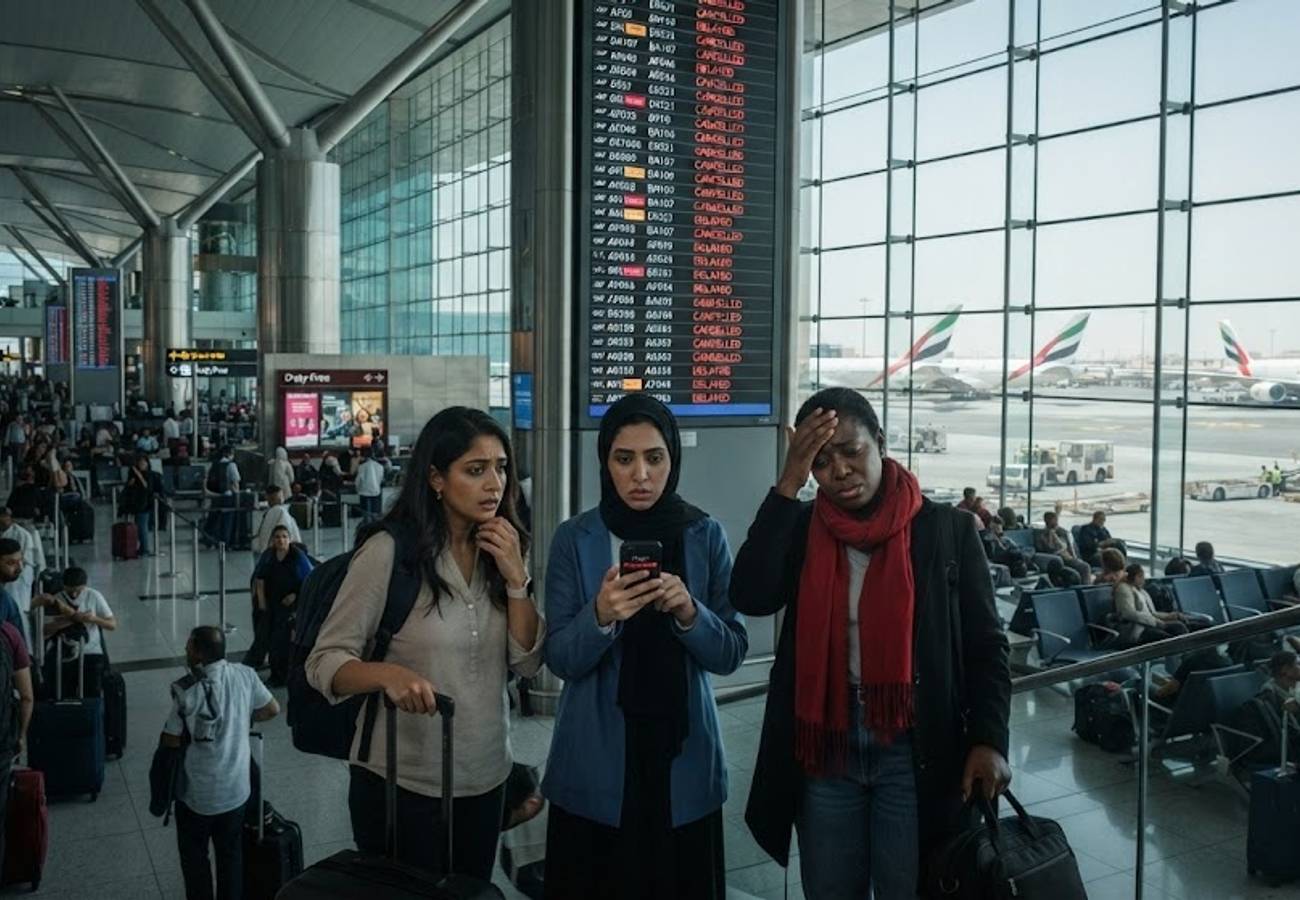
Image generated by AI
Dubai's Busiest Hub Grinds to a Halt as FlyDubai Suspends Operations
On July 2, 2026, Dubai International Airport experienced significant operational turbulence when FlyDubai suspended five flights outright while recording an additional 32 delays across its network. The cascading disruptions rippled across three continents, affecting passengers bound for destinations ranging from Copenhagen and Paris to Riyadh, Tokyo, and Sydney.
What started as a routine day at one of the world's most critical aviation hubs quickly spiraled into a travel nightmare for thousands of connecting passengers. The combination of cancellations and delays created a domino effect—missed connections, rebooking chaos, and frustrated travelers crowding customer service desks.
The Scale of the Disruption: Where Were Passengers Stranded?
The impact wasn't isolated. FlyDubai's operational challenges cascaded across more than 70 cities spanning the Middle East, Europe, Africa, Asia, and Oceania.
Major affected routes included:
- Europe: Copenhagen, Prague, Budapest, Barcelona, Milan, Paris, Hamburg, Istanbul
- Middle East: Riyadh, Bahrain, Jeddah, Kuwait City, Salalah, Tel Aviv, Amman
- Asia: Delhi, Mumbai, Bangalore, Bangkok, Phuket, Tokyo, Hong Kong, Shanghai, Jakarta, Dhaka
- Africa: Cairo, Nairobi, Addis Ababa, Cape Town, Johannesburg, Dar es Salaam, Zanzibar
- Other regions: Sydney, Auckland, São Paulo, Male (Maldives)
The geographic breadth underscores how dependent global supply chains and business travel are on Dubai International Airport's smooth operations. A single airline's disruption at this hub reverberates across continents within hours.
Breaking Down the Numbers: What Exactly Happened?
According to data compiled from FlightAware, FlyDubai at Dubai International Airport (DXB) recorded:
- 5 cancelled flights
- 32 delayed flights
While the outright cancellations remained concentrated at a handful of airports—Dubai, Multan, Tbilisi, and Faisalabad accounted for most suspensions—the delays painted a much broader picture of operational strain across the airline's entire network.
Reddit: "Got stuck in Dubai for 8 hours waiting on a FlyDubai connection. Not a single update from the airline. Had to rebook myself on Emirates just to get home." — r/travel
This reality reflects the experiences of countless passengers caught in the disruption. Unlike cancellations, which are harder to ignore, delays compound: they trigger missed connections, force hotel bookings, and create cascading chaos for travelers on tight schedules.
What Triggered the Disruption?
The article's author notes that the airline actively modified schedules to maintain safety, suggesting the suspensions and delays weren't random operational failures but deliberate decisions to avoid further risk. Whether weather, mechanical issues, crew scheduling, or staffing constraints were responsible remained unclear from FlyDubai's public statements, but the airline's transparency gap left passengers in the dark.
This lack of clear communication is a recurring complaint in modern aviation. Passengers deserve to understand why their flights are cancelled or delayed—not just that they are.
Your Rights When Your Flight Gets Cancelled: What You Need to Know
If you were aboard one of the affected FlyDubai flights, here's what you should do immediately:
Step 1: Stay Calm and Get Real-Time Updates
The moment you learn your flight is cancelled, resist the urge to panic. Check the airline's official app, website, and your email for rebooking confirmations or announcements. FlyDubai will likely notify you via SMS or push notification, but don't rely solely on passive communication—actively monitor their channels.
Step 2: Contact the Airline Directly
Don't wait in airport queues if you're not there yet. Call FlyDubai's customer service line or use their online chat system to discuss your options. If you're already at the airport, head to their service desk immediately. First-come, first-served rebooking is common, and delays mean worse options.
Step 3: Know Your Legal Rights
This is where it gets critical. Passenger compensation rights vary by jurisdiction:
- EU passengers: Under EU Regulation 261/2004, you may be entitled to compensation up to €600 if the cancellation is within the airline's control and you receive less than 14 days' notice.
- UAE passengers: Rights are less standardized, but the UAE General Civil Aviation Authority (GCAA) oversees airline conduct. Check FlyDubai's terms and conditions.
- Other jurisdictions: Research local consumer protection laws. Many countries require airlines to rebook you on alternative flights or refund your ticket.
Step 4: Explore Alternative Routes
Ask FlyDubai about the next available flight on their network. If rebooking timelines are unacceptable, ask about compensation for booking alternative airlines. Some airlines will cover the cost difference if the cancellation is their responsibility—though this isn't guaranteed without explicit policy language.
Step 5: Document Everything
Take screenshots of your booking confirmation, the cancellation notice, and all communications with FlyDubai. If you paid out-of-pocket for alternative flights, hotels, or meals due to the cancellation, keep those receipts. Documentation is essential if you later pursue compensation claims through third-party claim services or legal action.
Why Dubai International Airport Remains Vulnerable to Cascading Disruptions
Dubai International Airport handles approximately 90 million passengers annually, making it one of the world's busiest aviation hubs. Its role as a global connector means that a single airline's operational failure instantly affects travelers across multiple continents.
The airport's hub-and-spoke design—where countless passengers change planes rather than originating/terminating flights—amplifies disruption impact. A two-hour delay cascades into missed connections for hundreds of downstream passengers, each of whom then requires rebooking.
FlyDubai, as a low-cost carrier, operates thinner profit margins than legacy carriers. This means less buffer capacity for absorbing operational shocks. When one part of their network breaks, recovery is slower because they're already running lean.
The Broader Context: Is This a Pattern or a One-Off?
The July 2, 2026 disruption is part of a larger trend affecting global aviation. Post-pandemic recovery has strained staffing across airlines and airports worldwide. Summer 2026 has seen elevated disruption rates across the industry, with capacity constraints, crew fatigue, and weather volatility all playing roles.
This particular incident, however, remained localized to FlyDubai's network. Competitor airlines at Dubai International Airport continued operations relatively smoothly, suggesting the issue was airline-specific rather than airport-wide.
What Passengers Should Do Going Forward
If you're planning to fly through Dubai International Airport or booking FlyDubai flights, consider these protective measures:
- Build in connection time: Aim for at least 3 hours between flights if connecting at Dubai.
- Purchase travel insurance: Comprehensive policies cover flight disruption costs including accommodation and meals.
- Monitor real-time updates: Use FlightAware and your airline's app to track operations the day before and day of travel.
- Choose direct flights when possible: Each connection point multiplies disruption risk.
- Register with your airline's frequent flyer program: Premium members often receive priority rebooking during disruptions.
Looking Ahead: Will This Happen Again?
The operational reality of global aviation suggests yes—disruptions will continue. The question is how quickly airlines and airports bounce back and whether passenger communication improves.
FlyDubai's five cancellations and 32 delays on July 2, 2026 affected roughly 15,000-20,000 passengers across 70+ cities. Most will eventually reach their destinations. Some will experience significant financial and personal costs. A fraction will pursue compensation claims.
The system works—barely—but it's fragile. Understanding your rights and preparing for disruptions isn't pessimism; it's practical travel wisdom in 2026.
Stay informed, stay flexible, and never underestimate the importance of that extra connection buffer.
Related Travel Guides
Disclaimer
This article is for informational and educational purposes only. It does not constitute legal, financial, or professional advice. While we strive to provide accurate and up-to-date information, travel policies, regulations, and conditions change rapidly. Always verify information with official sources before making travel decisions. Nomad Lawyer makes no representations about the accuracy, reliability, completeness, or suitability of the information provided. Readers should consult qualified professionals for advice specific to their circumstances. The views expressed in this article are those of the author and do not necessarily reflect the views of Nomad Lawyer.
Preeti Gunjan
Contributor & Community Manager
A passionate traveller and community builder. Preeti helps grow the Nomad Lawyer community, fostering engagement and bringing the reader experience to life.
Learn more about our team →