
Flight Chaos Reveals $34B Systemic Crisis in Global Aviation 2026
March 2026 flight disruptions expose $34 billion in annual economic losses across the United States. Flight chaos reveals systemic aviation infrastructure failures affecting tens of thousands of passengers worldwide.

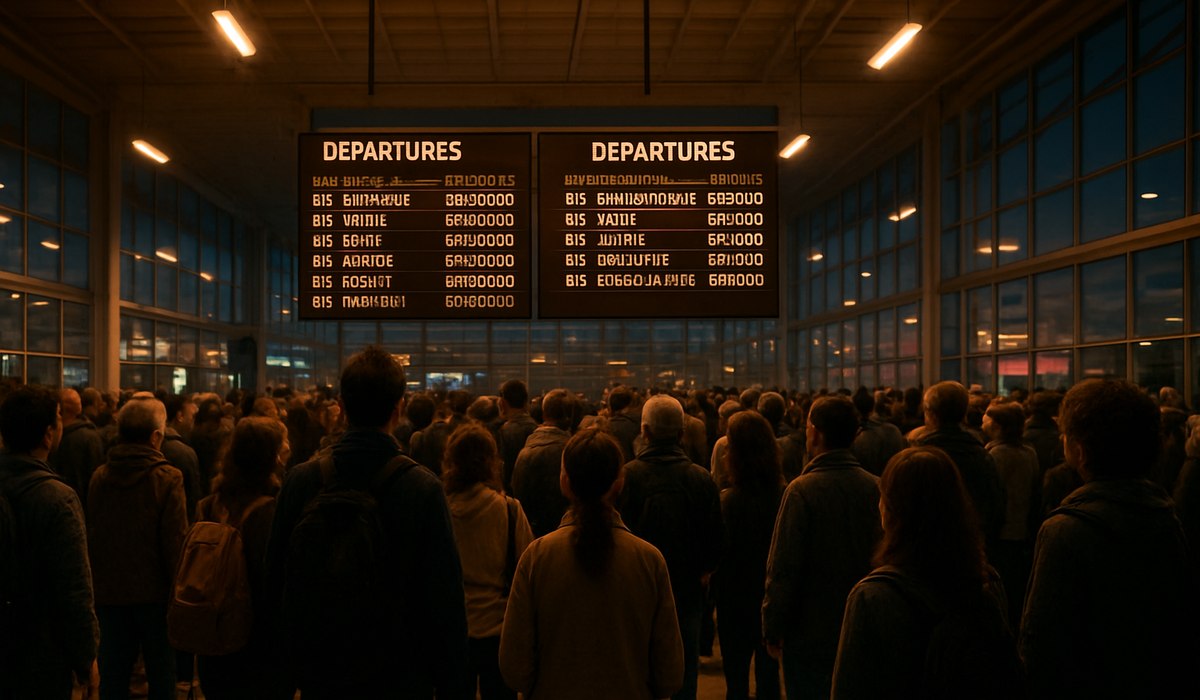
Image generated by AI
Flight Chaos Reveals Global Aviation at Critical Capacity Threshold
A cascading wave of flight disruptions in March 2026 has exposed what industry analysts now call a $34 billion annual systemic crisis in global aviation infrastructure. The United States aviation network recorded more than 31,000 combined flight delays and cancellations across North America and the Caribbean during this period alone, affecting millions of travelers and triggering widespread economic losses. Flight chaos reveals the hard truth: the world's air transportation system is operating beyond sustainable capacity limits, with no meaningful recovery in resilience since the COVID-19 pandemic disrupted operations from 2020 through 2023.
Global Aviation System Operating at Breaking Point
The aviation sector faces an unprecedented convergence of operational stresses that experts describe as unsustainable. Multiple simultaneous factors—from weather extremes and geopolitical tensions to aging infrastructure and critical staffing shortages—have pushed the system past its breaking point.
Industry data shows that regional disruption cascades have become the norm rather than the exception. On March 11, 2026 alone, global monitoring services recorded 2,300 flight cancellations and over 18,000 delays, with Asia-Pacific bearing 774 cancellations and 2,100 delays. The region's vulnerability stems from monsoon weather patterns, typhoon activity, and Middle East airspace restrictions triggered by geopolitical instability. Aircraft rotation failures compounded these challenges, leaving crews and planes stranded in wrong locations across transpacific routes.
Flight chaos reveals how single-point infrastructure failures now ripple instantly across continents. A July 2024 IT outage at a major U.S. carrier canceled 7,000 flights in five days, stranding 1.3 million passengers. Previous FAA system outages and national airspace closures in the Philippines demonstrated how quickly localized failures become global disruptions. The system lacks redundancy and recovery capacity.
March 2026 Disruption Cascade: By the Numbers
The March 2026 disruption cascade quantifies aviation's systemic vulnerability with stark precision:
| Metric | Count | Impact Region |
|---|---|---|
| Combined delays + cancellations (March 2026) | 31,000+ | North America, Caribbean, South America |
| Global cancellations (March 11, 2026) | 2,300 | Worldwide |
| Global delays (March 11, 2026) | 18,000+ | Worldwide |
| Asia-Pacific cancellations (single day) | 774 | Tokyo, Dubai, regional hubs |
| Asia-Pacific delays (single day) | 2,100+ | Trans-Pacific routes |
| Passengers affected by July 2024 IT outage | 1.3 million | United States |
| Annual economic impact (U.S. only) | $34 billion | 2022-2026 period |
These figures represent not isolated incidents but symptoms of systemic failure. Flight chaos reveals that current operational margins have disappeared entirely.
Root Causes: Weather, Geopolitics, and Infrastructure Failures
Three interconnected factors drive aviation's current crisis, and none shows signs of improvement.
Weather and Climate Volatility account for cascading delays that amplify through hub networks. March 2026 monsoon patterns in Asia-Pacific combined with typhoon activity to overwhelm regional air traffic management systems. Climate instability is becoming the new normal, yet infrastructure investments in weather resilience remain minimal.
Geopolitical Tensions have carved new airspace restrictions that eliminate efficient routing options. Middle East volatility forces flights into longer, more fuel-intensive paths. These detours generate environmental costs equivalent to 2 million additional passenger cars annually across key markets, while adding fuel surcharges and operational complexity.
Staffing Shortages and Aging Infrastructure represent the most preventable crisis layer. The Federal Aviation Administration operates with a deficit of several thousand air traffic controllers relative to target staffing levels. Hiring interruptions, training bottlenecks, and impacts from government shutdowns have created a workforce crisis that neither Congress nor the FAA has adequately addressed. Air traffic control towers struggle with technology dating from the 1990s, lacking automation and predictive capabilities modern networks require.
Long-Term Resilience Crisis Since COVID-19 Recovery
The aviation industry never truly recovered operationally after COVID-19, despite passenger volumes returning to pre-pandemic levels. Industry research covering 2019 through 2023 describes an "extraordinary wave" of disruption during pandemic shock, followed by a deceptive reset that restored flight capacity while neglecting infrastructure modernization.
Airlines shed workers, deferred maintenance, and reduced training investments during recovery. Regional carriers consolidated. Hub flexibility disappeared. When disruptions strike—whether weather, IT failures, or staffing issues—the system has zero slack. Flight chaos reveals a network optimized for profit, not resilience.
Each major incident since 2024 has exposed this fragility. The 2024 IT outage affected 1.3 million passengers because systems lacked redundancy. Controller shortages mean minimal coverage for sick leave or peak travel periods. Aging aircraft inventory and reduced spare-parts stockpiles mean single mechanical issues cascade into fleet-wide ground stops.
Recovery times have lengthened dramatically. Historical data suggests disruptions now take 48-72 hours to fully resolve, compared to 24 hours pre-2020. This extended recovery window multiplies passenger frustration, hotel costs, and missed connection fees.
The $34 Billion Economic Reality
Flight chaos reveals staggering economic losses that extend far beyond airline balance sheets. The $34 billion annual figure cited by industry researchers combines multiple damage categories often discussed separately.
Passenger costs represent approximately 50-60% of total disruption losses. Travelers lose an average of $385 per significant disruption once replacement flights, hotels, meals, and missed work hours are totaled. Multiply this across millions of disrupted passengers annually, and individual burden becomes an economy-wide drag on business travel, tourism, and commerce.
Airline operating costs account for roughly one-third of total impact, including fuel burned during holding patterns, crew overtime, aircraft repositioning, unplanned maintenance, and reputational damage. Airlines cannot pass these costs entirely to consumers without reducing demand further.
Broader economic effects include lost business productivity, canceled meetings, missed deadlines, and supply chain disruptions. Just-in-time manufacturing relies on predictable air cargo schedules. Medical equipment, perishable goods, and time-sensitive commerce suffer from flight delays and cancellations.
Environmental costs add a hidden layer. Disruption-related detours, go-arounds, and recovery flying produced carbon emissions equivalent to 2 million passenger cars annually across key markets in 2022 alone. As climate regulations tighten, these environmental liabilities will increasingly convert to regulatory fines and compliance costs.
European passenger rights regulations layer additional costs onto disruption. Carriers must provide meals, hotels, and compensation when delays exceed certain thresholds. These direct payouts and care obligations cost airlines billions annually across the continent.
Real-Time Disruption Tracking and Passenger Information
Understanding current disruption status requires reliable, real-time data sources that provide transparency airlines don't always volunteer.
FlightAware (https://FlightAware.com) offers the most comprehensive flight tracking platform, showing live delays, cancellations, gate information, and historical reliability metrics by airline and route. The platform's Misery Map visualizes disruption in real-time, showing exactly which airports and carriers face capacity stress.
FAA Status and Information (https://www.faa.gov) provides official ground stop notices, airspace restrictions, and operational alerts. The FAA website's "Notice to Airmen" section explains weather delays and geopolitical airspace changes before carriers formally announce them.
US Department of Transportation Airline Consumer Information (https://www.transportation.gov/airconsumer) maintains
Disclaimer
This article is for informational and educational purposes only. It does not constitute legal, financial, or professional advice. While we strive to provide accurate and up-to-date information, travel policies, regulations, and conditions change rapidly. Always verify information with official sources before making travel decisions. Nomad Lawyer makes no representations about the accuracy, reliability, completeness, or suitability of the information provided. Readers should consult qualified professionals for advice specific to their circumstances. The views expressed in this article are those of the author and do not necessarily reflect the views of Nomad Lawyer.
Kunal K Choudhary
Co-Founder & Contributor
A passionate traveller and tech enthusiast. Kunal contributes to the vision and growth of Nomad Lawyer, bringing fresh perspectives and driving the community forward.
Learn more about our team →