
A380 Wake Turbulence Incident: EW635 Plunges Over Sarajevo
Eurowings flight EW635 encountered violent wake turbulence from an Emirates A380 over Bosnia, injuring five people. The May 30 incident reveals critical gaps in airspace separation protocols.

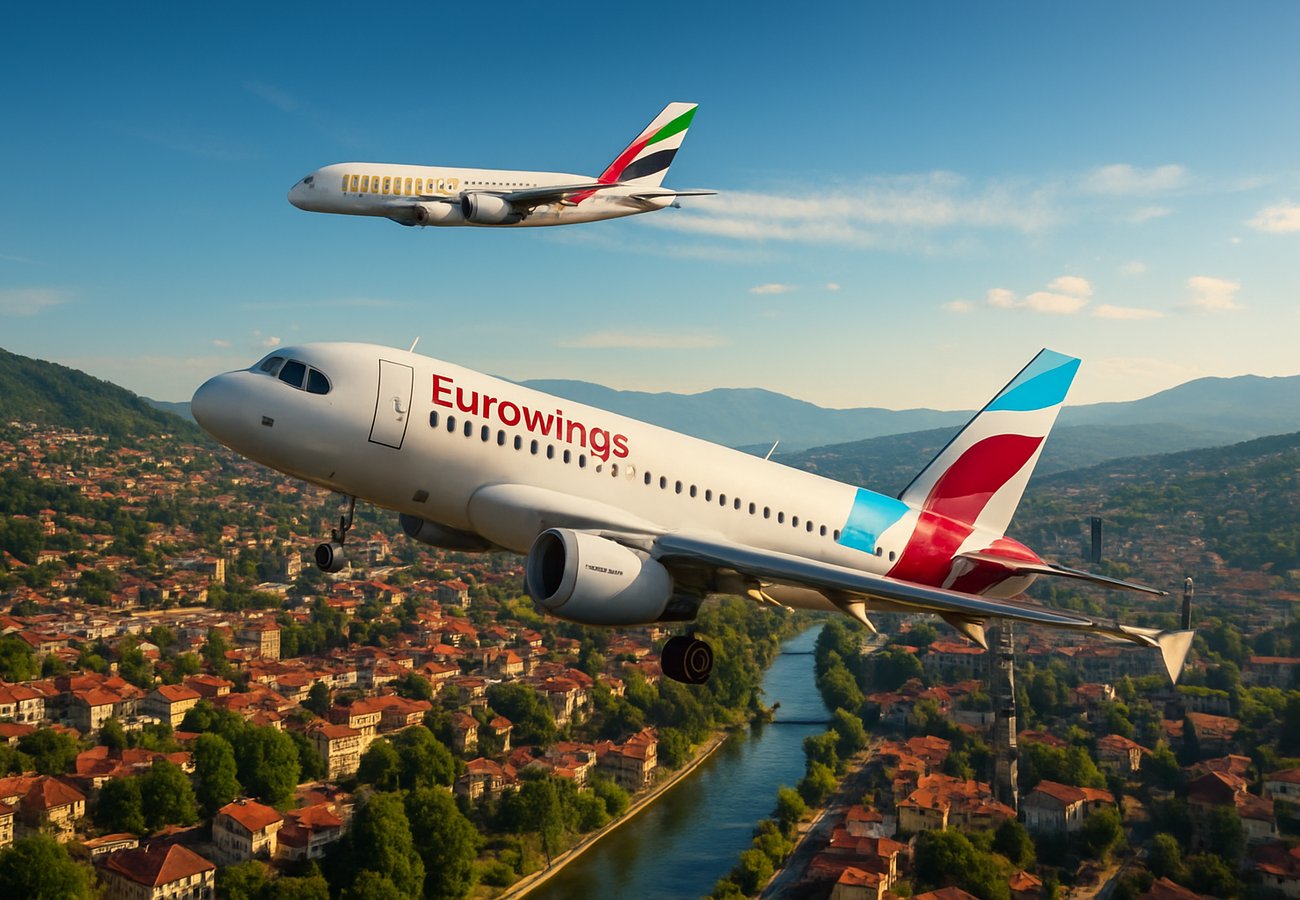
Image generated by AI
When the Skies Turn Violent: The EW635 Encounter
It happened in seconds. On May 30, 2026, passengers aboard Eurowings flight EW635 experienced something few ever forget—a sudden, violent plunge through 3,000 feet of thin air. The Airbus A320, climbing toward cruising altitude near Sarajevo, Bosnia and Herzegovina, collided invisibly with something far more powerful: the invisible wake vortex left behind by an Emirates Airbus A380-800.
The aircraft was operating from Rhodes, Greece to Cologne, Germany when the unthinkable occurred. Five people—four passengers and one flight attendant—were injured as unsecured items and bodies were thrown upward. What makes this incident chilling isn't just the violence of the moment. It's what it reveals about how we manage the world's busiest skies.
The Setup: When Safe Separation Isn't Quite Safe Enough
The sequence of events reads like a script written by physics itself. Eurowings EW635 (registration D-AEWS) was climbing from flight level 360 (36,000 feet) to flight level 380 (38,000 feet) when air traffic control cleared it to ascend into airspace already occupied by Emirates flight EK-1 (registration A6-EUF), an Airbus A380-800 cruising from Dubai to London Heathrow.
Radar showed a horizontal separation of approximately 7.6 nautical miles—just above the ICAO minimum standard of seven nautical miles required between "Super" and "Medium" category aircraft. On paper, that's safe. In reality, at cruising altitude, it wasn't enough.
Reddit: "I fly A320s regularly. We are trained to expect wake turbulence, but an A380 wake hitting you at 37,600 feet? That's rare and terrifying." — r/aviation
The Invisible Enemy: How Wake Turbulence Works
Most passengers don't realize what they're flying through. Wake turbulence consists of powerful counter-rotating spirals of air generated at the wingtips of aircraft during flight. For a massive Airbus A380—which can weigh up to 1.2 million pounds at maximum takeoff weight—these vortices are exponentially more dangerous than those from smaller jets.
The physics are unforgiving. As the A320 climbed through roughly 37,600 feet, it entered the path of a descending wake vortex. The aircraft immediately experienced a descent rate of 3,000 feet per minute, creating violent upheaval inside the cabin. Luggage became projectiles. Passengers who weren't belted in were hurled from their seats.
The Physics of Danger
An A380's massive wingspan—over 262 feet—generates vortices that can persist for several minutes depending on atmospheric conditions. Wind speed, atmospheric stability, and direction all play roles. In this case, calm conditions may have allowed the vortex to linger longer and descend deeper than expected.
According to ICAO guidelines, separation minima exist for exactly this reason. Yet this incident suggests those minima may not account for all variables, particularly during climb and descent phases where vertical trajectories intersect with horizontal separation rules in unexpected ways.
The Moment Everything Changed
At cruising altitude near Sarajevo, the violent encounter forced the flight crew into emergency mode. The cockpit crew stabilized the aircraft quickly—a testament to pilot training—and made the decision to continue to Cologne, where emergency medical services were standing by.
When EW635 touched down in Cologne, ambulances were waiting. The four injured passengers and flight attendant were treated on board before being transported to a local hospital. The cockpit voice recorder (CVR) and flight data recorder (FDR) were immediately recovered for investigation.
The aircraft continued flying. No other aircraft were affected. But the incident report had only just begun.
What the Investigators Are Looking For
Germany's Federal Bureau of Aircraft Accident Investigation (BFU), along with regional authorities in Bosnia and Herzegovina, launched a formal investigation. They're analyzing flight recorder data to measure G-forces experienced by the A320, reconstructing radar tracks with precision, and evaluating meteorological conditions at the exact moment of encounter.
The critical question: How did the wake vortex extend beyond the expected separation threshold? Was atmospheric stability the culprit? Did low wind speeds allow the vortex to persist unnaturally? Or does current ICAO separation policy fundamentally underestimate wake hazards during climbing phases?
Investigators are also reviewing whether current separation standards should be adjusted for climbing and descending aircraft. While ICAO rules rest on decades of safety research, incidents like this one suggest real-world conditions sometimes exceed laboratory assumptions.
A Conversation About Airspace Management
This incident has triggered important conversations among aviation authorities worldwide. The Federal Aviation Administration (FAA), European Union Aviation Safety Agency (EASA), and other regulatory bodies actively monitor and update procedures to mitigate wake turbulence risk.
The question isn't whether A380s are safe—they are. The question is whether the procedures governing mixed-fleet operations at similar altitudes adequately protect smaller aircraft. With thousands of intercontinental flights daily, the stakes are massive.
Heavy aircraft like the A380 will continue flying major international routes. Smaller aircraft will continue sharing those same airways. The challenge for regulators is ensuring they don't share the same airspace at the same moment in ways that create hazard.
What This Means for Travelers
For most passengers, this incident will remain unknown. For the five people injured aboard EW635, it will remain unforgettable. But the broader implication affects everyone who flies international routes.
Aviation safety is built on continuous improvement. Incidents like this—rare as they are—force the system to examine itself. Whether through adjusted separation minima, enhanced pilot training, or technological solutions, aviation authorities will respond. They always do.
The investigation into the May 30 incident over Sarajevo will inform future guidance on mixed-aircraft operations at cruising altitudes and contribute to global aviation safety standards for years to come.
The skies remain among the safest places on Earth—because incidents like this one ensure they stay that way.
Related Travel Guides
How to File an Aviation Incident Report: Your Legal Rights as an Injured Passenger
Understanding ICAO Regulations: What International Aviation Law Means for Travelers
Air Traffic Control Systems Explained: Safety Protocols That Keep You Safe
Disclaimer
This article is for informational and educational purposes only. It does not constitute legal, financial, or professional advice. While we strive to provide accurate and up-to-date information, travel policies, regulations, and conditions change rapidly. Always verify information with official sources before making travel decisions. Nomad Lawyer makes no representations about the accuracy, reliability, completeness, or suitability of the information provided. Readers should consult qualified professionals for advice specific to their circumstances. The views expressed in this article are those of the author and do not necessarily reflect the views of Nomad Lawyer.
Kunal K Choudhary
Co-Founder & Contributor
A passionate traveller and tech enthusiast. Kunal contributes to the vision and growth of Nomad Lawyer, bringing fresh perspectives and driving the community forward.
Learn more about our team →