
European Aviation Gridlock: 2,508 Delays and 62 Cancellations Paralyze Major Hubs
Major European airports including Rome Fiumicino and Frankfurt face massive disruptions with 2,508 delays and 62 cancellations affecting thousands of passengers

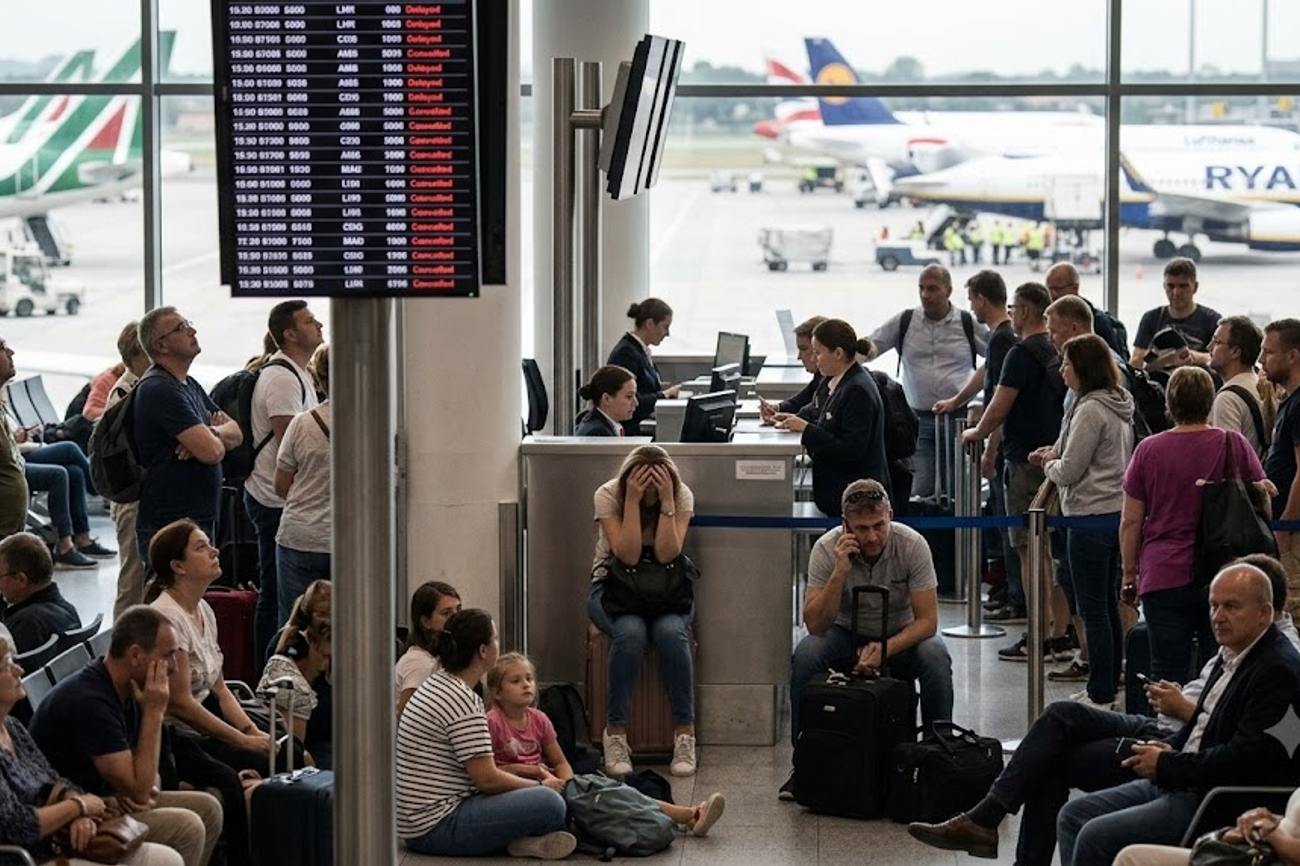
Image generated by AI
[Frankfurt, September 11, 2026] — European air travel descended into chaos on September 11, 2026, as a systemic series of disruptions triggered 2,508 delays and 62 cancellations across nine nations. The volatility impacted critical infrastructure in Germany, Norway, Austria, Italy, the United Kingdom, France, Spain, Ireland, and the Netherlands, leaving travelers stranded at major gateways including Frankfurt, Rome Fiumicino, and Amsterdam Schiphol.
The disruption was not limited to a single region but spanned the continent's most vital transit points. High-traffic airports such as London Heathrow, Paris Charles de Gaulle, and Berlin-Brandenburg reported significant bottlenecks, while budget carriers and flag carriers alike struggled to maintain schedules. Industry data indicates that KLM suffered the most severe impact in terms of scrubbed flights, recording 11 cancellations, followed by easyJet with nine and Transavia France with seven.
Rome Fiumicino and Barcelona Lead Delay Statistics
The most severe congestion was concentrated in Southern Europe. Rome Fiumicino emerged as the hardest-hit facility, recording a staggering 352 delays and two cancellations. The brunt of this instability was felt by ITA Airways passengers, who accounted for 138 of those delays, while Wizz Air Malta (44) and Ryanair (28) also saw significant setbacks.
Close behind was Barcelona, where 307 delays and four cancellations were documented. Vueling Airlines was the primary driver of instability at this hub, reporting 158 delays and two cancellations. Ryanair and easyJet also contributed to the congestion with 19 and 18 delays respectively.
Northern European Hubs Face Heavy Cancellations
In Northern Europe, Amsterdam Schiphol reported a high volume of both delays and total flight removals. With 286 delays and 14 cancellations, the airport saw KLM bear the majority of the burden, recording 142 delays and 10 cancellations. easyJet contributed 27 delays and two cancellations, while Delta Air Lines reported seven delays and one cancellation.
Meanwhile, Frankfurt remained a focal point of disruption with 274 delays and two cancellations. Lufthansa was the primary entity affected, recording 110 delays and both of the airport's cancellations. Other impacted carriers at the German hub included Condor, with 46 delays, and Discover, with 21.
French and British Gateways Report Systemic Slumps
Parisian airports faced dual-pronged disruptions. Paris Orly recorded 254 delays and six cancellations, largely driven by Transavia France, which saw 127 delays and five cancellations. Vueling Airlines added 28 delays and one cancellation to the Orly total.
At Paris Charles de Gaulle, the situation was similarly strained with 224 delays and seven cancellations. Air France recorded 79 delays and two cancellations, while easyJet reported 40 delays and two cancellations. Vueling Airlines recorded four delays and two cancellations at the facility.
In the United Kingdom, London Heathrow reported 178 delays and five cancellations. British Airways was the most affected carrier at the hub with 108 delays and one cancellation, while American Airlines recorded four delays and two cancellations.
Central European Impact and Regional Data
Vienna recorded 143 delays and three cancellations, with Austrian Airlines reporting 62 delays and one cancellation. Air Baltic also struggled at the Vienna hub, recording nine delays and two cancellations.
The following table provides a comprehensive breakdown of the operational failures across the most impacted European airports:
| Airport | Total Delays | Total Cancellations | Primary Affected Airline |
|---|---|---|---|
| Rome Fiumicino | 352 | 2 | ITA Airways (138 delays) |
| Barcelona | 307 | 4 | Vueling Airlines (158 delays) |
| Amsterdam Schiphol | 286 | 14 | KLM (142 delays / 10 cancellations) |
| Frankfurt | 274 | 2 | Lufthansa (110 delays / 2 cancellations) |
| Paris Orly | 254 | 6 | Transavia France (127 delays / 5 cancellations) |
| Paris Charles de Gaulle | 224 | 7 | Air France (79 delays / 2 cancellations) |
| London Heathrow | 178 | 5 | British Airways (108 delays / 1 cancellation) |
| Vienna | 143 | 3 | Austrian Airlines (62 delays / 1 cancellation) |
Airline-Specific Performance Failures
The disruption was widespread across various business models, from low-cost carriers to full-service airlines. easyJet recorded a total of 220 delays, with the highest concentrations at London Luton (46), Paris Charles de Gaulle (40), Berlin-Brandenburg (34), and Amsterdam Schiphol (27). The airline also saw nine flights cancelled.
Vueling Airlines followed closely with 210 total delays. While the majority occurred in Barcelona (158), the airline also faced setbacks at Paris Orly (28), Amsterdam Schiphol (9), London Heathrow (7), and both Venice Marco Polo and Paris Charles de Gaulle (4 each). Vueling recorded five cancellations.
KLM’s instability was concentrated heavily at its home hub, with 142 of its 146 total delays occurring at Amsterdam Schiphol. However, the airline led all carriers in total cancellations with 11. ITA Airways recorded 143 delays, primarily at Rome Fiumicino (138) and Venice Marco Polo (5), though it avoided total cancellations.
Transavia France recorded 128 delays, almost entirely concentrated at Paris Orly (127), and suffered seven cancellations. Ryanair reported 119 delays, with the highest figures coming from Dublin (43), Rome Fiumicino (28), Barcelona (19), and Venice Marco Polo (13).
Operational Root Causes and Passenger Guidance
Industry reports suggest these disruptions stem from a combination of aircraft availability, crew scheduling conflicts, and essential maintenance requirements. Furthermore, airport capacity constraints and air-traffic management issues, compounded by fluctuating weather conditions, created a domino effect. Because crews and aircraft typically operate multiple rotations per day, a single delay in the morning frequently cascades into multiple schedule shifts by evening.
For passengers currently navigating this volatility, aviation experts recommend the following steps:
- Verify real-time flight status via airline apps before departing for the airport.
- Increase the time allocated for security and check-in to account for terminal congestion.
- Maintain digital and physical copies of all booking references.
- Initiate contact with the carrier immediately upon receiving a cancellation alert.
- Request the earliest possible rebooking alternative.
- Confirm the status of checked luggage following any flight change.
- Stay alert to gate changes via airport monitors.
Why This Matters (Information Gain & Experience)
For the modern traveler, this data highlights a precarious vulnerability in the European "hub-and-spoke" model. When a primary hub like Amsterdam Schiphol or Rome Fiumicino experiences a surge in delays, the impact is not localized; it ripples across the entire continent. For a passenger, this means that even if your departure airport is functioning perfectly, a delay in a connecting city can effectively strand you.
From a logistical standpoint, the heavy concentration of delays within specific airlines—such as Vueling in Barcelona or ITA in Rome—suggests that operational bottlenecks are often tied to specific carrier resource management rather than just airport infrastructure. Travelers should be aware that during these periods of instability, budget carriers with tighter turnaround times are often more susceptible to "cascading delays" than full-service carriers with more buffer in their schedules.
Related Travel Guides
Disclaimer
This article is for informational and educational purposes only. It does not constitute legal, financial, or professional advice. While we strive to provide accurate and up-to-date information, travel policies, regulations, and conditions change rapidly. Always verify information with official sources before making travel decisions. Nomad Lawyer makes no representations about the accuracy, reliability, completeness, or suitability of the information provided. Readers should consult qualified professionals for advice specific to their circumstances. The views expressed in this article are those of the author and do not necessarily reflect the views of Nomad Lawyer.
Preeti Gunjan
Contributor & Community Manager
A passionate traveller and community builder. Preeti helps grow the Nomad Lawyer community, fostering engagement and bringing the reader experience to life.
Learn more about our team →