
Europe’s Secondary Capitals: The Shift Toward Low-Friction Urban Tourism
EU tourism hits record 3 billion nights. Discover why smaller capitals like Ljubljana and Tallinn are replacing over-saturated hubs for short-stay travel.

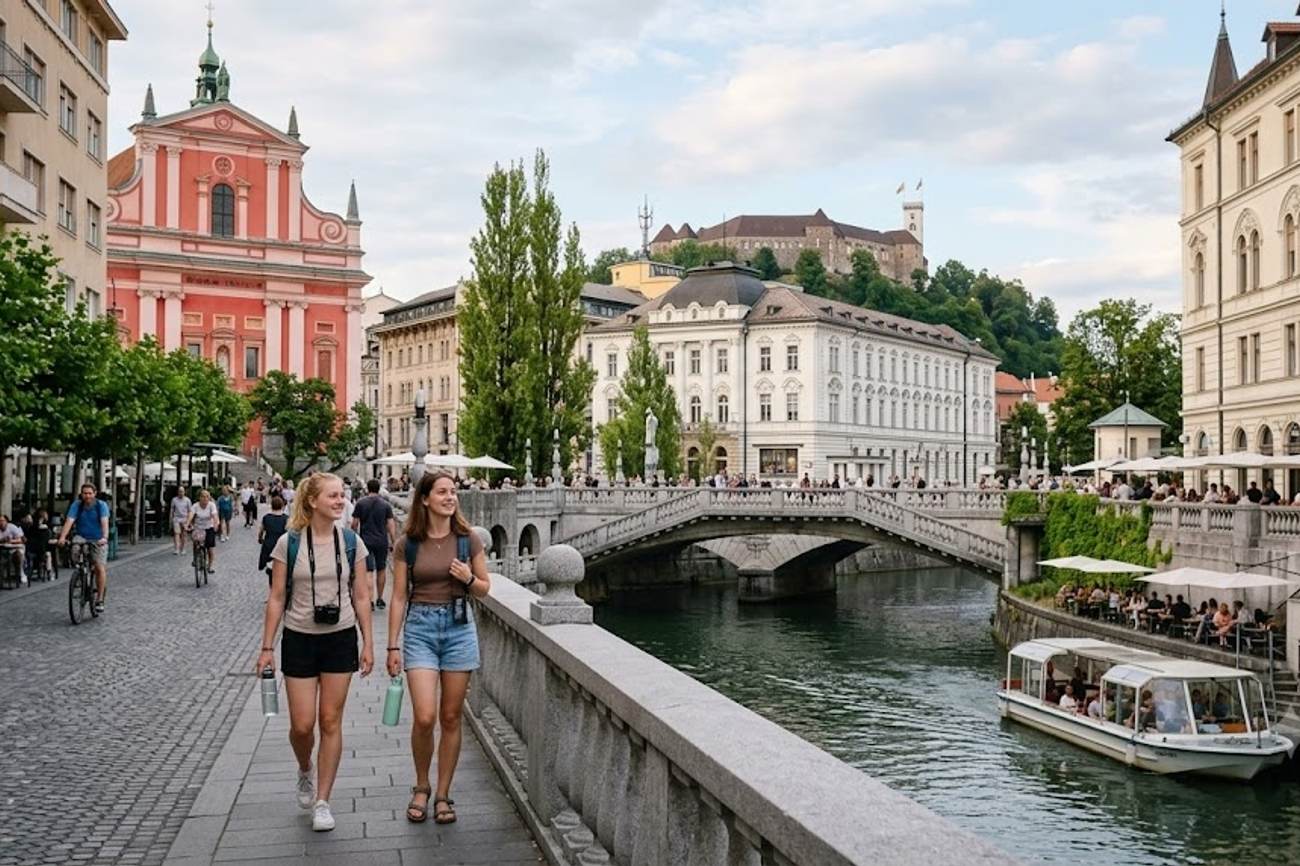
Image generated by AI
European tourism has entered a new scale of operation, with EU accommodation establishments recording over 3 billion overnight stays in 2024. While international nights rose by 4.9%, the distribution of these visitors remains heavily skewed toward a few primary gateways. Paris led the bloc with approximately 74 million accommodation nights, followed by Rome at 42 million and Berlin at 30 million.
This concentration has strained housing availability, public space, and the integrity of historic centers in Tier-1 cities. Consequently, a parallel market is emerging around "secondary capitals"—cities that offer high cultural density without the metropolitan friction of mega-cities.
The Efficiency Model: Compact Urbanism
For travelers operating on 48-to-72-hour itineraries, the primary constraint is transit time between attractions. Smaller capitals are gaining a competitive edge by concentrating museums, gastronomy, and historic quarters within walkable distances.
Ljubljana serves as the primary case study for this model. In 2024, the Slovenian capital recorded 1.276 million tourist arrivals and 2.591 million overnight stays. Foreign visitors accounted for 2.48 million of those nights, with significant contributions from Italy (250,322 nights), Germany (243,835 nights), and the United States (185,408 nights). Arrivals increased by 14.6% year-on-year, while overnight stays rose by 12.7%.
Similarly, Tallinn has leveraged its identity as a blend of medieval heritage and digital modernity. Foreign overnight stays in Tallinn reached 2.54 million in 2024 (approximately 90% of 2019 levels). Data indicates Tallinn recorded 5.77 foreign visitor nights per resident, significantly outpacing Vilnius (2.77) and Helsinki (1.64).
Strategic Route Specifications
| City | Primary Proposition | Strategic Advantage |
|---|---|---|
| Ljubljana | Gastronomy & Nature | Integrated city-plus-outdoors itineraries |
| Tallinn | Medieval & Digital | High visitor-per-resident ratio; digital ease |
| Vilnius | Heritage & Creative Districts | Compact cultural discovery; adaptive reuse |
| Bratislava | Central European History | Strategic multi-city positioning (Vienna/Budapest) |
| Valletta | Mediterranean Heritage | Extremely high sightseeing concentration |
| Zagreb | Urban Culture & Cafés | Alternative to coastal Croatia circuits |
Traveler Logistics Guide
From a ground-level perspective, navigating these smaller capitals requires a different strategy than the "hub-and-spoke" model used in London or Paris.
1. Connection Optimization When booking connections to cities like Ljubljana or Tallinn, prioritize "Open-Jaw" tickets. For example, fly into Ljubljana and out of Zagreb to cover the Balkan corridor without backtracking. Because these cities are compact, the optimal layover for a "city-break" is 72 hours; this allows for one full day of urban exploration and one day for regional excursions (e.g., Lake Bled from Ljubljana).
2. Navigating Local Policies Be aware of evolving municipal taxes designed to fund infrastructure. As of January 2024, Vilnius implemented a city tax of €2 per person, per night (up from €1). These fees are typically settled at check-in and are used specifically for tourism marketing and public recreation.
3. Digital Transit Integration Utilize national digital transit portals. In the Baltics and Slovenia, digital ticketing for regional trains and buses is the standard. Avoid physical ticket kiosks at smaller stations, as many have transitioned to app-only or QR-code systems.
Infrastructure Impact Assessment
The pivot toward secondary capitals redistributes economic impact away from saturated centers. In Estonia and Latvia, capitals account for 49.8% and over 50% of national accommodation nights, respectively. By promoting these cities as primary destinations rather than stopovers, these nations can increase the average length of stay and spread spending across local museums, boutique hotels, and regional transport.
This shift reduces the "overtourism" pressure on Paris and Rome while providing a sustainable growth trajectory for smaller urban economies that can offer high-value, low-friction experiences.
Related Travel Guides
Disclaimer
This article is for informational and educational purposes only. It does not constitute legal, financial, or professional advice. While we strive to provide accurate and up-to-date information, travel policies, regulations, and conditions change rapidly. Always verify information with official sources before making travel decisions. Nomad Lawyer makes no representations about the accuracy, reliability, completeness, or suitability of the information provided. Readers should consult qualified professionals for advice specific to their circumstances. The views expressed in this article are those of the author and do not necessarily reflect the views of Nomad Lawyer.
Raushan Kumar
Founder & Lead Developer
Full-stack developer with 11+ years of experience and a passionate traveller. Raushan built Nomad Lawyer from the ground up with a vision to create the best travel and law experience on the web.
Learn more about our team →