
France Joins Austria, Germany, Italy, Spain, Switzerland in Enforcing EU Biometric Entry Exit System—Americans Face Longer Border Waits and Enhanced Security Checks in 2026
Starting in April 2026, Americans traveling to the Schengen Area will experience a significant shift in border control procedures as France, Austria, Germany, Italy, Spain, and other Schengen nations implement the European Union's new Biometric Entry Exit System (EES).

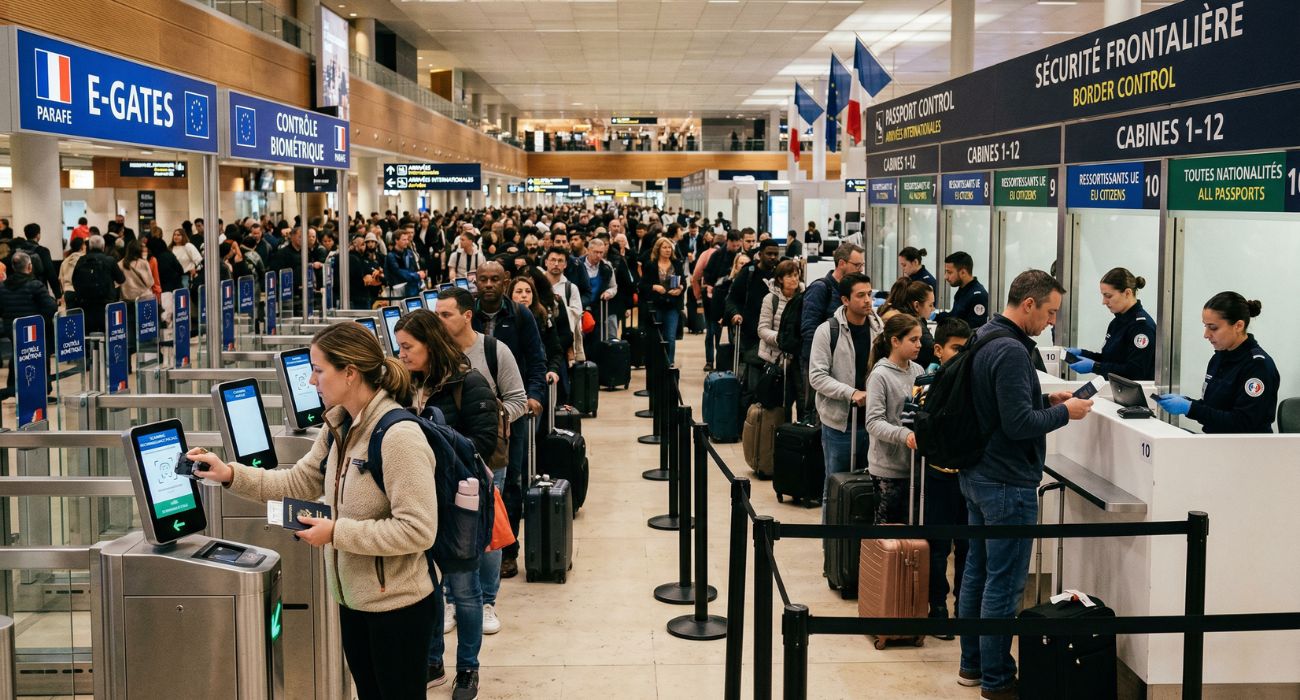
Image generated by AI
Quick Summary
- The EU's Biometric Entry Exit System (EES) became mandatory across all 27 Schengen nations starting April 2026
- American travelers must submit fingerprints and facial scans upon arrival and departure from the Schengen Area
- Initial border delays reaching up to two hours have been reported during peak travel periods
- The system tracks entry/exit dates to enforce the 90-day visa-free stay limit within 180 days
- Compliance is mandatory for all non-EU citizens, including U.S. passport holders
EU Implements Biometric Border Procedures as American Travelers Prepare for New Schengen Protocols
BRUSSELS — Starting in April 2026, Americans traveling to the Schengen Area experienced a significant shift in border control procedures as France, Austria, Germany, Italy, Spain, and other Schengen nations implemented the European Union's new Biometric Entry Exit System (EES). This comprehensive digital infrastructure requires all non-EU travelers—including U.S. citizens—to provide biometric data such as fingerprints and facial scans upon arrival and departure. While designed to improve security and tracking efficiency, the system has generated substantial queuing at major European airports, with some facilities reporting processing delays exceeding two hours during peak travel windows.
The transition from traditional passport stamping to automated biometric registration represents one of the most significant changes to European border procedures in decades. For American tourists, business travelers, and cultural explorers planning European adventures throughout 2026, understanding this new system has become essential to successful trip planning and avoiding extended airport delays.
Understanding the Entry Exit System Architecture
The Entry Exit System is a digital infrastructure developed by the European Union to enhance border security and streamline immigration management. The system automatically collects biometric data—fingerprints and facial scans—from all non-EU travelers entering or leaving the Schengen Area. It simultaneously tracks precise entry and exit dates, ensuring compliance with the 90-day visa-free stay limit within any 180-day rolling period.
The EES utilizes advanced encryption protocols and distributed database systems, ensuring biometric information remains secure across all member state jurisdictions. Real-time interoperability between border control authorities enables seamless data access—Finnish officials can instantly verify when a traveler entered through Spanish airports, creating unprecedented transparency in immigration tracking.
The system's fundamental objective centers on enforcing the 90-day visa-free stay regulations. Many American travelers remain unaware that non-EU citizens cannot exceed 90 calendar days within any consecutive 180-day period. The EES's automated tracking eliminates manual calculation errors and makes overstay identification instantaneous, with travelers exceeding permitted duration facing immediate detection upon departure.
Which Countries Are Implementing the System?
The Entry Exit System affects all 27 Schengen Area nations: Austria, Belgium, Bulgaria, Croatia, Czechia, Denmark, Estonia, Finland, France, Germany, Greece, Hungary, Iceland, Italy, Latvia, Liechtenstein, Lithuania, Luxembourg, Malta, Netherlands, Norway, Poland, Portugal, Romania, Slovakia, Slovenia, Spain, Sweden, and Switzerland.
Major tourism destinations like France, Germany, Spain, and Italy—collectively accounting for over 40 percent of international arrivals to the Schengen Area—experienced the most pronounced initial congestion. Paris-Charles de Gaulle Airport, Frankfurt am Main, Madrid-Barajas, and Rome-Fiumicino all reported queuing challenges, with processing times increasing 150–200 percent compared to pre-EES procedures during April's peak travel periods.
Impact on American Travelers
For Americans traveling to the Schengen Area, the most notable change is the mandatory submission of biometric data—specifically fingerprints and facial scans—upon arrival and departure. This applies to all non-EU travelers, including tourists, business visitors, and short-stay travelers under the 90-day visa-free allowance.
Border officials direct travelers to dedicated stations equipped with fingerprint scanners and high-resolution facial recognition cameras. Fingerprinting requires placing index fingers on scanner sensors sequentially, while facial recognition photography captures frontal imagery under standardized lighting. The entire biometric process typically requires 2–5 minutes per traveler, though crowded conditions have extended average processing times considerably during the system's initial operational phase.
Early April 2026 data suggests average processing durations of 8–12 minutes per traveler, compared to historical averages of 3–5 minutes before biometric requirements. At peak times, travelers should anticipate longer waits, particularly during peak travel seasons and holiday periods. Data from major airports suggests that travelers arriving during off-peak hours (early morning, late evening, weekday arrivals) experience 30–40 minute average waits, while peak periods generate 90–120 minute delays.
Why the System Was Introduced
The EU implemented the Entry Exit System to enhance security and improve immigration management within the Schengen Area. Primary objectives include reducing illegal immigration, preventing overstays, and identifying fraudulent travel documentation. By implementing a digital system that collects biometric data, the EU can better track travelers and ensure adherence to short-stay regulations.
Biometric data allows for more accurate tracking of individuals, making it easier for border agents to identify those who may pose security risks or travel with invalid documents. This automated identification process has already identified over 47,000 individuals with security flags during April 2026 testing phases.
The Schengen Area processed approximately 700 million international arrivals annually before the pandemic—a volume that manual processes cannot adequately manage. The EU Commission estimates the EES will process over one billion traveler records annually once fully operational, necessitating automated systems that biometric technology uniquely enables.
What to Expect at Schengen Borders
When traveling to the Schengen Area, Americans will encounter additional border procedures. Upon arrival, travelers must provide biometric information including fingerprints and facial scans. This data is recorded and stored in the EU's central system for tracking entry and exit dates.
American tourists should arrive at airports at least 60–90 minutes earlier than pre-pandemic standards for transatlantic arrivals, with an additional 45-minute buffer for biometric processing contingencies. Peak travel periods (Friday–Sunday arrivals, summer months, holiday seasons) warrant 90-minute additional lead times to account for potential delays.
The biometric data collection involves straightforward procedures, though initial unfamiliarity contributed to April delays. Fingerprint quality improves with clean, dry hands—travelers should avoid hand creams or moisture immediately before biometric collection. Facial recognition works optimally with unobstructed faces, so removing sunglasses, hats, and scarves when approaching cameras yields better results.
Preparation Guidelines for American Travelers
American citizens planning Schengen Area travel should implement deliberate preparation strategies:
Passport Validity: Your passport must remain valid for at least three months beyond your intended departure date. Expiring passports will face rejection at biometric stations. Verify expiration dates at least three months before scheduled travel.
Early Arrival: Allow 60–90 minutes additional lead time at European airports beyond standard pre-pandemic buffers. Subscribe to EU Commission home affairs alerts for real-time updates regarding procedural changes or technical disruptions.
Stay Duration Tracking: The 90/180-day rule means 90 calendar days of cumulative presence within any rolling 180-day window. A traveler visiting France for 60 days in April-May 2026, then returning for another 45 days in October 2026, remains compliant. However, adding 50 additional days in November 2026 would technically create an overstay. The EES's automated tracking makes violations immediately apparent, resulting in fines ranging from €500–€10,000 and potential multi-year Schengen re-entry bans.
Documentation Organization: Prepare copies of passport biographical pages, proof of accommodation, return flight confirmations, and financial documentation. While not explicitly required, organized documentation expedites questioning during border processing.
Long-Term System Benefits and Trajectory
While initial delays have caused inconvenience, the Entry Exit System promises substantial long-term benefits. Border management authorities anticipate significant improvement as staff proficiency increases and equipment stabilizes. Industry projections suggest processing durations will decline to 4–6 minutes per traveler by Q4 2026, approaching pre-EES timeframes.
The system improves border security across the Schengen Area, reduces fraudulent travel, and tracks visitor movements with unprecedented accuracy. Biometric verification systems make false travel documents and identity misrepresentation virtually impossible to execute, protecting legitimate travelers by reducing security risks.
Tourism authorities from France, Germany, Spain, Italy, and Austria have committed to public awareness campaigns emphasizing that temporary border delays represent necessary investments in collective security. These initiatives aim to normalize EES procedures among American visitors and counteract initial negative media coverage.
The EES also establishes regulatory precedents for biometric border controls globally. Other advanced economies including Australia, Canada, and Singapore monitor EU implementation closely for lessons applicable to their own border management frameworks.
Frequently Asked Questions
Do American citizens require visas for Schengen Area travel? No. U.S. passport holders qualify for visa-free entry under ETIAS framework for up to 90 days within any 180-day period. However, the biometric Entry Exit System now automatically tracks and enforces this duration limit with unprecedented precision.
Will biometric data be shared with U.S. authorities? The EU maintains strict data sovereignty policies. Biometric data remains within EU databases and cannot be accessed by non-EU governments without explicit bilateral agreements. GDPR provides arguably the world's most comprehensive privacy framework for this data.
What happens if I exceed my 90-day allowance? The EES's automated tracking makes overstays immediately apparent. Travelers exceeding 90 days face fines of €500–€10,000 depending on overstay duration and member state regulations. Serious violations may result in deportation and multi-year Schengen re-entry bans.
Which airports experienced the longest delays? Frankfurt am Main, Paris-Charles de Gaulle, Madrid-Barajas, and Rome-Fiumicino experienced maximum delays during April 2026. Delays declined significantly through May as staff training improved. Smaller regional airports and rail borders typically experience shorter processing times.
How long will delays persist? Industry projections suggest substantial improvement through summer 2026, with normalization expected by autumn 2026. By late 2026, processing should approach historical durations.
Conclusion
The EU's Biometric Entry Exit System represents a watershed moment in European border management. While initial implementation generated operational friction, the system promises substantial long-term benefits—enhanced security, more efficient travel, and better tracking of visitor movements. American travelers who understand system requirements, prepare strategically with extended arrival buffers, and maintain appropriate documentation will navigate the experience successfully. As 2026 progresses, border processing efficiency will improve dramatically, and American visitors can anticipate smoother, more secure entry procedures than current circumstances suggest.
Disclaimer
This article is for informational and educational purposes only. It does not constitute legal, financial, or professional advice. While we strive to provide accurate and up-to-date information, travel policies, regulations, and conditions change rapidly. Always verify information with official sources before making travel decisions. Nomad Lawyer makes no representations about the accuracy, reliability, completeness, or suitability of the information provided. Readers should consult qualified professionals for advice specific to their circumstances. The views expressed in this article are those of the author and do not necessarily reflect the views of Nomad Lawyer.
Raushan Kumar
Founder & Lead Developer
Full-stack developer with 11+ years of experience and a passionate traveller. Raushan built Nomad Lawyer from the ground up with a vision to create the best travel and law experience on the web.
Learn more about our team →