
Etihad Airways Expands 2026 North American Network With New Calgary Route and 998,282 Seats
Etihad Airways is significantly scaling its North American footprint in 2026, introducing a landmark nonstop service to Calgary and increasing total regional capacity to nearly 1 million seats.
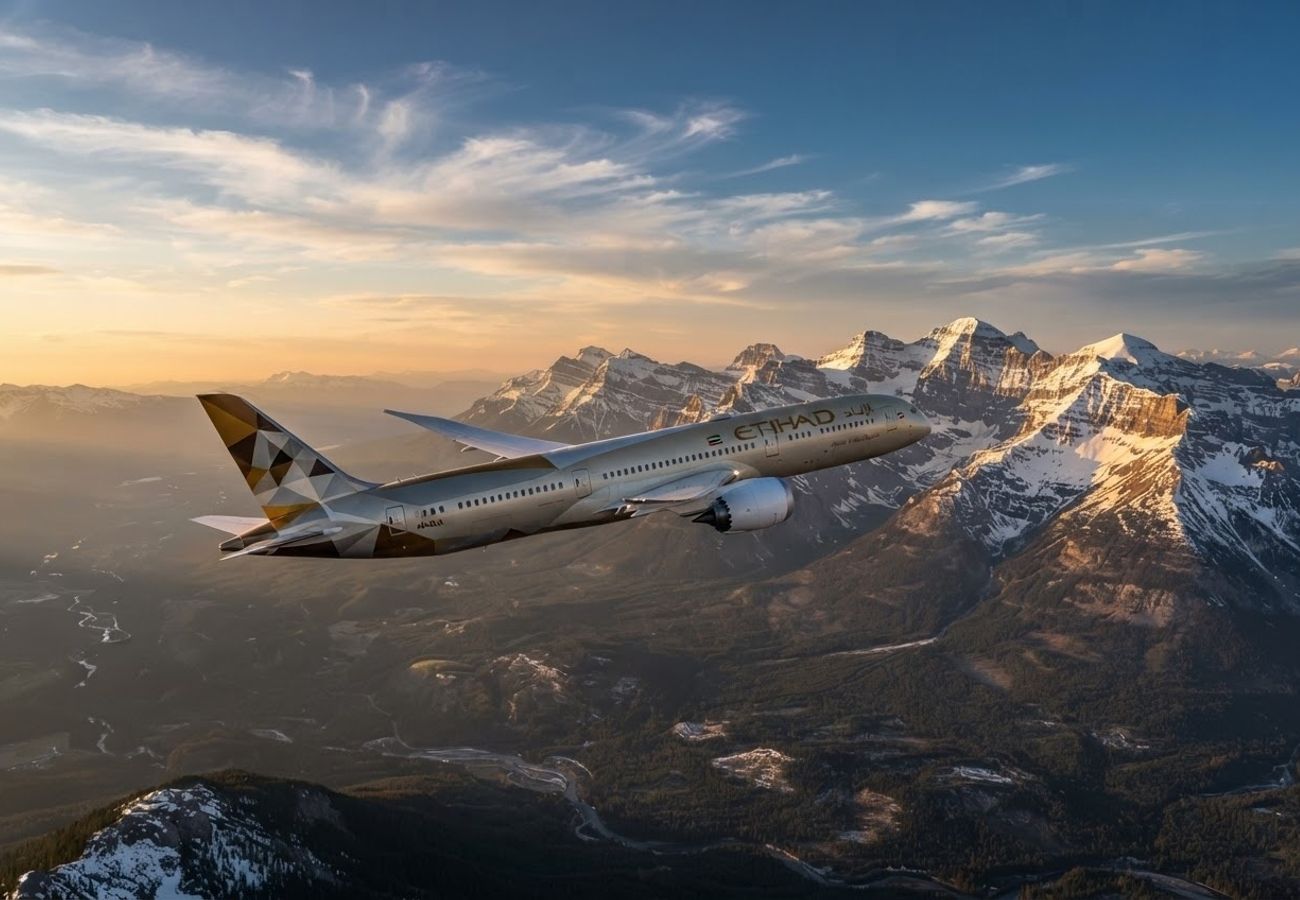
Image generated by AI
Abu Dhabi is cementing its status as a global transit powerhouse as Etihad Airways scales its North American operations to nearly 1 million seats in 2026, highlighted by a first-of-its-kind direct link to Western Canada.
The UAE-based carrier is aggressively diversifying its reach across the United States and Canada, moving beyond traditional coastal gateways to capture new markets in the Midwest, Southeast, and the Canadian Rockies. According to industry schedule data, Etihad's planned capacity for the North American region in 2026 stands at 998,282 round-trip seats—a substantial 25.7% increase over the figures recorded in 2025.
Strategic Hub Growth in Abu Dhabi
This expansion is a calculated move to transform Abu Dhabi into a primary connecting point for passengers traveling between the Americas and the wider East. By integrating eight distinct destinations across the U.S. and Canada, Etihad is positioning its home hub as a viable alternative to European or other Middle Eastern transit centers.
The airline's current American footprint includes major metropolitan centers such as New York, Washington, D.C., Boston, Chicago, Atlanta, and Charlotte. By leveraging a broader network of over 100 global destinations, the carrier allows passengers arriving from North America to seamlessly transition toward Asia, Africa, and the Middle East.
New Nonstop Connection to Calgary International Airport
The most significant addition to the 2026 calendar is the launch of service to Calgary. Starting November 3, 2026, Etihad will operate the first-ever nonstop flight between Abu Dhabi and Calgary International Airport. This route is set to operate four times per week, with flights scheduled for Tuesdays, Thursdays, Fridays, and Sundays.
To support this long-haul venture, Etihad will deploy the Boeing 787-9, an aircraft known for its efficiency on ultra-long-range missions. As confirmed by Calgary Airports, this service establishes the only direct aerial link between the United Arab Emirates and Western Canada.
For the leisure sector, this route is a game-changer. Calgary serves as the primary gateway to the Canadian Rockies, providing streamlined access to world-renowned destinations like Lake Louise and Banff. This removes the need for international visitors from the UAE, India, and Asia to navigate multiple domestic Canadian connections after landing in eastern cities.
Rising International Demand in Alberta
The timing of Etihad's entry aligns with a measurable surge in international traffic flowing into Alberta. Data from the Government of Alberta’s Economic Dashboard reveals that Calgary International Airport hosted 175,384 international visitors in July 2026, marking a 1.9% increase compared to July 2025.
This growth is mirrored at the federal level. Transport Canada has recently emphasized that international air corridors are the primary engines driving post-pandemic passenger recovery. The expansion of air-service agreements is intended to lower barriers for shippers and travelers, making Etihad's entry into the Calgary market a timely alignment with national economic goals.
Scaling Capacity in Chicago and Charlotte
While Calgary captures the headlines, Etihad is also deepening its penetration into the United States through frequency increases and new city pairs.
- Chicago Expansion: The airline has moved to a double-daily service for its Chicago route. This increased frequency is specifically designed to provide more flexible connection windows for passengers heading toward India and other Asian hubs via Abu Dhabi.
- Charlotte Entry: In 2026, Etihad added Charlotte, North Carolina, to its map. This move secures a stronger foothold in the southeastern U.S., ensuring the airline is not overly reliant on the Northeast corridor.
By spreading its capacity across the Midwest, Southeast, and Western Canada, Etihad is effectively decentralizing its North American strategy to capture a wider demographic of business and leisure travelers.
Implications for Indian and Asian Travelers
The growth of the North American network creates a highly efficient "one-stop" pipeline for travelers from India and Asia. By utilizing Abu Dhabi as a pivot point, passengers from Indian cities can now access Western Canada and the U.S. Southeast with significantly fewer transfers.
For those planning a Canadian holiday, the Calgary route is particularly valuable. Travelers can now bypass the long overland or domestic flight journeys from Toronto or Vancouver, landing directly in the heart of the Rockies.
Regulatory and Entry Requirements for Canada
Despite the increase in flight availability, the legal requirements for entering Canada remain unchanged. All passengers must verify their visa status or Electronic Travel Authorization (eTA) requirements via the official Canadian immigration portal prior to departure.
To streamline the arrival process, Calgary International Airport supports the Advance Declaration system via the ArriveCAN app. This allows eligible travelers to submit customs and immigration declarations digitally before landing, reducing congestion at the terminal.
Why This Matters: The Shift in Long-Haul Logistics
From a logistical standpoint, Etihad's 2026 strategy represents a shift from "point-to-point" thinking to "ecosystem" thinking. By adding nearly a million seats to the region, the airline isn't just selling tickets to the U.S. or Canada; it is selling Abu Dhabi as a global crossroads.
For the traveler, this means shorter total travel times and more competitive pricing due to increased capacity. The Calgary route, in particular, removes a significant friction point for high-net-worth tourists from the Gulf region who previously faced arduous journeys to reach Alberta. Legally and operationally, the success of this expansion depends on the continued stability of air-service agreements between the UAE and Canada, but the current data suggests a strong appetite for direct connectivity.
The aviation map is being redrawn, making the rugged peaks of the Rockies more accessible than ever from the sands of the Emirates.
Related Travel Guides
Disclaimer
This article is for informational and educational purposes only. It does not constitute legal, financial, or professional advice. While we strive to provide accurate and up-to-date information, travel policies, regulations, and conditions change rapidly. Always verify information with official sources before making travel decisions. Nomad Lawyer makes no representations about the accuracy, reliability, completeness, or suitability of the information provided. Readers should consult qualified professionals for advice specific to their circumstances. The views expressed in this article are those of the author and do not necessarily reflect the views of Nomad Lawyer.