
Southern Rail Derailment Near Lewes Injures 11 Passengers and Disrupts East Sussex Routes in 2026
A Southern Rail passenger service from London Victoria to Eastbourne derailed near Lewes, injuring 11 people and triggering a major infrastructure inquiry into track buckling.

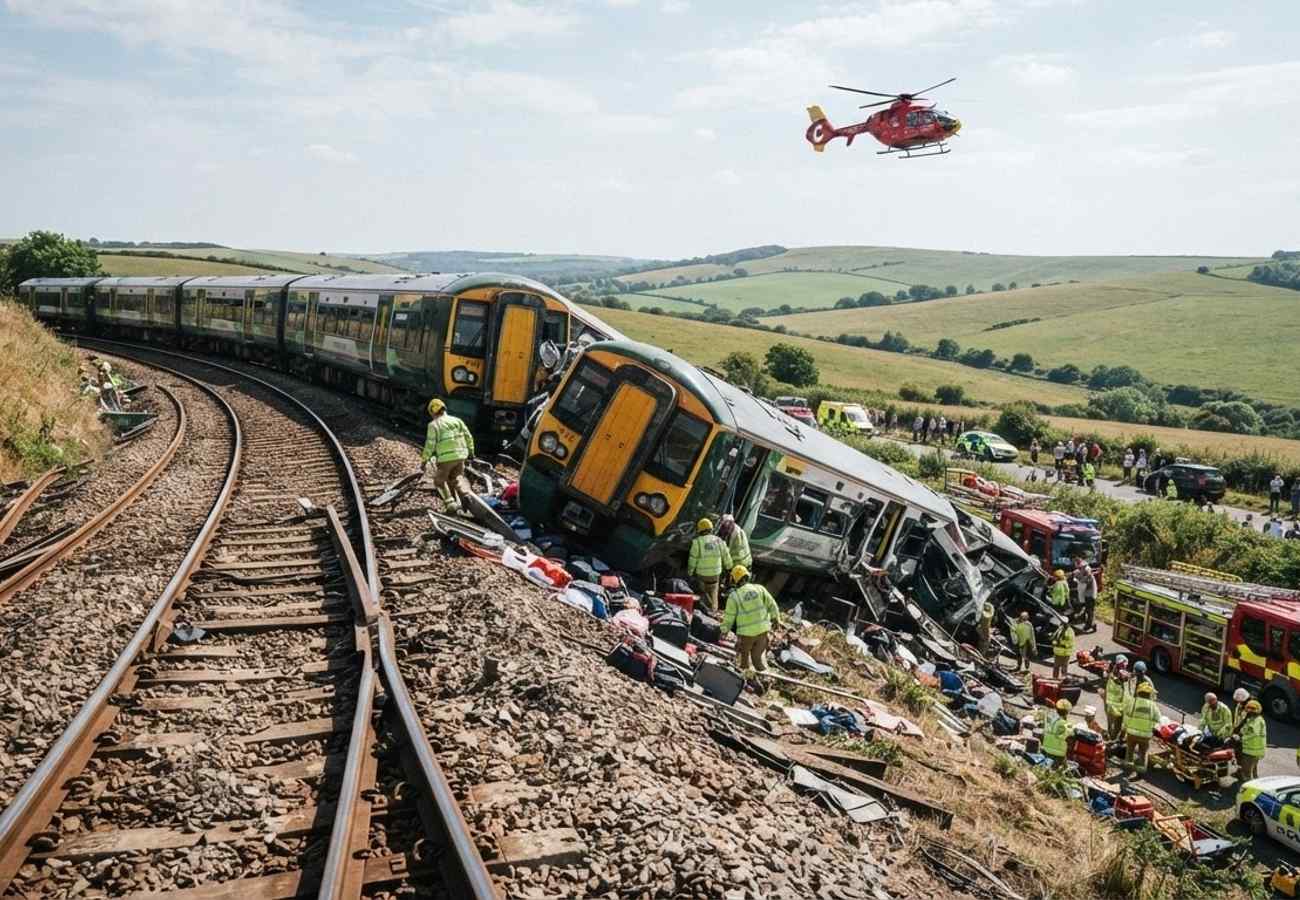
Image generated by AI
A Southern Rail passenger service derailed near Lewes in East Sussex on August 13, 2026, leaving 11 people injured and causing widespread disruption across the Sussex coastal rail network.
Incident Analysis: London Victoria to Eastbourne Service
The derailment occurred shortly before 4:00 p.m. local time on Thursday, August 13, on a critical stretch of line connecting London with the Sussex coast. The Southern Rail service was transporting approximately 150 passengers at the time of the incident.
Flight and rail tracking data indicates that several rear carriages left the tracks, overturning and coming to rest on their sides on an embankment. Witnesses reported a sudden lurching motion followed by the carriages tipping, resulting in broken windows and displaced luggage within the tilted interiors.
Emergency response teams activated major incident protocols, deploying air ambulances and specialist rescue crews to extract passengers from the overturned carriages.
Impact Breakdown: Routes and Infrastructure
The derailment caused immediate and severe disruption to the regional transport grid:
- Affected Routes: Services between Brighton, Haywards Heath, Eastbourne, and Seaford were suspended.
- Hub Impact: Lewes railway station served as the epicenter of the disruption, with trains diverted or terminated short of their destinations.
- Road Traffic: Heavy emergency vehicle congestion was reported along the A27 corridor.
- Mitigation: Replacement bus services were deployed to maintain coastal and commuter links.
Passenger Rights & Advisory
For the affected passengers, this incident triggers specific protections under UK rail consumer law and the National Rail Conditions of Travel. Our analysis of these policies suggests the following actionable steps for those impacted:
1. Compensation for Delay and Distress Passengers on the derailed service, and those significantly delayed by the resulting suspensions, are entitled to "Delay Repay" compensation. For a derailment of this magnitude, passengers should document all out-of-pocket expenses incurred due to the disruption.
2. Duty of Care and Medical Claims With 11 injuries reported—including two serious cases—affected individuals may have grounds for claims beyond standard ticket refunds. Under the Montreal Convention (for integrated travel) or national negligence laws, the operator must demonstrate that the incident was not caused by a failure in maintenance.
3. Rebooking and Alternative Transport Passengers stranded by the Lewes suspension are entitled to be rerouted to their destination at the earliest opportunity. If the operator failed to provide timely replacement buses, passengers may be able to claim back the cost of alternative private transport (e.g., taxis), provided they can produce valid receipts.
Industry Analyst View: The Heat-Stress Factor
Our analysis indicates that this incident is likely linked to environmental stressors on aging infrastructure. Preliminary reports from the scene highlight visible track distortion and warped rails behind the train.
Rail specialists suggest the pattern of damage is consistent with "track buckle," a phenomenon where rails expand and bend due to extreme heat. This follows a period of unusually high temperatures across England, raising urgent questions about the resilience of the UK's rail ballast and sleeper systems.
The investigation will now focus on whether speed restrictions were appropriately implemented during the heatwave and if maintenance records for the Lewes section were up to date. This event underscores a growing tension between the push for high-speed rail investment and the critical need for incremental resilience upgrades on existing commuter lines.
The investigation into the Lewes derailment will likely set a new precedent for heat-related speed restrictions across the Southern region.
Related Travel Guides
Disclaimer
This article is for informational and educational purposes only. It does not constitute legal, financial, or professional advice. While we strive to provide accurate and up-to-date information, travel policies, regulations, and conditions change rapidly. Always verify information with official sources before making travel decisions. Nomad Lawyer makes no representations about the accuracy, reliability, completeness, or suitability of the information provided. Readers should consult qualified professionals for advice specific to their circumstances. The views expressed in this article are those of the author and do not necessarily reflect the views of Nomad Lawyer.
Preeti Gunjan
Contributor & Community Manager
A passionate traveller and community builder. Preeti helps grow the Nomad Lawyer community, fostering engagement and bringing the reader experience to life.
Learn more about our team →