
Dulles Flight Disruptions Expose Hub Vulnerability Across U.S. Networks
Forty-four delays and seven cancellations at Washington Dulles in early April 2026 reveal how hub vulnerabilities cascade across domestic and international routes, affecting thousands of passengers nationwide.

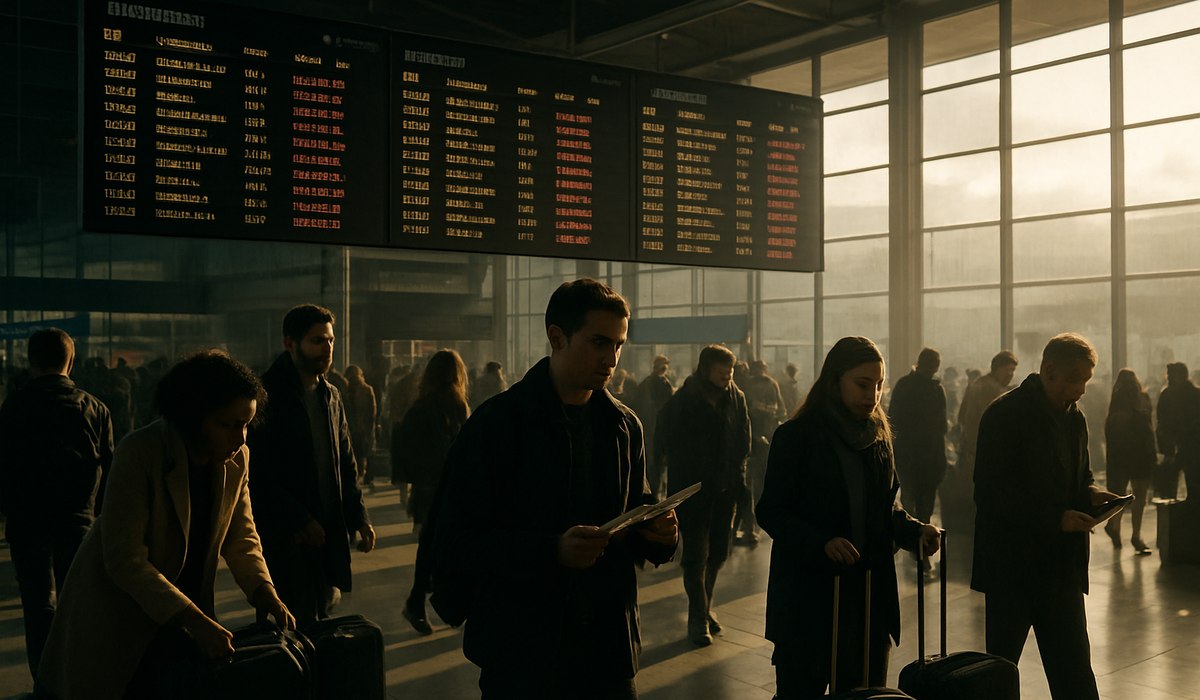
Image generated by AI
A Single Day That Exposed Network Fragility
Washington Dulles International Airport experienced significant operational strain in early April 2026 when 44 flight delays and 7 cancellations triggered a nationwide cascade of connection problems. The incident, though modest compared to major weather disruptions, demonstrated how vulnerabilities at major aviation hubs amplify disruptions across the entire U.S. transportation network. Passengers connecting through Washington faced missed connections, extended layovers, and schedule complications affecting routes from the Northeast to the Pacific Northwest and transatlantic departures to Europe.
The operational data pointed to concentrated disruptions during peak morning and late afternoon departure waves—precisely when Dulles handles its densest traffic volume. This timing proved critical: when aircraft and crews slip out of position during busy periods, secondary delays cascade through subsequent flight rotations affecting hundreds of downstream flights operated by multiple carriers.
A Localized Disruption With National Reach
The early April incident at Dulles flight disruptions occurred during spring break season when passenger loads reached near-capacity levels across the U.S. network. Within a 24-hour window, the airport's operational metrics revealed a concentrated pattern affecting both domestic and international services.
Flight tracking data showed that the disruption clustered around morning departures between 6:00 AM and 10:00 AM, when Dulles typically dispatches 60+ flights toward major metropolitan areas. The second wave struck between 4:00 PM and 8:00 PM, when evening arrivals compress into brief windows before night-time operations wind down. This bimodal pattern created particular challenges: aircraft scheduled for afternoon regional routes arrived late from morning delays, forcing crew reassignments and maintenance reschedules.
Unlike catastrophic weather events or system failures, this disruption remained contained geographically. However, containment meant little in practical terms. A single cancelled flight from Dulles to a regional hub like Pittsburgh or Charlotte can strand aircraft needed later that day for completely different routes, forcing airlines to execute emergency aircraft swaps or cancel connecting flights preemptively. For passengers, the impact manifested as missed connections rather than direct cancellations—often the most frustrating travel outcome.
Check real-time flight status at FlightAware and consult the FAA for official disruption information.
How Hub-and-Spoke Networks Amplify Disruptions
Understanding why the Dulles incident cascaded nationwide requires examining how modern U.S. airlines structure their operations. Most major carriers—United, American, Southwest, and others—rely on hub-and-spoke network models. Passengers connecting through hubs generate approximately 40% of U.S. domestic traffic, making hub efficiency critical to network stability.
Hub-and-spoke architecture concentrates aircraft and crew resources at specific airports during scheduled banks—tightly timed windows when dozens of flights coordinate arrivals and departures. At Dulles, these banks occur roughly every 90-120 minutes during peak hours. When one flight within a bank runs late, it creates immediate downstream effects: ground crews cannot begin servicing the aircraft for its next rotation, pilots cannot start their next duty period, and passengers cannot board connecting flights that depend on equipment arrival.
This cascading effect explains why the Dulles disruptions rippled across the entire country. An aircraft delayed leaving Washington for Miami might arrive 45 minutes late, compressing its turnaround window and pushing its next departure—possibly to Denver—behind schedule. That Denver flight then departs late, affecting a subsequent rotation to Seattle. By mid-afternoon, a single morning delay has propagated through four or five connected flight legs, each affecting different passenger populations and geographic markets.
Research on aviation networks shows that major hubs like Dulles, Atlanta, Denver, and Dallas experience amplification ratios of 3:1 to 5:1—meaning each hour of primary disruption generates three to five hours of cascading delays across the network.
The Ripple Effect for Connecting Passengers
Passengers booking connections through Dulles faced the most acute impacts from the April 2026 disruptions. The typical connecting passenger encountered one of three outcomes: missed connections requiring rebooking to later flights, overnight hotel accommodations due to no available same-day alternatives, or involuntary rerouting through alternate hubs.
The transatlantic market experienced particular vulnerability. Long-haul flights departing Dulles for London, Paris, and Frankfurt typically operate on tight schedules with minimal ground time. When a departure delayed by 30-45 minutes finally pushes back, the aircraft arrives in Europe near closing time for ground handling facilities. Return-leg crews work compressed rest periods, and maintenance checks run behind schedule. Airlines often respond by adjusting departure times for westbound flights, padding block times to maintain schedule reliability, or cancelling specific flights to reset the operation.
Domestic connecting passengers experienced compression of turnaround times at secondary hubs. A passenger connecting from Dulles to Chicago on a disrupted flight might arrive 35 minutes late for a 60-minute connection—barely feasible even without the initial delay. Airlines typically flag such connections as at-risk and proactively rebook passengers to later flights, converting what should have been same-day travel into two-day journeys.
Spring Strain on a System Already Operating at Capacity
The early April timing of the Dulles disruptions proved significant. Spring represents the critical transition from winter weather constraints to summer leisure travel demand. April specifically generates predictable operational strain: winter weather systems still affect the Mid-Atlantic and Northeast, yet spring break and Easter holidays drive passenger volumes upward.
Federal data consistently shows April experiencing roughly 18-22% of flights arriving 15+ minutes late—substantially higher than January's 12-14% delay rates. Cancellation rates in April average 0.8-1.2% compared to 0.5-0.7% in quieter months. This seasonal vulnerability reflects competing pressures: airline schedules remain finely tuned to meet demand with minimal slack, yet weather unpredictability persists through April.
The broader operational context surrounding the Dulles incident included lingering impacts from late March weather systems, air traffic management flow-control initiatives addressing congestion, and airline crew scheduling at maximum utilization rates. When multiple stressors compound—even individually manageable ones—the system loses buffering capacity to absorb disruptions.
What This Reveals About U.S. Aviation Fragility
The April 2026 Dulles disruptions offer important lessons about structural vulnerabilities in U.S. domestic aviation. Despite technological advances and operational efficiency gains, the system remains surprisingly sensitive to single-point disruptions at major hubs.
Modern airline operations prioritize schedule reliability and cost efficiency over redundancy. Spare aircraft, standby crews, and buffer time between flight rotations have largely disappeared. This optimization works efficiently during normal operations but provides zero flexibility when disruptions occur. The industry's response to revenue pressure has created a system that functions elegantly most days but becomes unstable during even modest disruptions.
The Dulles incident also highlighted the geographically dispersed nature of aviation networks. Passengers in Minneapolis, Denver, Los Angeles, and Boston all experienced secondary delays despite no disruptions occurring in their home airports. This interconnectedness means U.S. travelers cannot evaluate their flight risk based on local conditions—nationwide hub status matters more than local weather.
The Federal Aviation Administration (FAA) continues researching resilience improvements, and the Department of Transportation (U.S. DOT) enforces passenger compensation requirements following extended delays and cancellations. However, structural solutions—mandating schedule padding, requiring standby aircraft, or limiting connections—remain economically challenging for airlines operating on 2-4% profit margins.
Key Operational Data from April 2026 Dulles Disruptions
| Metric | Value | Impact |
|---|---|---|
| Total Delayed Flights | 44 | Ripple effect across domestic and |
Disclaimer
This article is for informational and educational purposes only. It does not constitute legal, financial, or professional advice. While we strive to provide accurate and up-to-date information, travel policies, regulations, and conditions change rapidly. Always verify information with official sources before making travel decisions. Nomad Lawyer makes no representations about the accuracy, reliability, completeness, or suitability of the information provided. Readers should consult qualified professionals for advice specific to their circumstances. The views expressed in this article are those of the author and do not necessarily reflect the views of Nomad Lawyer.
Raushan Kumar
Founder & Lead Developer
Full-stack developer with 11+ years of experience and a passionate traveller. Raushan built Nomad Lawyer from the ground up with a vision to create the best travel and law experience on the web.
Learn more about our team →