
Delta Flight DL1145 Makes Emergency Diversion to Raleigh-Durham Mid-Route from Myrtle Beach to Detroit
Delta Air Lines flight DL1145, an Airbus A319, abruptly diverted from its Myrtle Beach–Detroit route and executed an emergency landing at Raleigh-Durham International Airport. Flight tracking logged the aircraft reaching ground speed zero, confirming a safe landing after the sudden course change.

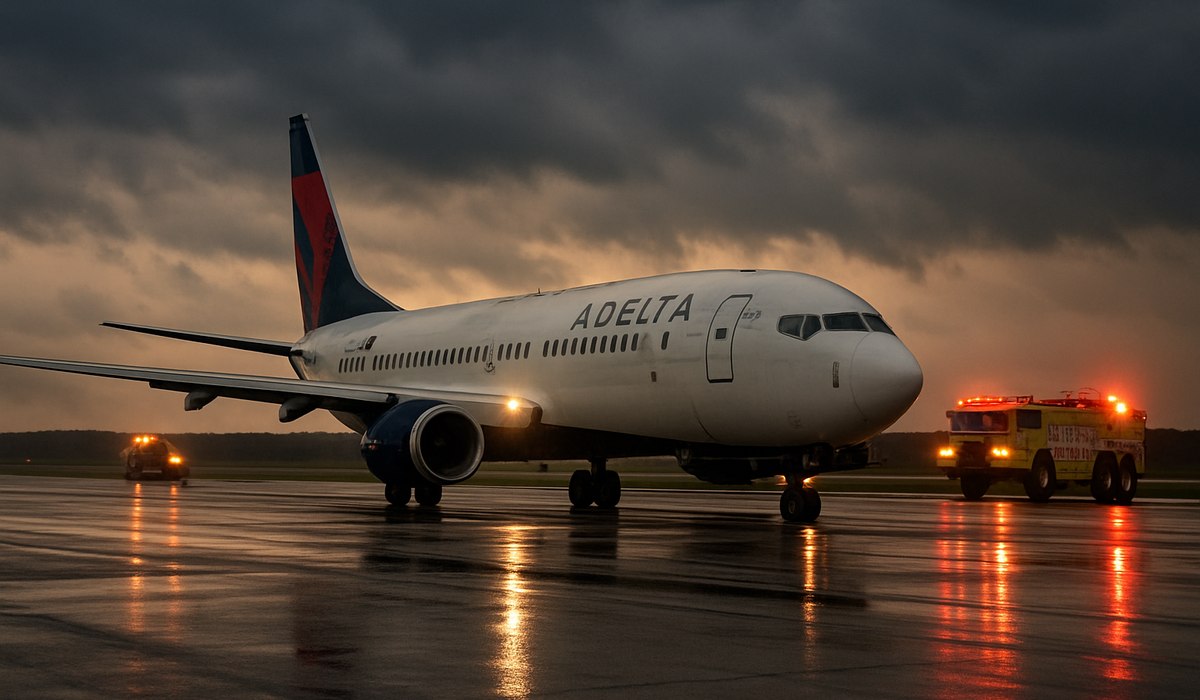
Image generated by AI
Delta DL1145 Abandons Detroit Route in Mid-Air Emergency Diversion
A routine short-haul journey became a high-stakes airborne emergency when Delta Air Lines flight DL1145—a single-aisle Airbus A319 registered N349NB—abruptly abandoned its planned trajectory toward Detroit Metropolitan Wayne County Airport and executed an unscheduled emergency landing at Raleigh-Durham International Airport (RDU). The diversion, occurring mid-route on the Myrtle Beach (MYR) to Detroit (DTW) segment, reflects the kind of split-second flight crew decision-making that aviation safety systems are specifically designed to enable.
Flight tracking data confirms the aircraft's recorded altitude reached zero feet and ground speed zeroed to zero knots at Raleigh-Durham—unambiguous confirmation of a safe, controlled landing. The recorded diversion heading of 168 degrees represents a decisive southwestern course correction from the original north-northwest routing to Detroit, a change that strongly indicates a time-sensitive onboard condition requiring immediate ground access.
What Caused the DL1145 Diversion?
Delta Air Lines has not yet released an official causal explanation, which is standard protocol in the immediate aftermath of a diversion event. Post-incident investigation and crew debrief protocol typically precedes any public statement.
However, the characteristics of this diversion are consistent with one of several standard scenarios that aviation safety protocols mandate immediate ground response for:
- Technical irregularity or cockpit warning alert — Modern aircraft like the A319 generate real-time system diagnostics. Any alert that cannot be conclusively resolved at altitude triggers mandatory diversion procedures regardless of severity assessment
- Onboard medical emergency — Passenger or crew medical crises requiring immediate hospital access are among the most common diversion triggers
- Precautionary mechanical assessment — Anomalous system performance that pilots cannot diagnose in-flight, even without active failure
Modern commercial aviation's foundational philosophy is conservative decision-making. Raleigh-Durham International Airport (RDU) was the logical diversion point—a major facility with full emergency response infrastructure, long runways capable of receiving widebody aircraft, and proximity to Level 1 trauma medical facilities.
The Aircraft: Airbus A319, Registration N349NB
The Airbus A319 is a proven, narrow-body workhorse operating millions of short-to-medium haul cycles annually. Key specifications relevant to this incident:
- Seating capacity: 128-156 passengers depending on configuration
- Advanced monitoring: The A319's ACARS (Aircraft Communications Addressing and Reporting System) continuously transmits flight data to airline operations centers in real time
- Engine type: CFM56 high-bypass turbofans with decades of operational reliability data
- Safety redundancy: Triple-redundant hydraulic, electrical, and flight control systems
The aircraft's advanced monitoring capability means Delta's Austin-based dispatch and operations control center would have been informed of any anomaly simultaneously with or even before the crew declared the diversion.
Passenger Experience and Airline Response Protocol
For the passengers aboard DL1145, the diversion created an abrupt and undoubtedly alarming departure from routine. Passengers noticed the course correction before any formal cabin announcement—a common experience in diversions, where pilots prioritize aircraft control over passenger communications during initial decision-making.
Delta's standard diversion protocol activates simultaneously on landing:
- Ground crew and emergency services pre-positioned before landing
- Deployment of maintenance inspection team as aircraft arrives at gate
- Passenger assistance center activated: rebooking, hotel accommodation if overnight, meal vouchers
- Passenger relations team prepared to handle compensation inquiries
What Guests Get
- Complimentary rebooking on the next available Detroit-bound flight via Delta's mobile app or at the gate
- Meal and accommodation vouchers if the delay extends overnight at Raleigh-Durham
- Priority customer service lanes for affected DL1145 passengers
- Real-time push notifications via the Delta mobile app with rebooking and new boarding pass issuance
- Medallion member priority rebooking on first-available premium cabin availability for elite frequent flyers
DL1145 Diversion: Key Technical Summary
| Data Point | Detail |
|---|---|
| Flight Number | Delta Air Lines DL1145 |
| Origin | Myrtle Beach International Airport (MYR) |
| Intended Destination | Detroit Metropolitan Wayne County Airport (DTW) |
| Diversion Airport | Raleigh-Durham International Airport (RDU) |
| Aircraft Type | Airbus A319 |
| Aircraft Registration | N349NB |
| Final Recorded Altitude | Zero feet (safe landing confirmed) |
| Final Recorded Ground Speed | Zero knots |
| Diversion Heading | 168 degrees |
| Official Cause | Not yet publicly released |
What This Means for Travelers
Unscheduled diversions are both rare and, paradoxically, evidence that aviation safety systems are working exactly as designed. The fact that this DL1145 crew identified a situation requiring ground intervention, made the call, executed a flawless diversion, and landed safely—without reported injuries—is a textbook demonstration of why commercial aviation maintains its status as the safest mass transportation mode in human history.
For passengers who experience a diversion, the priority actions are:
- Remain calm and follow crew instructions completely. The crew is executing a trained protocol; every instruction has a safety rationale
- Document your expenses. Hotels, meals, and ground transport costs incurred because of the diversion are reimbursable under most airline policies
- Use the app, not the queue. Delta's rebooking algorithm will process new itineraries within minutes of the diversion landing; checking your app is dramatically faster than joining the customer service line
- Keep your boarding pass. Your original boarding pass documents your entitlement to rebooking, compensation, and vouchers
FAQ: Delta DL1145 Emergency Diversion
How common are mid-flight diversions on US domestic routes? Diversions occur on roughly 1 in every 10,000–15,000 commercial flights globally, making them genuinely rare but a routine contingency in aviation operations planning. US airlines collectively operate approximately 45,000 flights per day, so diversions occur multiple times per week across the industry.
Was anyone injured on DL1145? No injuries have been reported as of publication. The aircraft executed a safe, controlled landing with emergency services standing by as precautionary protocol.
How long will passengers be delayed at Raleigh-Durham? The delay depends on how quickly Delta's maintenance team can assess and clear the aircraft. If a technical issue is confirmed, passengers will be rebooked on alternate Detroit-bound flights. If the aircraft clears inspection quickly, it may continue to Detroit with minimal additional delay.
Related Travel Guides
- Fiji Airways Adjusts January 2027 Nadi to Funafuti Flight Schedule
- Aviation Updates: Horizon Air Flight Attendants Vote 99.8 Percent in Favour of Strike Authorisation as AFA-CWA Union Representing 650 Cabin Crew Members Escalates Contract Dispute With Alaska Air Group After More Than a Year of Federal Mediation Under the Railway Labor Act
- From Featherweight to Colossus: How Aviation's Extreme Aircraft Redefine Engineering Limits
Disclaimer
This article is for informational and educational purposes only. It does not constitute legal, financial, or professional advice. While we strive to provide accurate and up-to-date information, travel policies, regulations, and conditions change rapidly. Always verify information with official sources before making travel decisions. Nomad Lawyer makes no representations about the accuracy, reliability, completeness, or suitability of the information provided. Readers should consult qualified professionals for advice specific to their circumstances. The views expressed in this article are those of the author and do not necessarily reflect the views of Nomad Lawyer.
Raushan Kumar
Founder & Lead Developer
Full-stack developer with 11+ years of experience and a passionate traveller. Raushan built Nomad Lawyer from the ground up with a vision to create the best travel and law experience on the web.
Learn more about our team →