
Costa Rica Opens 1.1 Billion Colones Isla San Lucas Pier: Prison Ruins, Tropical Dry Forests, and Gulf of Nicoya Travel 2026
With a 1.1 billion Costa Rican colones investment, Isla San Lucas National Park in the Gulf of Nicoya opens a sustainable multi-boat pier powered by solar energy, unlocking historic prison ruins and 15 km of tropical dry forest trails.

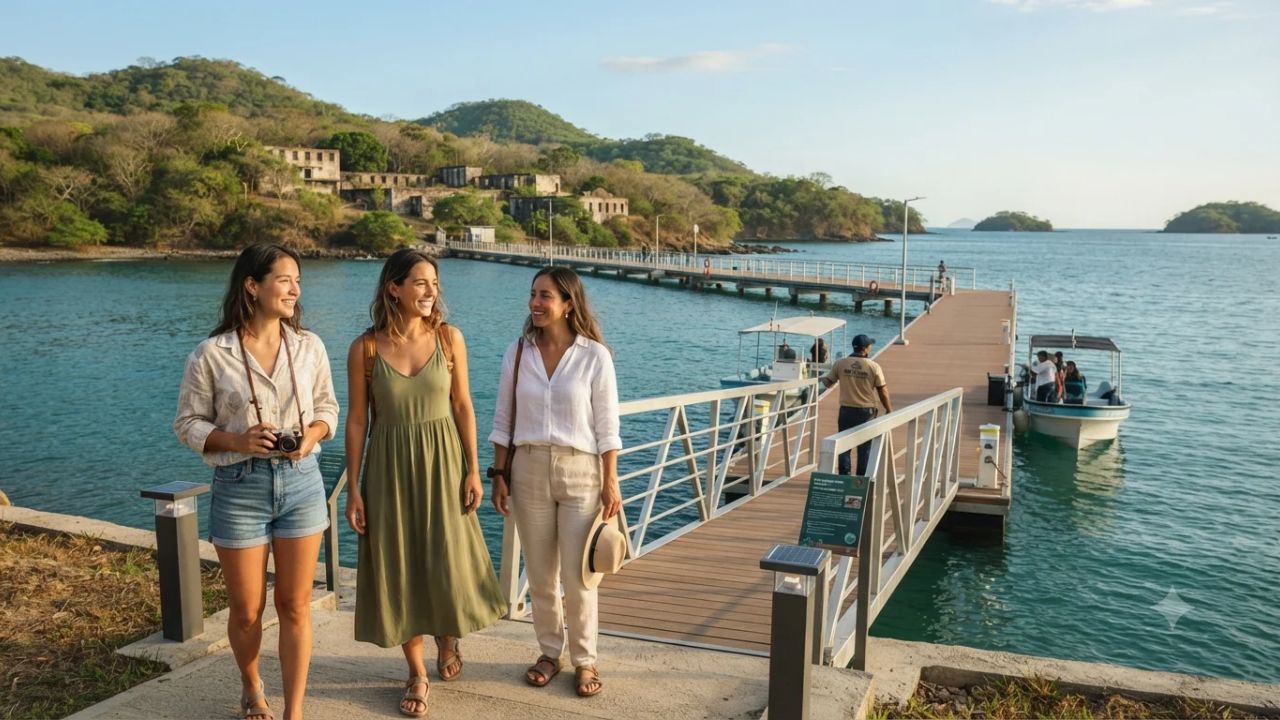
Once feared as Central America’s most notorious offshore penal colony—immortalized in José León Sánchez’s literary classic La Isla de los Hombres Solos—Isla San Lucas has completed a 1.1 billion Costa Rican colones transformation with the opening of a state-of-the-art sustainable tourist pier. Operating entirely on solar energy and rainwater harvesting in the Gulf of Nicoya, the new maritime gateway allows up to four passenger vessels to dock simultaneously, turning a once-forbidden island into Costa Rica’s premier heritage and wildlife sanctuary.
For decades, international travelers heading to Costa Rica focused almost entirely on cloud forest canopy tours in Monteverde or Pacific surf breaks in Guanacaste. However, the completion of this infrastructure milestone by the Costa Rican Tourism Institute (ICT) and the National System of Conservation Areas (SINAC) signals a strategic diversification toward cultural and historical tourism. Located just 40 minutes by boat from the port city of Puntarenas, Isla San Lucas National Park offers an extraordinary duality: crumbling 19th-century penitentiary architecture enveloped by one of the last remaining tropical dry forests in Mesoamerica.
Sustainable Engineering in a Sensitive Marine National Park
Building heavy maritime infrastructure inside a protected marine park requires strict environmental safeguards. The 1.1 billion CRC project was engineered to operate independently of mainland municipal utilities, minimizing environmental disturbance to the surrounding waters of the Gulf of Nicoya.
The new pier incorporates several eco-engineering features:
- Solar Photovoltaic Grid: Operates completely off-grid, powering lighting, communications, and administrative facilities through rooftop solar arrays.
- Self-Consumption Water Storage: Introduces the first self-consumption water reservoir on any island in the Gulf of Nicoya, supported by an advanced rainwater collection and filtration system.
- Universal Accessibility: Fully compliant with national accessibility regulations, featuring non-slip ramps, wide corridors, and stabilized boarding platforms for travelers with limited mobility.
- Quad-Berth Capacity: Accommodates four tour boats simultaneously, ending previous arrival bottlenecks and safely managing passenger flows from Puntarenas day tours and international cruise excursions.
| Park & Infrastructure Asset | Operational Metric / Dimension | Strategic Environmental Feature | Traveler Experience Highlight |
|---|---|---|---|
| New Tourist Pier | Over 1.1 billion CRC investment | 4 simultaneous boat berths; solar-powered | Safe, step-free boarding directly from Gulf of Nicoya boats |
| Penitentiary Ruins | Operational from 1873 to 1991 | Historical monument preservation zoning | Preserved graffiti, cell blocks, chapel, and medical dispensary |
| Island Trail Network | 15 kilometres of marked paths | Low-impact gravel and boardwalk paths | Hiking through endangered Mesoamerican tropical dry forest |
| Water Self-Sufficiency | Integrated island catchment system | First dedicated self-consumption tank in Nicoya | Potable water stations supporting zero-waste visitor policies |
| Wildlife Corridor | Protected national park status | Habitat protection for anteaters & deer | Encounters with howler monkeys, iguanas, and coastal seabirds |
What Makes Isla San Lucas Distinctive
Unlike standard tropical nature reserves, Isla San Lucas is a living historical archive. Established as a prison in 1873 by President Tomás Guardia Gutiérrez and operational until 1991, the island held political prisoners and dangerous convicts in severe isolation. Today, visitors walk through haunting cell blocks where inmates covered the walls with expressive murals, poetic inscriptions, and historical graffiti, providing raw insight into century-old penal life.
Beyond its penitentiary history, the island possesses significant pre-Columbian archaeological value, with indigenous burial mounds dating back to 1,500 BCE. Nature has reclaimed the island with astonishing speed: the surrounding canopy is home to white-tailed deer, northern tamandua anteaters, mantled howler monkeys, and over 40 species of resident and migratory coastal birds.
Economic Revitalization for Puntarenas Province
The modernized pier provides direct economic support to Puntarenas, a historic port city undergoing economic transition. By establishing Isla San Lucas as a regulated, high-value day excursion, the project creates steady employment for local panga boat captains, certified heritage guides, artisanal food vendors, and hospitality operators along the Paseo de los Turistas.
According to the Costa Rican Tourism Institute (ICT), connecting cruise passengers arriving at the Puntarenas cruise terminal with half-day cultural excursions to Isla San Lucas distributes tourist dollars into locally owned small businesses rather than concentrating expenditure in closed resort enclaves.
Visitor Insider Tips
- Boat Departures from Puntarenas: Book authorized boat tours departing from the public docks or yacht clubs along the Estero de Puntarenas. Ensure your boat operator is registered with ICT and provides certified life jackets and park admission tickets.
- Timing and Sun Protection: The tropical dry forest climate in the Gulf of Nicoya is hot and arid. Schedule morning departures between 07:30 and 08:30 to explore the prison ruins and trails before midday heat peaks.
- Footwear and Hiking Gear: Wear closed-toe hiking shoes or sturdy trail sandals. The island features roughly 15 kilometres of unpaved dirt trails with exposed roots and loose volcanic gravel leading to scenic lookouts like Playa Cocos and Playa El Chingo.
- Hydration and Waste Management: Isla San Lucas is a single-use plastic-free national park. Bring a refillable insulated stainless-steel water bottle to use at the pier's filtered water refilling stations. Pack out all trash back to the mainland.
Cultural and Environmental Context
The transformation of Isla San Lucas represents Costa Rica’s forward-thinking conservation philosophy: converting spaces of historical trauma into centers of ecological restoration and education. Protecting the island's 450 hectares of tropical dry forest is ecologically urgent, as less than 2% of original Mesoamerican dry forest ecosystems remain intact globally.
By controlling visitor flow through designated boat slots at the new pier and enforcing carrying capacities along the 15-kilometre trail network, park rangers prevent trail erosion and protect ground-nesting wildlife. Tourism receipts are reinvested directly into ongoing masonry restoration of the historic prison structures, ensuring this poignant piece of Costa Rican heritage is preserved for future generations.
FAQ: Visiting Isla San Lucas National Park 2026
How do I get to Isla San Lucas from San José?
Drive or take a public bus from San José to Puntarenas (roughly 2 hours via Route 27), then board an authorized 40-minute passenger boat across the Gulf of Nicoya to the island pier.
What are the main attractions on Isla San Lucas?
Key attractions include the historic prison ruins and inmate graffiti, the visitor museum, pre-Columbian archaeological sites, 15 km of hiking trails, and wildlife viewing in the tropical dry forest.
Is Isla San Lucas wheelchair accessible?
Yes. The new 1.1 billion CRC pier and primary access corridors leading to the central prison complex were built in compliance with Costa Rica's universal accessibility standards.
Are there hotels or restaurants on the island?
No. Isla San Lucas is a protected day-use national park without overnight lodging or commercial restaurants. Visitors must bring snacks and return to Puntarenas or neighboring Gulf islands for accommodation.
From the silent shadows of historic prison walls to the vibrant canopy of the tropical dry forest, Isla San Lucas embodies Costa Rica’s triumph of conservation over confinement.
Related Travel Guides
Disclaimer
This article is for informational and educational purposes only. It does not constitute legal, financial, or professional advice. While we strive to provide accurate and up-to-date information, travel policies, regulations, and conditions change rapidly. Always verify information with official sources before making travel decisions. Nomad Lawyer makes no representations about the accuracy, reliability, completeness, or suitability of the information provided. Readers should consult qualified professionals for advice specific to their circumstances. The views expressed in this article are those of the author and do not necessarily reflect the views of Nomad Lawyer.
Kunal K Choudhary
Co-Founder & Contributor
A passionate traveller and tech enthusiast. Kunal contributes to the vision and growth of Nomad Lawyer, bringing fresh perspectives and driving the community forward.
Learn more about our team →