
Aviation Updates: Massive Travel Chaos Engulfs China as 600 Delays Paralyze Air China, Hainan, and China Eastern
As catastrophic logistical bottlenecks severely paralyze the Chinese aviation grid, tens of thousands of passengers are trapped in intense travel chaos following over 600 delays and 85 flight cancellations.

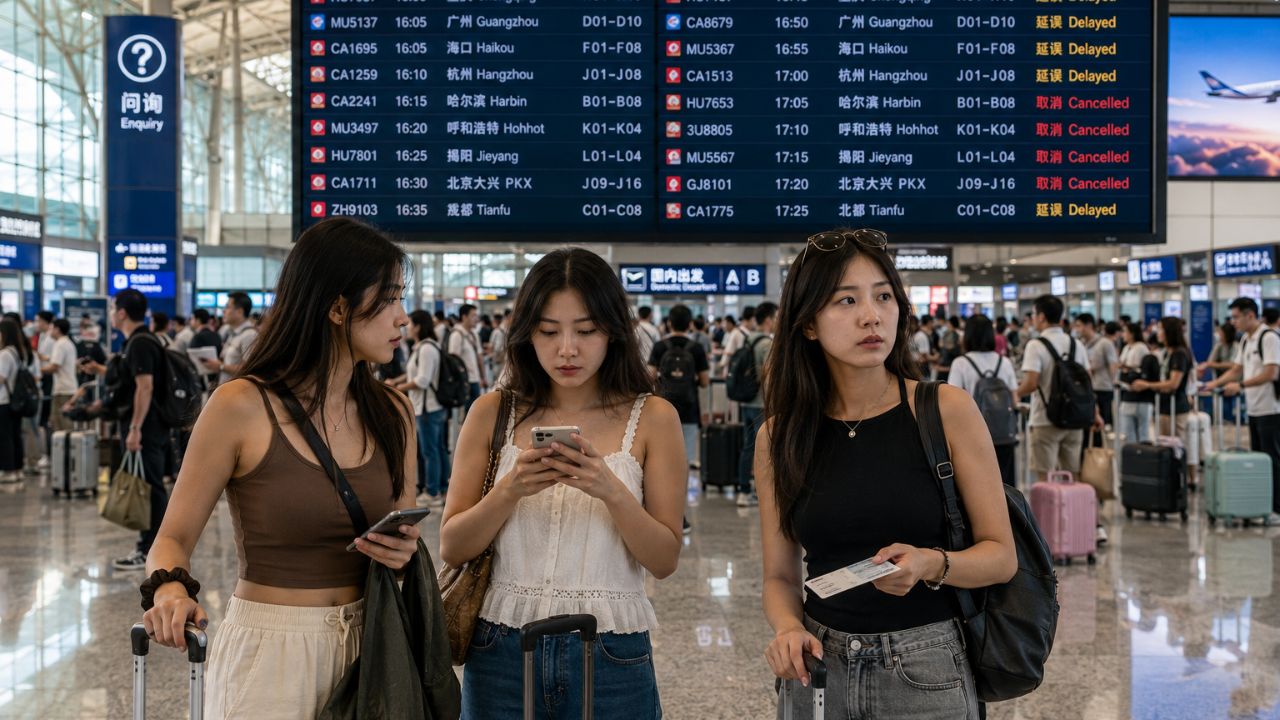
Image generated by AI
Aviation Updates: Massive Travel Chaos Engulfs China as 600 Delays Paralyze Air China, Hainan, and China Eastern
As extreme operational friction and suddenly compounding infrastructure bottlenecks continue to terrorize the Asian transit network, a severe wave of massive logistical failures has officially struck China's busiest aviation hubs.
Image generated by AI
As high-impact airline news platforms rapidly issue continuous aviation updates regarding the intense fragility of the global transit grid, mainland China has suffered a devastating operational meltdown. Flight operations across the massive nation completely deteriorated as airports collectively recorded an incredibly disruptive spike of over 600 delayed flights and more than 85 outright flight cancellations. This sudden, massive wave of severe airport disruptions instantly abandoned tens of thousands of domestic and international passengers, creating terrifying ripple effects across heavily scheduled networks. The intense travel chaos completely paralyzed the country’s massive legacy carriers, hitting Air China, Hainan Airlines, China Eastern, Sichuan Airlines, 9 Air, and various regional operators incredibly hard. Consequently, high-frequency routes running through key mega-hubs including Beijing, Chengdu, Chongqing, Guangzhou, Haikou, and beyond were thrown into absolute operational disarray.
Expanded Overview: The Collapse of the National Grid
To fully comprehend the sheer scale of this localized disaster, aviation analysts must closely examine the massive strategic interconnectedness of China's domestic aviation network.
The flight disruptions aggressively span several of China’s absolute busiest aviation hubs, severely affecting massive population centers. The impacted locations include Beijing Capital International Airport and Beijing Daxing International Airport, Chengdu Tianfu International Airport, Chongqing Jiangbei International Airport, Guangzhou Baiyun International Airport, and Haikou Meilan International Airport. Furthermore, secondary but highly vital hubs like Hangzhou Xiaoshan, Harbin Taiping, Hohhot Baita, and Jieyang Chaoshan also suffered under the immense terminal gridlock. Together, these mega-airports serve as the critical spine for both domestic commerce and international gateways. When an operational failure of this magnitude strikes, the widespread cancellations brutally sever passenger movement across multiple diverse regions simultaneously, proving how quickly the system fails under stress.
Section-Wise Breakdown: Beijing and Guangzhou Bear the Brunt
As the absolute epicenters of the crisis, the massive aviation hubs serving Beijing and Guangzhou suffered the most devastating operational breakdowns.
Beijing Aviation Hubs: The capital's dual-airport system completely buckled under the pressure. Beijing Capital International Airport reported a staggering volume of disruptions, with Air China suffering 125 delays and 6 cancellations. Hainan Airlines and China Eastern also slashed flights. Simultaneously, the ultra-modern Beijing Daxing International Airport experienced severe friction, where China Eastern led the chaos with 11 cancelled flights and 66 delays, heavily stranding high-paying corporate travelers.
Guangzhou Baiyun International Airport: In the southern economic powerhouse, the terminal gridlock was equally severe. Hainan Airlines suffered 7 cancellations and 25 delays, while China Eastern (6 cancellations) and Air China (6 cancellations) actively slashed their heavily utilized schedules. Even low-cost specialist 9 Air was forced to cancel 3 flights and delay 14 others.
Section-Wise Breakdown: Regional Hubs Paralyzed
The devastating travel chaos aggressively spilled beyond the primary mega-hubs, massively crippling critical regional gateways from the southwest to the far northeast.
In the southwest, Chengdu Tianfu International Airport saw Hainan, Sichuan Airlines, and Air China struggling to maintain their massive regional feeder networks. Meanwhile, Chongqing Jiangbei International Airport reported multiple cancellations by Hainan Airlines and China Eastern. Further south, Haikou Meilan International Airport recorded 7 devastating cancellations explicitly tied to Hainan Airlines operations. The disruptions reached all the way to Hangzhou Xiaoshan (where China Eastern and Air China suffered heavily), Harbin Taiping, Hohhot Baita, and Jieyang Chaoshan, violently proving that no region of the country escaped the operational friction.
Flight Details: China Aviation Network Disruption Matrix
To ensure international travelers and aviation analysts can accurately track the sheer scale of this massive national transit failure, the verified disruption telemetry (sourced via FlightAware) has been consolidated into the mandatory matrix below.
| Airport | Country | Airline | Cancelled Flights | Delayed Flights |
|---|---|---|---|---|
| Beijing Capital International | China | Air China | 6 | 125 |
| Beijing Capital International | China | Hainan Airlines | 5 | 45 |
| Beijing Capital International | China | China Eastern | 2 | 4 |
| Beijing Daxing International | China | China Eastern | 11 | 66 |
| Beijing Daxing International | China | China United Airlines | 4 | 33 |
| Beijing Daxing International | China | Air China | 1 | 19 |
| Chengdu Tianfu International | China | Hainan Airlines | 2 | 5 |
| Chengdu Tianfu International | China | Sichuan Airlines | 1 | 34 |
| Chengdu Tianfu International | China | Air China | 1 | 15 |
| Chongqing Jiangbei International | China | Hainan Airlines | 4 | 12 |
| Chongqing Jiangbei International | China | China Eastern | 1 | 24 |
| Chongqing Jiangbei International | China | Juneyao Airlines | 1 | 0 |
| Guangzhou Baiyun International | China | Hainan Airlines | 7 | 25 |
| Guangzhou Baiyun International | China | China Eastern | 6 | 55 |
| Guangzhou Baiyun International | China | Air China | 6 | 26 |
| Guangzhou Baiyun International | China | 9 Air | 3 | 14 |
| Haikou Meilan International | China | Hainan Airlines | 7 | 27 |
| Hangzhou Xiaoshan International | China | China Eastern | 4 | 32 |
| Hangzhou Xiaoshan International | China | Air China | 3 | 33 |
| Harbin Taiping International | China | China Eastern | 3 | 9 |
| Hohhot Baita International | China | Tianjin Airlines | 2 | 6 |
| Hohhot Baita International | China | China Express Airlines | 1 | 14 |
| Hohhot Baita International | China | China Eastern | 1 | 7 |
| Jieyang Chaoshan International | China | Hainan Airlines | 2 | 1 |
| Jieyang Chaoshan International | China | Shanghai Airlines | 1 | 6 |
Passenger Impact: Surviving the Chaos
For the thousands of stranded tourists violently caught in the crossfire of this massive Chinese aviation failure, understanding rebooking procedures is absolutely critical for financial survival.
Flight cancellations are incredibly frustrating, but knowing the exact steps to take minimizes severe stress. As airlines like Air China and China Eastern desperately work to reset their crumbled schedules, passengers are fiercely advised to actively monitor their email and the airline’s mobile app for automatic rebooking confirmations. If stuck in massive queues at Beijing Capital or Guangzhou Baiyun, travelers should immediately utilize online chat systems to bypass the overwhelmed terminal customer service desks. Passengers must familiarize themselves with specific airline compensation policies, as many carriers offer complimentary meals or structural refunds when the localized disruption remains completely within their operational control.
Conclusion: A Highly Fragile Infrastructure
Ultimately, the staggering 600 flight delays and more than 85 cancellations across China represent a highly brutal day for Asian transit. The sheer volume of disruptions definitively highlights that China Eastern, Hainan Airlines, and Air China accounted for a substantial share of the collapse, brutally affecting operations across the country’s busiest aviation hubs. For passengers, travel is vastly more than simply reaching a destination; it represents crucial business opportunities and highly anticipated holidays. As sudden airspace bottlenecks and severe operational breakdowns continue to trigger massive airport disruptions, the Chinese aviation network has proven highly vulnerable to cascading failures. While airline teams tirelessly work to restore their fractured schedules, passengers must remain hyper-vigilant. Travelers are fiercely encouraged to rigorously monitor airline notifications, consider alternative high-speed rail transport if severely delayed, and strictly verify their flight status before ever leaving for the airport.
Key Takeaways
- Massive National Gridlock: Chinese mega-hubs suffered a devastating 600 flight delays and over 85 cancellations, triggering widespread travel chaos.
- Beijing and Guangzhou Collapsed: Beijing Capital, Beijing Daxing, and Guangzhou Baiyun experienced the absolute highest concentration of severe operational disruptions.
- Major Carriers Crippled: Air China, China Eastern, and Hainan Airlines accounted for the vast majority of the slashed flights and devastating delays.
- Regional Networks Severed: Highly lucrative routes connecting Chengdu, Chongqing, Haikou, and Hangzhou were thrown into absolute operational disarray.
- Digital Rebooking Essential: Stranded passengers are fiercely encouraged to utilize airline mobile applications and online chat tools to secure rapid rebooking.
FAQ: China Airports Mass Flight Disruptions
How many total flights were delayed or canceled across China today? According to verified FlightAware data, China's major airports collectively recorded an incredibly disruptive wave consisting of over 600 flight delays and more than 85 outright cancellations.
Which Chinese airports experienced the worst flight disruptions? Beijing Capital International, Beijing Daxing International, and Guangzhou Baiyun International suffered the most severe terminal gridlock and highest concentration of cancelled flights.
Which airlines were most impacted by the travel chaos in China? The massive gridlock heavily disrupted operations for China's legacy carriers, with Air China, China Eastern, and Hainan Airlines suffering the absolute highest volume of delays and cancellations.
What should I do if my flight in China is severely delayed or cancelled? Passengers are fiercely advised to immediately utilize their airline's mobile app to secure automatic rebooking, avoid massive physical queues at customer service desks, and explore alternative high-speed rail options if flying between major connected cities.
Related Travel Guides
Australia New Zealand 480 Delays Qantas Virgin Travel Chaos 2026
Krakow Airport 100 Delays Ryanair LOT Polish Travel Chaos 2026
Asia Regional Tourism and Transit Survival Guide 2026
Disclaimer: This article is strictly for informational and aviation planning purposes. The specific flight disruption telemetry (600+ delays, 85+ cancellations), affected airports (Beijing, Guangzhou, Chengdu, etc.), and impacted airlines (Air China, China Eastern, Hainan) are based on verified, manually obtained FlightAware data available at the time of publication. Chinese airspace conditions, specific airline recovery schedules, and localized weather restrictions are highly dynamic and subject to immediate modification by the operating carriers and regulatory authorities. Passengers planning domestic or international travel through China should explicitly verify their exact flight itineraries, strictly monitor their airlines for sudden flight cancellations, and secure comprehensive travel insurance prior to departure.
Disclaimer
This article is for informational and educational purposes only. It does not constitute legal, financial, or professional advice. While we strive to provide accurate and up-to-date information, travel policies, regulations, and conditions change rapidly. Always verify information with official sources before making travel decisions. Nomad Lawyer makes no representations about the accuracy, reliability, completeness, or suitability of the information provided. Readers should consult qualified professionals for advice specific to their circumstances. The views expressed in this article are those of the author and do not necessarily reflect the views of Nomad Lawyer.
Kunal K Choudhary
Co-Founder & Contributor
A passionate traveller and tech enthusiast. Kunal contributes to the vision and growth of Nomad Lawyer, bringing fresh perspectives and driving the community forward.
Learn more about our team →