
Canada Snubs U.S. Officials at $4.5 Billion Gordie Howe Bridge Opening Amid Trade War and Travel Boycott
Canada excluded U.S. representatives from the Gordie Howe International Bridge opening as diplomatic tensions peak over 50% tariffs and a continuing Canadian travel boycott of the United States.

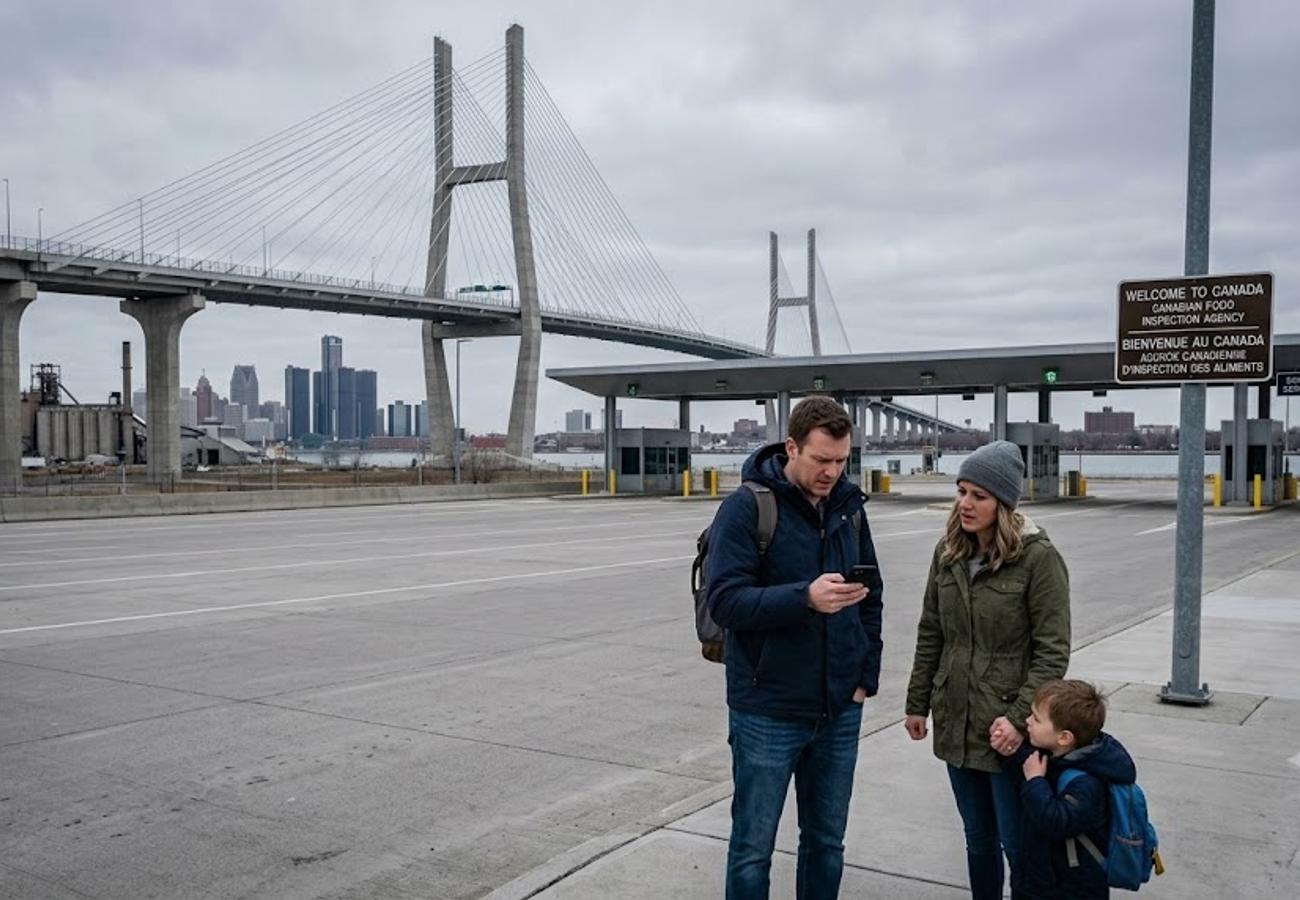
Image generated by AI
[Detroit, July 26, 2026] — Diplomatic relations between Canada and the United States reached a new low on Friday, July 24, when Canadian officials formally excluded American representatives from the inauguration of the $4.5 billion Gordie Howe International Bridge. The snub comes as a direct response to the Trump administration's announcement of new 50% tariffs on select Canadian exports, further incentivizing a grassroots travel boycott that has already cost the U.S. economy billions in lost tourism revenue.
The bridge, a massive infrastructure project designed to streamline transit between Windsor, Ontario, and Detroit, Michigan, was intended to be a symbol of bilateral cooperation. Instead, the opening ceremony served as a stark manifestation of the current geopolitical rift.
Canada Excludes U.S. Representatives From Gordie Howe Bridge Ceremony
The Gordie Howe International Bridge spans 1.5 miles across the Detroit River, providing a critical new artery for trade and passenger travel. While the event was originally envisioned as a joint celebration with a shared ribbon-cutting ceremony at the center of the span, Canada unilaterally withdrew all invitations to U.S. officials just days before the event.
The ceremony was relocated entirely to the Canadian side of the border at the inspection plaza. According to a spokesperson for Canadian Infrastructure Minister Gregor Robertson, the decision was made because it would be "inappropriate" to hold a celebratory bilateral event following the trade threats issued by the United States earlier in the week.
The event proceeded with a focus on Canadian identity, featuring members of the Howe family and a road hockey game to honor the legendary Gordie Howe. Windsor Mayor Drew Dilkens described the scaled-back, Canada-only affair as a regrettable but accurate reflection of the deteriorated state of the relationship between the two neighbors.
Trump Challenges Bridge Agreements and Revenue Shares
The tension surrounding the bridge is not limited to the ceremony. President Donald Trump had previously threatened to block the bridge's opening unless the United States received what he termed "fairness and respect" and full compensation for U.S. contributions.
During the Canadian ceremony, Trump took to social media to dismiss the snub, suggesting that the exclusion was acceptable given that Canada is paying "substantial TARIFFS" to the U.S. He further claimed that the original governing agreement for the crossing is no longer valid and asserted that his administration has renegotiated the deal to ensure the U.S. receives 50% of the bridge's profits.
However, official documentation from the Gordie Howe International Bridge suggests a different reality. While an agreement in principle states that Canada will contribute 50% of net bridge and crossing-related revenue into a U.S.-controlled economic development fund for the first 15 years, the documents explicitly state that this does not supersede the original 2012 Canada-Michigan Crossing Agreement. Notably, Canada financed the entire C$6.4 billion project and intended to recover those costs through tolling.
Escalating Trade War and 50% Tariffs on Canadian Goods
The diplomatic freeze is largely driven by a series of aggressive trade maneuvers. On July 20, the Trump administration announced an additional 50% tariff on a variety of Canadian products, including cement, hockey sticks, and wine. These tariffs are scheduled to take effect following a 30-day grace period.
Canadian Prime Minister Mark Carney has characterized these moves as a pattern of aggression. The sentiment in Canada is one of retaliation; Ontario Premier Doug Ford stated on social media that Canada should respond to these measures "tariff for tariff, dollar for dollar."
Impact of the Canadian Travel Boycott on U.S. Tourism
The political friction has translated into a significant economic blow to the U.S. travel industry. Since early 2025, Canadians have increasingly avoided traveling south, spurred by tariff threats and rhetoric from the U.S. President regarding Canada becoming the "51st state."
Prior to this friction, Canada was the primary source of international visitors to the U.S. In 2024, over 20 million Canadians crossed the border, contributing approximately $20.5 billion to the U.S. economy. The U.S. Travel Association had previously warned that even a modest 10% drop in visitation would result in a $2.1 billion loss.
The actual impact was far more severe. Canadian visitation plummeted by approximately 22% in 2025, resulting in an estimated economic loss of $4.5 billion. While 2026 has seen a slight recovery, the data indicates that travel patterns remain deeply suppressed compared to pre-dispute levels.
Canadian Travel Trends: 2024 vs. 2026
| Metric | Percentage Change |
|---|---|
| June 2026 vs. June 2025 | +3.2% |
| June 2026 vs. June 2024 | -28.7% |
| Vehicle trips (June 2026 vs. 2024) | -29.6% |
| Air trips (June 2026 vs. 2024) | -25.0% |
According to Statistics Canada, there were 1.7 million return trips by Canadian residents from the U.S. in June 2026. While this represents a 3.2% increase over June 2025, it remains nearly 29% lower than the figures from June 2024.
Why This Matters: The Real-World Impact on Travelers
For the average traveler and digital nomad, this diplomatic freeze creates significant uncertainty. The "Elbows Up" travel backlash is not merely a political statement but a shift in consumer behavior that affects flight capacities and border wait times.
From a logistical standpoint, the dispute over the Gordie Howe International Bridge highlights a volatile environment for cross-border commerce. When infrastructure meant to ease transit becomes a bargaining chip in a trade war, the predictability of border crossings vanishes. For those relying on the Windsor-Detroit corridor, the shift from a joint operation to a contentious one could lead to increased scrutiny and potential delays at the border inspection plazas.
Furthermore, the economic shift is palpable. As Canadians divert their spending toward domestic tourism or other international destinations, U.S. hospitality hubs—particularly in border states—are seeing a permanent shift in their visitor demographics. The 25% to 30% drop in air and vehicle travel suggests that the "boycott" has moved beyond a social media trend and into a long-term economic realignment.
As the 30-day window for new tariffs closes, the border remains a flashpoint for a relationship in crisis.
Related Travel Guides
Disclaimer
This article is for informational and educational purposes only. It does not constitute legal, financial, or professional advice. While we strive to provide accurate and up-to-date information, travel policies, regulations, and conditions change rapidly. Always verify information with official sources before making travel decisions. Nomad Lawyer makes no representations about the accuracy, reliability, completeness, or suitability of the information provided. Readers should consult qualified professionals for advice specific to their circumstances. The views expressed in this article are those of the author and do not necessarily reflect the views of Nomad Lawyer.
Raushan Kumar
Founder & Lead Developer
Full-stack developer with 11+ years of experience and a passionate traveller. Raushan built Nomad Lawyer from the ground up with a vision to create the best travel and law experience on the web.
Learn more about our team →