
Breaking Airline News: Severe Thunderstorms Trigger Extreme Travel Chaos as Canada Suffers 109 Flight Cancellations
Breaking airline news: Amidst a terrifying era of severe operational fragility, a massive wave of 109 flight cancellations violently paralyzes Canada, plunging Air Canada and WestJet passengers into extreme travel chaos.

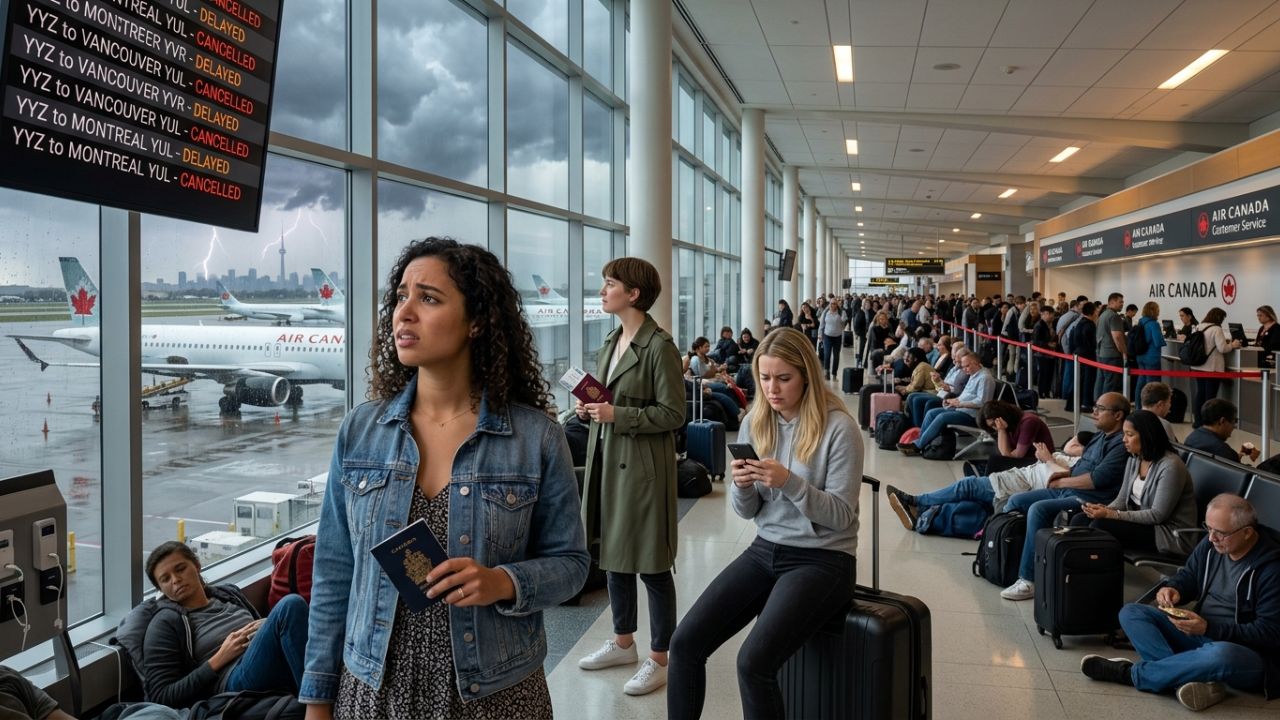
Image representing the intense strategic battle as thousands of abandoned passengers desperately navigate severe weather cancellations and massive terminal gridlock, battling extreme travel chaos across the Canadian aviation grid.
Breaking Airline News: Severe Thunderstorms Trigger Extreme Travel Chaos as Canada Suffers 109 Flight Cancellations
As paralyzing terminal bottlenecks, terrifying El Niño-driven weather systems, and severe operational fragility violently threaten to completely shatter passenger mobility across North America, the Canadian commercial aviation network has suffered a devastating network collapse. In a harrowing display of infrastructure vulnerability, thousands of travelers have been utterly abandoned today after major operators suddenly succumbed to massive meteorological threats, triggering a terrifying cascade of delays. This sudden, catastrophic disruption instantly severed critical aviation lifelines, plunging passengers across Montreal, Calgary, Kelowna, Toronto, Ottawa, Puvirnituq, and Nain into absolute, extreme travel chaos. By violently executing an astonishing 109 total cancellations and initiating a massive 434 unannounced delays, airlines—including Air Canada, Air Canada Rouge, Jazz, SkyWest, WestJet Encore, and Air Inuit—completely destroyed travel itineraries, leaving tourists and corporate executives trapped in an agonizing state of transit paralysis.
In a brutal demonstration of how fragile modern, high-density networks truly are, the sheer logistical nightmare of attempting to navigate the Canadian airspace rapidly degenerated into a terrifying transit scenario. The epicenter of this massive failure was driven by intense thunderstorm activity and severe lightning threats violently moving across the continent. The situation escalated so rapidly that Environment Canada was forced to issue a severe "yellow" thunderstorm warning for Calgary and its surrounding regions—stretching south of Airdrie to north of Fort Macleod, and covering areas east to High River and west to Longview. The terrifying ripple effects of this operational meltdown violently spread to Toronto, where poor weather directly forced the immediate, emergency evacuation and cancellation of the FIFA Fan Festival, proving that these massive storm cells are aggressively compromising both ground operations and public safety.
Expanded Overview: The Massive Scale of the Meteorological Contagion
The terrifying crisis of overwhelming passenger stress currently gripping the Canadian aviation sector brutally exposes the severe limitations of airlines attempting to maintain flawless operational records during periods of highly unstable atmospheric conditions. Recognizing that aggressively pushing compromised schedules into severe storm cells leads directly to systemic failure, carriers were forced into a massive defensive posture, resulting in prolonged waiting periods.
This extreme weather variability is directly linked to developing El Niño conditions in the Pacific, which scientists confirm is shifting global patterns and amplifying extreme events, including massive storm systems that violently sever travel networks. Furthermore, the situation is being aggressively compounded by severe storms tearing through the U.S. Midwest—specifically across Iowa, Kansas, and Missouri—which have triggered power outages and hazardous flight conditions, bleeding directly into the Canadian transit grid and causing uncontrollable, cascading delays nationwide.
Section-Wise Breakdown: The Operational Realignment
To fully comprehend the massive logistical and strategic fallout of this terrifying network collapse, corporate travel managers must review the exact operational metrics across the compromised gateways and carriers. The following matrices provide a granular breakdown of the specific airline and airport failures.
Shattering the Hubs: The Airport Collapse
The operational constraints violently compromised the nation's primary aviation hubs. Toronto Pearson International Airport emerged as the absolute worst-hit facility, suffering 49 cancellations and nearly 200 severe delays. The disruption also aggressively severed regional connectivity, brutally impacting remote airports such as Puvirnituq, Nain, and Makkovik.
Canadian Airports Disruption Matrix
| Airport / Location | Airport Code | Cancelled Flights | Delayed Flights |
|---|---|---|---|
| Toronto Pearson International | YYZ | 49 | 197 |
| Montreal-Trudeau | YUL | 29 | 103 |
| Vancouver International | YVR | 13 | 101 |
| Kelowna International | YLW | 8 | 14 |
| Ottawa Macdonald-Cartier Int'l | YOW | 4 | 15 |
| Puvirnituq | – | 2 | 4 |
| Nain | – | 2 | 0 |
| Makkovik | – | 2 | 0 |
The Carrier Meltdown: Airline-Level Failure
Simultaneously, the failure to secure clear airspace stranded passengers relying on both major legacy carriers and critical regional operators. Jazz was disproportionately devastated due to its high flight volumes, registering 42 cancellations and 115 delays. Flag carrier Air Canada also suffered massive operational friction, while regional lifelines like PAL Airlines and Air Inuit were forced into severe scheduling adjustments.
Canadian Airlines Disruption Matrix
| Airline Operator | Cancelled Flights | Delayed Flights |
|---|---|---|
| Jazz | 42 | 115 |
| Air Canada | 14 | 97 |
| WestJet Encore | 9 | 32 |
| PAL Airlines | 9 | 7 |
| Air Borealis | 4 | 0 |
| Air Canada Rouge | 3 | 22 |
| Air Inuit | 2 | 15 |
Passenger Impact: Surviving the Canadian Aviation Lockdown
For the thousands of travelers attempting to navigate the rapidly collapsing transit corridors toward destinations across Alberta, Ontario, and Quebec, this massive capacity failure represents a highly terrifying reality. The sudden wave of disruptions is expected to violently reverberate through local travel networks, destroying itineraries and severely testing travel confidence during one of the most severe mid-year disruption periods in recent memory.
What Passengers Can Do Now: A Survival Guide
Travelers desperately preparing to navigate the highly fragile Canadian network must immediately execute the following survival protocols:
- Violently Monitor Airline Status: Check real-time flight updates continuously. Official airline websites or apps are the only reliable source of immediate intelligence regarding rebooking or refund options.
- Execute Alternate Routing Defense: For flights heavily delayed into major, congested hubs like Toronto (YYZ) or Montreal (YUL), passengers must aggressively consider flying through secondary airports if alternative transportation can be secured.
- Monitor Critical Weather Alerts: Follow Environment Canada updates constantly, particularly if operating within the massive severe warning zone surrounding Calgary.
- Arrive Early and Expect Gridlock: Anticipate severe delays simply reaching the terminal, as road closures and public transport interruptions caused by the storms are heavily impacting ground logistics.
Conclusion: A Strategic Retreat to Ensure Aviation Survival
As the extremely critical travel network continues to face terrifying strain from severe weather and El Niño-induced atmospheric instability, the massive disruptions executed across Canada represent a massive warning to passengers attempting to rely blindly on scheduled itineraries. Author's Observation: The flight information presented is based on data sourced directly from FlightAware. Airlines frequently adjust schedules to prioritize operational safety. The aggressive spread of these delays proves that surviving modern aviation requires terrifyingly swift adaptability and a highly aggressive approach to rebooking, especially when severe thunderstorms fracture the national grid.
Key Takeaways
- Massive Tactical Failure: The Canadian aviation grid suffered a massive operational meltdown on June 12, resulting in 109 total flight cancellations and 434 severe delays.
- Toronto Epicenter: Toronto Pearson (YYZ) experienced the absolute highest volume of destruction, with 49 cancellations due to severe thunderstorms and lightning threats.
- Total Network Contagion: The travel chaos violently spread to major hubs including Montreal, Vancouver, and Calgary, as well as critical regional airports like Kelowna and Puvirnituq.
- Primary Operators Crippled: Jazz suffered a massive 115 delays and 42 cancellations, while Air Canada and WestJet Encore recorded severe operational friction.
- Traveler Advisory: Stranded passengers must aggressively monitor official Environment Canada warnings, secure alternative flights immediately through digital portals, and maintain absolute flexibility as the severe weather system continues to heavily impact airline rotations.
Related Travel Guides
Disclaimer
This article is for informational and educational purposes only. It does not constitute legal, financial, or professional advice. While we strive to provide accurate and up-to-date information, travel policies, regulations, and conditions change rapidly. Always verify information with official sources before making travel decisions. Nomad Lawyer makes no representations about the accuracy, reliability, completeness, or suitability of the information provided. Readers should consult qualified professionals for advice specific to their circumstances. The views expressed in this article are those of the author and do not necessarily reflect the views of Nomad Lawyer.
Kunal K Choudhary
Co-Founder & Contributor
A passionate traveller and tech enthusiast. Kunal contributes to the vision and growth of Nomad Lawyer, bringing fresh perspectives and driving the community forward.
Learn more about our team →